
In a sample of 21 S&P 500 futures sessions from Sept. 25 to Oct. 23, 2026, the overnight gap usually filled in the first hour when the cash open landed inside the previous day's value area. That happened in 6 of 8 sessions. When the open landed outside the previous day's range, the gap filled early in only 2 of 9. All of this comes from one source: an education post by the TradingView author AKORDERFLOW2. Nobody has independently checked it, and the author calls it a "small sample, not a system."

What the post measured
- Market: the December E-mini S&P 500 futures contract (ES), using 5-minute bars with "real CME volume" taken from Yahoo, according to the post.
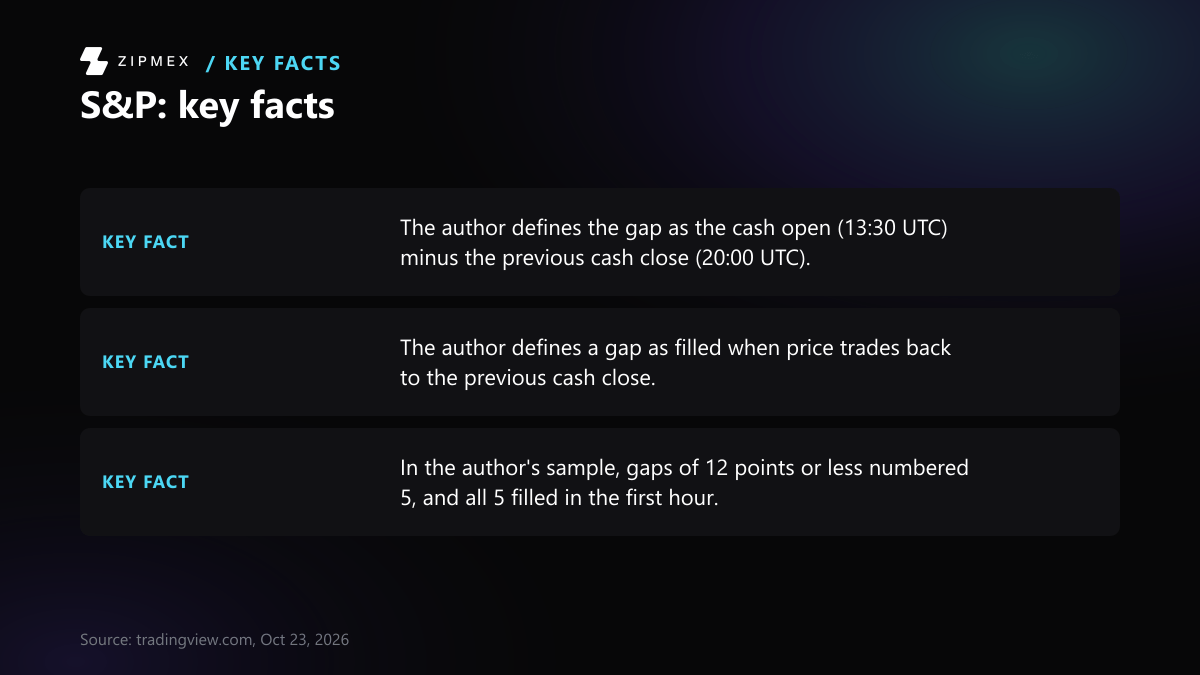
- Gap: the cash open at 13:30 UTC (9:30 New York) minus the previous cash close at 20:00 UTC.
- Fill: price trades back to the previous cash close.
- Value area: "70% of cash-session volume, 1-point bins."
- Window: 21 cash sessions, Sept. 25 to Oct. 23, 2026. The last session counts only up to 16:45 UTC.
- Not defined: the post never says where the "first hour" ends. Reading it as 13:30–14:30 UTC is the obvious choice, but the post doesn't say so.
For scale, CME sets the ES contract at $50 times the S&P 500 index, with a minimum tick of 0.25 index points ($12.50). So a 12-point gap is worth $600 per contract.
Fill rates by where the open landed
The post sorts the same 21 sessions three ways. Each sort covers all 21 sessions, so the groups within one sort add up, but the sorts can't be merged with each other.
Against yesterday's value area and range
| Where the open landed | Sessions | Filled in first hour | Filled by close |
|---|---|---|---|
| Inside yesterday's value area | 8 | 6 | 6 |
| Inside yesterday's range, outside value | 4 | 1 | 2 |
| Outside yesterday's range (includes Oct. 23) | 9 | 2 | 3 |
Against the overnight range
| Where the open landed | Sessions | Filled in first hour |
|---|---|---|
| Top or bottom 20% of the overnight range | 9 | 2 |
| Middle 60% of the overnight range | 12 | 7 |
By gap size
| Gap size | Sessions | Filled in first hour |
|---|---|---|
| 12 points or less | 5 | 5 |
| More than 12 points | 16 | 4 |
Each sort gives the same total: 9 of the 21 gaps filled in the first hour. That's 43%, so in this sample an early fill was slightly less common than no early fill.
How many gaps filled in the first hour?
Switch between the post's three ways of sorting the same 21 S&P futures sessions to see how many gaps filled in the first hour in each group.
Data table
| Item | gaps filled in first hour | Source |
|---|---|---|
| Inside value (8) | 6 | |
| In range, outside value (4) | 1 | |
| Outside range (9) | 2 |
Data table
| Item | gaps filled in first hour | Source |
|---|---|---|
| Top or bottom 20% (9) | 2 | |
| Middle 60% (12) | 7 |
Data table
| Item | gaps filled in first hour | Source |
|---|---|---|
| 12 points or less (5) | 5 | |
| More than 12 points (16) | 4 |
These are one author's unaudited counts from 21 sessions of December ES with the first hour undefined. The three sorts can't be combined, and the bars don't predict whether any future gap will fill.
Open inside yesterday's value area: 8 sessions. Gap filled in the first hour in 6, by the close in 6.
The author's three takeaways
The post presents these as observations from the sample, not as a tested method. Quoted:
- "Small gap, open inside yesterday's value: yesterday's close acted like a magnet early (6 of 8)."
- "Open outside yesterday's range: treat the gap as information. Fading it worked only 2 of 9 times in the first hour."
- "Open at an overnight extreme: the inventory is one-sided, and in this sample the gap rarely closed quickly (2 of 9)."
The Oct. 23 session
The post uses Friday, Oct. 23 as a live example:
- Thursday's cash close was 7,706.50. Thursday's range was 7,676.75–7,742.50, with a value area of 7,686–7,715.
- The overnight range was 7,660–7,716.25. The cash open came at 7,661, in the bottom 2% of that range and below Thursday's low.
- The gap was -45.5 points, about $2,275 per ES contract at the CME multiplier. That puts the session in both weak groups: outside the range, and at an overnight extreme.
- There was no fill in the first hour. The low was 7,648.50 at 14:25 UTC. The first 5-minute close back above Thursday's low came at 14:40 UTC. The high was 7,697.25 at 15:30 UTC, and price was about 7,687 at 16:45 UTC.
- At the cutoff, Thursday's close of 7,706.50 still hadn't traded, so the gap was open. The post doesn't report how the session ended.
How much weight the counts can carry
- Small groups move fast. The strongest result, 6 of 8, rests on 8 sessions. One different outcome changes it from 75% to 63% or 88%. The 5-of-5 result for small gaps rests on five sessions.
- The groups overlap. Small gaps and opens inside value are probably many of the same sessions, but the post doesn't publish the cross-tabulation. So it's unclear whether open location or gap size explains more.
- One month of one contract. The window covers about four weeks of December ES. It says nothing about other periods, other volatility regimes or other index futures.
- Clock times shift soon. The post's times are fixed in UTC. U.S. daylight saving time ends on the first Sunday of November (15 U.S.C. 260a), which is Nov. 1, 2026. After that, the 9:30 New York open is 14:30 UTC and the 16:00 close is 21:00 UTC. Anyone extending the sample needs to adjust for this.
- Checking the counts needs the same 5-minute ES bars, the post's gap, fill and value-area definitions, and a stated first-hour window.
Limitations: one author's unaudited counts from 21 sessions, with the first hour undefined. Educational only, not a trading signal.
