You've heard about crypto trading. Maybe a friend doubled their money, or you've seen the headlines. Either way, you're here - and that's step one. The good news? Getting started is simpler than most guides make it look.
⚡ Quick Answer
To start crypto trading, choose a regulated exchange, complete KYC verification, deposit funds ($50-$100 is enough to start), pick a major coin like Bitcoin or Ethereum, and place a small market or limit order. The whole process takes about 15 minutes once your account is verified.
This guide walks you through every step of how to start crypto trading - from picking your first exchange to placing your first trade and protecting your capital with risk management. No hype, no jargon you don't need.
What Is Crypto Trading? A Beginner's Starting Point
Before placing a single order, you need to understand what you're actually doing. Crypto trading is the buying and selling of digital assets like Bitcoin (BTC), Ethereum (ETH), and hundreds of altcoins to generate a profit from price movements.
Unlike traditional stock markets, the crypto market runs 24/7 with no closing bell. That means opportunity - but also risk - at any hour of the day.
Types of Crypto Trading
Not all crypto trading looks the same. The main styles are:
- Spot trading - Buying the actual asset and owning it. Best for beginners.
- Day trading - Opening and closing positions within a single day.
- Swing trading - Holding positions for days or weeks to capture price swings.
- HODLing - Long-term holding regardless of short-term price moves.
- Futures/derivatives - Leveraged contracts. Not recommended for beginners.
Start with spot trading. You own real crypto, risks are capped at what you put in, and there's no liquidation risk.
How Crypto Markets Work
Crypto prices are driven by supply and demand. When more people want to buy a coin than sell it, the price rises - and vice versa. Key factors influencing prices include news and regulation, institutional flows, on-chain activity, and the broader macro environment (interest rates, USD strength).
As of April 2026, the global crypto market cap sits at approximately $3.4 trillion, according to CoinMarketCap - a market big enough to support liquid trading across hundreds of assets.
How to Trade Cryptocurrency Step by Step
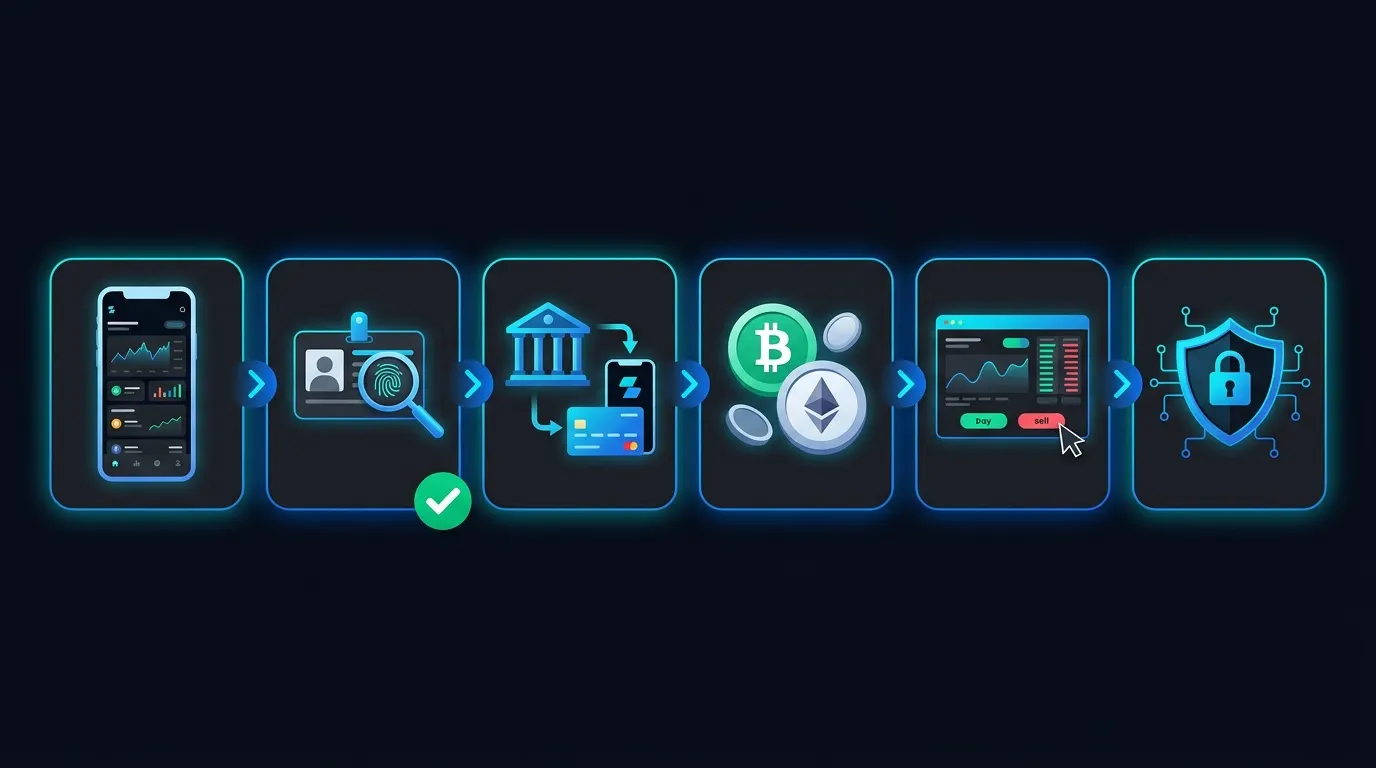
Here is the exact process for how to trade cryptocurrency as a complete beginner. Follow these six steps in order.
Step 1 - Choose a Crypto Exchange
Your exchange is where you'll buy, sell, and hold crypto. The most important criteria: is it regulated, does it support your country, and what are the fees?
The leading exchanges in 2026 include Binance (lowest fees at 0.1% spot trading), Coinbase (most beginner-friendly interface, higher fees of 0.5-1.5%), Kraken (strong security reputation, 0.16-0.26% maker/taker), and Bybit (popular for traders who want more tools).
One important note for 2026: under the OECD's Crypto-Asset Reporting Framework (CARF), exchanges in the EU and many other jurisdictions are now required to collect and report user transaction data starting January 1, 2026. This means KYC is no longer optional on any regulated platform - it's a legal requirement.
Step 2 - Complete KYC Verification
KYC (Know Your Customer) is identity verification. Every regulated exchange requires it before you can deposit or withdraw. The process typically takes 5-15 minutes and requires a government-issued ID and sometimes a selfie.
Complete KYC before you need it. Some platforms take 24-48 hours to verify accounts manually. Don't wait until you're ready to trade.
Step 3 - Fund Your Account
Most exchanges accept bank transfers (cheapest, 1-3 business days), debit/credit cards (instant but 1-3% fees), and crypto transfers (instant if you already hold crypto elsewhere).
Recommended starting amount for beginners: $50-$100. This is enough to learn the mechanics of trading without meaningful financial risk. As CoinBureau's 2026 beginner guide recommends: start with spot trading and small amounts before scaling up.
Step 4 - Choose Your First Crypto
For your first trade, stick to Bitcoin (BTC) or Ethereum (ETH). Both are highly liquid, have long track records, and are available on every exchange. Avoid chasing small-cap tokens or meme coins on your first trade.
Understanding trading pairs is essential here. When you see BTC/USDT, it means you're buying Bitcoin priced in Tether (USDT). The base currency (BTC) is what you're buying; the quote currency (USDT) is what you're spending.
Step 5 - Place Your First Trade
Two order types matter most for beginners:
For your first trade: use a limit order for BTC/USDT or ETH/USDT on a small amount. Set a price slightly below the current market price - this gives you a better entry and teaches you how the order book works.
Step 6 - Set Stop Loss and Take Profit
After entering a position, immediately set a stop-loss order. A stop-loss automatically sells your position if the price drops to a set level, capping your downside.
A common beginner rule: never risk more than 1-2% of your total capital on a single trade. If you have $100, your maximum loss on one trade should be $1-$2. This keeps you in the game long enough to learn.
Set a take-profit level too - a price at which you'll sell and lock in gains. Decide both before entering. Emotions after you're in a position will try to change your mind.
Best Crypto Trading Strategies for Beginners
Once you know how to execute a trade, you need a strategy. Without one, you're gambling - not trading.
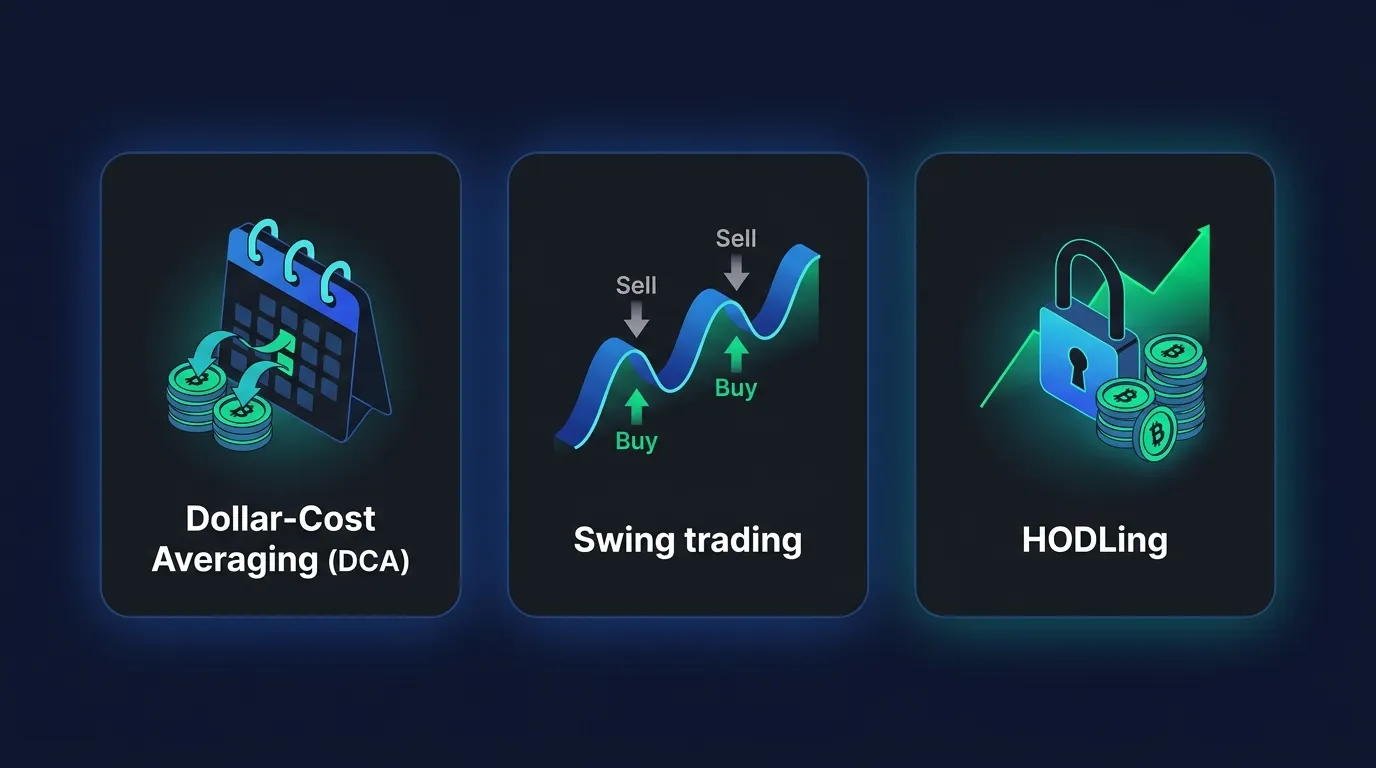
Dollar Cost Averaging (DCA)
DCA is the most beginner-friendly crypto trading strategy, and arguably the most consistently effective. Instead of trying to time the market with one large buy, you invest a fixed amount at regular intervals - say, $25 every week in Bitcoin - regardless of the current price.
This smooths out your average entry cost over time and removes the emotional decision-making that ruins most new traders. CoinBureau's 2026 trading guide specifically recommends DCA for beginners as the lowest-risk starting approach.
Swing Trading Basics
Swing trading means holding a position for days or weeks, aiming to capture a "swing" in price direction. You buy near support levels (where price has bounced before) and sell near resistance levels (where price has struggled to break through).
For beginners who want to be more active than DCA but less risky than day trading, swing trading with a 1-2 week horizon on BTC or ETH is a reasonable starting point. The key: always have a stop-loss set before you enter.
HODLing vs Active Trading
🎯 Key Takeaways: HODLing vs Trading
- HODLing - Buy and hold long-term. Lowest time commitment. Best for those who believe in crypto's long-term value. Historically, BTC and ETH holders over 4+ year periods have outperformed most active traders.
- Active trading - Requires daily attention, risk management skill, and emotional discipline. Most beginners lose money actively trading before developing the necessary skills.
- Verdict for beginners: Start with DCA + long-term holding. Add active trading only after you've spent 3-6 months learning market mechanics.
You can also explore passive income options alongside trading - crypto staking lets you earn yield on assets you're already holding, without needing to actively trade.
How to Choose a Crypto Exchange in 2026
Your exchange is the foundation of your trading experience. The wrong choice means higher fees, security risks, or limited access to the coins you want.
Key Factors to Consider
Five things to evaluate before committing to an exchange:
1. Regulation and security - Is it licensed in your jurisdiction? Does it have proof of reserves? Post-FTX, exchange security is non-negotiable. Stick to exchanges that publish audited proof-of-reserves data.
2. Trading fees - Even small fee differences compound significantly over time. A 0.1% fee vs 1% fee means 10x more cost per trade. Binance charges 0.1% spot fees with VIP discounts available.
3. Supported assets and pairs - If you plan to trade beyond BTC and ETH, check that your exchange lists the assets you want. Major exchanges like Binance offer 350+ trading pairs.
4. Fiat on/off ramps - Can you deposit and withdraw in your local currency? What are the limits and processing times?
5. User interface - A confusing interface leads to costly mistakes. If you find the UI overwhelming, choose a more beginner-friendly platform - usability matters.
Exchange Comparison Table
Once you've funded your exchange account and made your first trade, consider security hygiene: enable 2FA on your exchange account immediately, and if you plan to hold significant amounts long-term, learn about moving crypto to a self-custody wallet.
Crypto Trading Risk Management: Protect Your Capital First
The difference between traders who last and traders who blow up their account in the first month is almost always risk management. This section is the most important in the guide.
The 1-2% Rule
Never risk more than 1-2% of your total trading capital on a single trade. If you have $500 to trade, your maximum loss on any single position should be $5-$10. This sounds overly conservative - but it means you can lose 50 trades in a row and still have capital left to learn from.
A stop-loss order is how you enforce this rule mechanically. Set it before you enter the trade. See how stop-loss and take-profit orders work in practice via Gemini's detailed guide.
Portfolio Diversification
Don't put everything into one coin. A starting allocation for beginners might look like: 50-60% Bitcoin, 20-30% Ethereum, 10-20% in 1-2 other established coins (Solana, BNB). Keep stablecoins (USDT, USDC) on hand as 10-20% of your portfolio - they let you re-enter positions without converting back to fiat.
For broader strategy guidance, check out 6 cryptocurrency tips every investor needs in 2026 for additional risk management frameworks.
Common Beginner Mistakes to Avoid
⚠ Risk Warning - These Mistakes Wipe Out Beginner Accounts
FOMO buying - Buying after a coin has already pumped 50%+ because you fear missing out. This is how most beginners buy the top. Leverage before understanding - Using 10x or 20x leverage without knowing what liquidation means is how accounts go to zero. Emotional trading - Panic-selling at the bottom and chasing pumps at the top. Decide your strategy before you enter, and stick to it. Ignoring fees - Frequent small trades with high fees eat returns faster than most people realize.
If you're curious about more advanced trading approaches like crypto arbitrage, understand the basics of spot trading first - arbitrage and more advanced strategies require a solid foundation.
Frequently Asked Questions
How much money do I need to start crypto trading?
You can start with as little as $10-$20 on most exchanges, but $50-$100 gives you enough capital to learn without meaningless micro-position sizes. The amount isn't as important as the discipline: never trade money you can't afford to lose entirely.
Is crypto trading legal in 2026?
Crypto trading is legal in the United States and most countries worldwide. Under CARF regulations launching in January 2026, exchanges in participating jurisdictions are required to report user transaction data to tax authorities. This means gains from crypto trading are taxable events in most regions - consult a local tax professional for your specific situation.
What is the safest crypto trading strategy for beginners?
Dollar Cost Averaging (DCA) into Bitcoin and Ethereum is widely considered the lowest-risk strategy for beginners. It removes the need to time the market and reduces emotional decision-making. Start with DCA, learn market mechanics for 3-6 months, then consider adding active trading strategies.
What's the difference between a market order and a limit order?
A market order executes immediately at the current price - fast but you don't control the exact price. A limit order executes only at the specific price you set - slower, but gives you price control and typically lower fees. Beginners should practice both but default to limit orders for less urgent trades.
How do I keep my crypto safe?
Enable 2FA on your exchange account immediately. Use a strong, unique password. For amounts over $1,000, consider moving long-term holdings to a hardware wallet (cold storage). Never share your seed phrase or private keys with anyone.
Can I really start trading crypto in 15 minutes?
Yes - if you already have a verified exchange account. The actual steps (choose a pair, set an order, confirm) take under 60 seconds. The preparation - choosing an exchange, completing KYC, funding your account - is what takes time. KYC can take anywhere from 5 minutes to 24 hours depending on the exchange. Complete it before you need it.
What happens if the exchange goes bankrupt?
This is a real risk. Post-FTX, it's critical to only keep on an exchange what you're actively trading. Move long-term holdings to a self-custody wallet. Choose exchanges that publish proof-of-reserves data - this confirms they actually hold the assets they claim. Learn more about safely withdrawing Bitcoin and securing your holdings.
Conclusion: Your First 15 Minutes in Crypto Trading
Starting crypto trading doesn't require advanced knowledge, a large account, or perfect timing. It requires the right steps in the right order: choose a regulated exchange, complete KYC, fund with an amount you can afford to lose, pick a major coin, place a small limit order, and set a stop-loss before you do anything else.
The traders who succeed long-term are not the ones who found a magic strategy - they're the ones who protected their capital long enough to actually learn the market. Start small. Learn fast. Scale carefully.
⚠ Disclaimer: The information provided in this article is not intended to provide investment or financial advice. Investment decisions should be based on the individual's financial needs, objectives, and risk profile. We encourage readers to understand the assets and risks before making any investment entirely. Cryptocurrency investments are subject to high market risk. Past performance does not guarantee future results.
ZIPMEX promotes trading on trade.zipmex.com. Promotions are labelled and kept separate from news coverage, which is selected and checked without regard to them. Perpetual futures are leveraged derivatives. Prices can move fast and you can lose all of your margin. Not available in every jurisdiction. Not investment advice.