
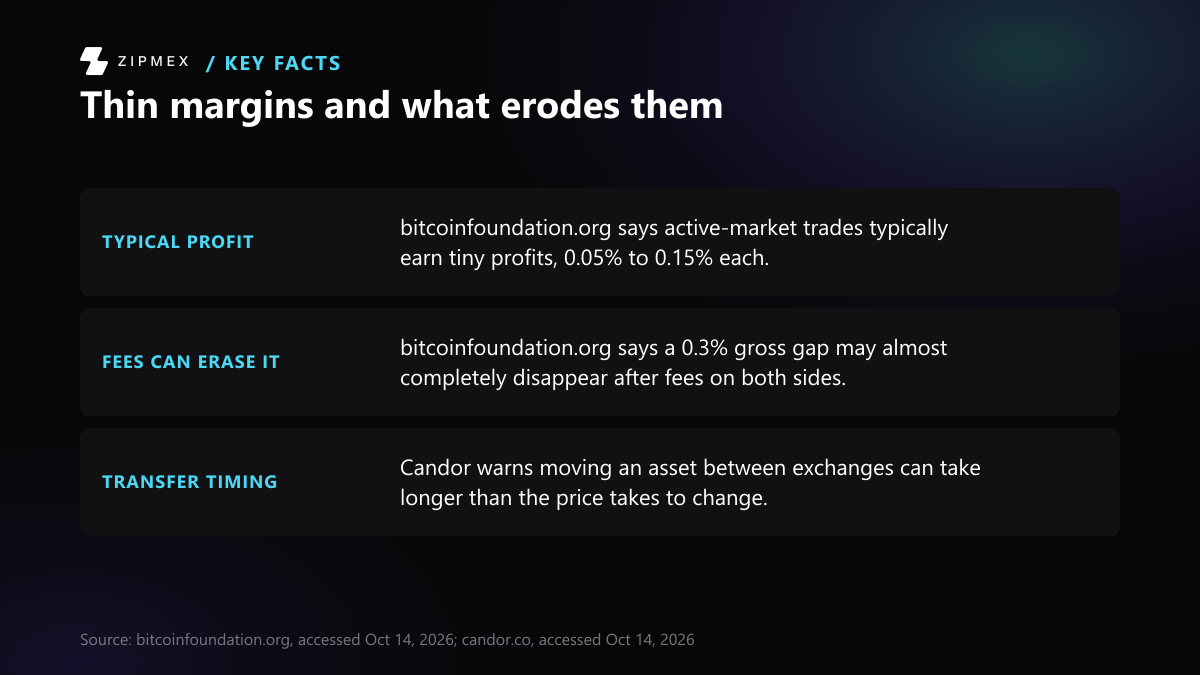
Crypto arbitrage means buying a coin on one venue where it is cheaper and selling the same coin at the same time on another venue where it is dearer. The profit is the price gap minus every cost. Researchers have found gaps between exchanges in the past, sometimes large ones. But a gap you can see is not a profit you can take. A guide published on 4 May 2026 says a 0.3% gross gap "may almost completely disappear after all trading fees on both sides are taken into account." The largest gaps on record were between countries, and capital controls made them hard to close.

How a two-leg trade works
An arbitrage trade has two legs:
- Buy on the venue with the lower ask price.
- Sell on the venue with the higher bid price.
Each leg pays its own trading fee. The trade only works if both orders fill before the prices move back together.
Where the time goes
Moving coins between venues means waiting for a blockchain to confirm the transfer. The May 2026 guide on bitcoinfoundation.org says "blockchain confirmation times create a delay, which eliminates profit margin potential." That is why it says traders keep funds on both venues in advance instead of moving coins for each trade.
Research supports the point. In "Building Trust Takes Time" (arXiv preprint, latest version 19 October 2023), Nikolaus Hautsch, Christoph Scheuch and Stefan Voigt use Bitcoin network and order book data. They find that price differences between exchanges coincide with high settlement latency, that asset flows follow arbitrage opportunities, and that price differences are smaller between exchanges with low default risk. Their conclusion: slow on-chain settlement exposes an arbitrageur to price risk, while keeping funds on the exchanges exposes them to the risk that an exchange defaults.
A worked example: does a 0.3% gap survive?
The net margin is the gross gap, minus the buy fee, minus the sell fee, minus any price move against you before both legs fill. Below, the 0.3% gap is the figure from the 2026 guide. The fee and price-move values are made-up inputs for illustration, not quoted rates.
| Gross gap | Buy fee | Sell fee | Price move | Net margin |
|---|---|---|---|---|
| 0.30% | 0.12% | 0.12% | 0.00% | 0.06% |
| 0.30% | 0.12% | 0.12% | 0.10% | −0.04% |
| 0.30% | 0.05% | 0.05% | 0.00% | 0.20% |
A 0.1% move against you during the trade turns the first case into a loss. This table also leaves out withdrawal and network fees, spread and slippage on larger orders, and tax. Each of these cuts the margin further.
Why price gaps appear
The most cited study is Igor Makarov and Antoinette Schoar, "Trading and arbitrage in cryptocurrency markets," Journal of Financial Economics, vol. 135, no. 2 (February 2020), pp. 293–319. It uses trade-level data from 34 exchanges in 19 countries. Its main findings:
- Gaps recur and can be large. "Cryptocurrency markets exhibit periods of large, recurrent arbitrage opportunities across exchanges."
- Borders matter more than venues. Price deviations are "much larger across than within countries, and smaller between cryptocurrencies." The authors say this shows how much capital controls matter for moving arbitrage capital. A summary of the study on the Harvard Law School Forum on Corporate Governance (21 September 2019) says gaps within one country "typically do not exceed 1%, on average."
- Gaps widen in rallies. Price deviations across countries "co-move and open up in times of large bitcoin appreciation."
- Some gaps were extreme. The same summary says the US–Korea daily average price ratio "reached 40% for several days" between December 2017 and February 2018, a gap the press called the "Kimchi premium." The authors estimate that at least $2 billion of potential arbitrage profit went untaken in that period. They say deviations "often persist for several hours, and, in some instances, days and weeks."
These figures describe 2017–2018. They show where gaps tend to open: across borders, with restricted capital, during sharp rallies. They do not describe today's spreads.
Does your price gap survive fees?
Enter a gross gap, your fee on each leg and any price move against you to see the net margin.
| Gross price gap between the two venues | Your fee on the buy leg | Your fee on the sell leg | Price move against you before both legs fill | Net margin after fees and price move |
|---|---|---|---|---|
| 0.3 % | 0.12 % | 0.12 % | 0 % | 0.06 % |
| 0.3 % | 0.12 % | 0.12 % | 0.1 % | -0.04 % |
| 0.3 % | 0.05 % | 0.05 % | 0 % | 0.2 % |
- Fee and price-move values are your own inputs, not figures from any source.
- A positive result means the gap beat the costs entered; a negative result means a loss on those inputs.
This is arithmetic on your inputs only: it leaves out withdrawal fees and tax, and cannot show whether a gap exists or lasts until both orders fill.
Who competes for the gap
On a single venue, competition for an open gap is fierce. The 2026 guide describes bots that "continually scan for possible opportunities and execute them at millisecond speeds."
On decentralised exchanges, the competition takes place inside the blockchain itself. In "Flash Boys 2.0" (arXiv, 10 April 2019), Philip Daian and co-authors document a widespread and growing use of arbitrage bots on decentralised exchanges. These bots pay high transaction fees and tune their network latency to get ahead of ordinary users' trades. The authors call the fee bidding between bots "priority gas auctions." They group this kind of value from ordering transactions under the name "miner extractable value" (MEV). So a gap that a person can spot by hand has usually been taken already by software.
Is crypto arbitrage still profitable in 2026?
This section rests on a single source, the bitcoinfoundation.org guide by Yevheny Serhiienko, published 4 May 2026 and labelled "Opinion / Editorial." It says:
- "crypto arbitrage is still viable in 2026, but opportunities are smaller and more competitive."
- "Individual trades in an actively traded market will produce tiny profits—typically between 0.05% and 0.15% per trade." The guide gives no data source for this range, so it has not been verified.
No peer-reviewed study we found measures current cross-exchange spreads, fees or transfer times. The research does agree that the large gaps of the past were mostly cross-border and tied to capital controls, and that slow settlement and default risk limit how fast anyone can close a gap. For a single trader, the practical question is not whether gaps exist. It is whether a given gap beats both fees, transfer costs and the price move before both orders fill.
Tax
In the United States, the IRS says "digital assets are considered property, not currency." Selling a digital asset, or trading it for another digital asset, must be reported. Gains and losses are generally capital gains or losses: short-term if the asset was held for one year or less, long-term if held for more than a year. Arbitrage trades are usually held for minutes or hours, so in the US any gains would be short-term. Brokers report gross proceeds on Form 1099-DA for transactions on or after 1 January 2025, and basis reporting begins for certain transactions in 2026. Rules differ by country. A separate explainer covers what triggers crypto tax reporting, and another asks whether crypto arbitrage is legal.
Before acting on a gap
- Check the trading fee on both venues at your actual fee tier.
- Check the withdrawal fee and the typical confirmation time for the coin's network.
- Check order book depth, because a gap at the best price may not hold for your full order size.
- Think about how much money you are willing to leave on each venue, and the risk that a venue fails.
- Find out how your country taxes short-holding-period gains.
For trading costs more broadly, see crypto day trading: how a trade works and what it costs.
Limitations: the research data covers 2017–2018 and Bitcoin settlement, and the only 2026 figures come from one opinion guide. This article is not investment advice.
