
SundaeSwap is an automated market maker (AMM) decentralized exchange on Cardano. Its own site calls it "the first Cardano AMM DEX". The newest development is Sundae v4, which Sundae Labs announced on July 30, 2026. The announcement described v4 as "code complete, and nearly finished with its audit". It said v4 would "begin launching within the next month" as a rolling deployment that starts with a small core set of features. In October 2026, sundae.fi leads with "Introducing Sundae V4" and links to its app, but it gives no launch date. The swap model has not changed since 2022: you place an order, and a third party called a scooper batches orders and executes them against a liquidity pool. Fees are paid in ADA.

What Sundae v4 changes
The July 30, 2026 announcement, signed by the Sundae Labs Team, calls v4 "the next iteration of the SundaeSwap protocol". It is built around modular pools. The post defines a pool as "simply a reserve of tokens and an issued pro-rata claim on that reserve (an LP token)". Every other feature is meant to be configurable.
Features named in the announcement
- Automated routing. Orders can be split across pools by default. The post says "the smart contracts enforce that any surplus generated this way is directed to the user." Users can still set a route themselves.
- Linear swaps. Stablecoin baskets trade 1:1 plus a fee. A bounty system rebalances the pools.
- Concentrated liquidity. This is a UTxO-native design that uses "a small, isolated state". No parameters had been published as of the announcement.
- Partial fills. Orders can execute gradually against a budget, at "a small amount of extra ADA in fees".
- Multi-asset pools. A pool can hold a bundle of assets instead of a single pair.
- Composition and custom vaults. The post names Butane, Indigo and the DeFi Kernel orderbook as examples of protocols that pools could integrate. It does not say they were confirmed integrations at launch.
- Scooper authorization module. Builders can reuse it to prevent front-running while swapping in their own liquidity curve.
What is still open
The announcement gave no fee schedule for v4 and no audit results. It also gave no migration plan for v3 liquidity. It said those details would come later, and it called asking users to migrate between major versions "an extreme step". The sundae.fi homepage lists the v4 features but does not say which ones are live today.
How a swap works: the scooper model
Cardano uses an extended UTXO (eUTXO) model. Coin Bureau's review puts the constraint plainly: "any given eUTXO can only be spent once as part of one transaction." A pool held in a single output could therefore seem limited to about one swap per block.
SundaeSwap's answer is the scooper. In this model, a user doesn't trade against the pool directly. They submit an order. A scooper, which is a third-party aggregator, collects pending orders and builds and submits the transaction that executes them against the AMM. For that work the scooper collects a fee in ADA.
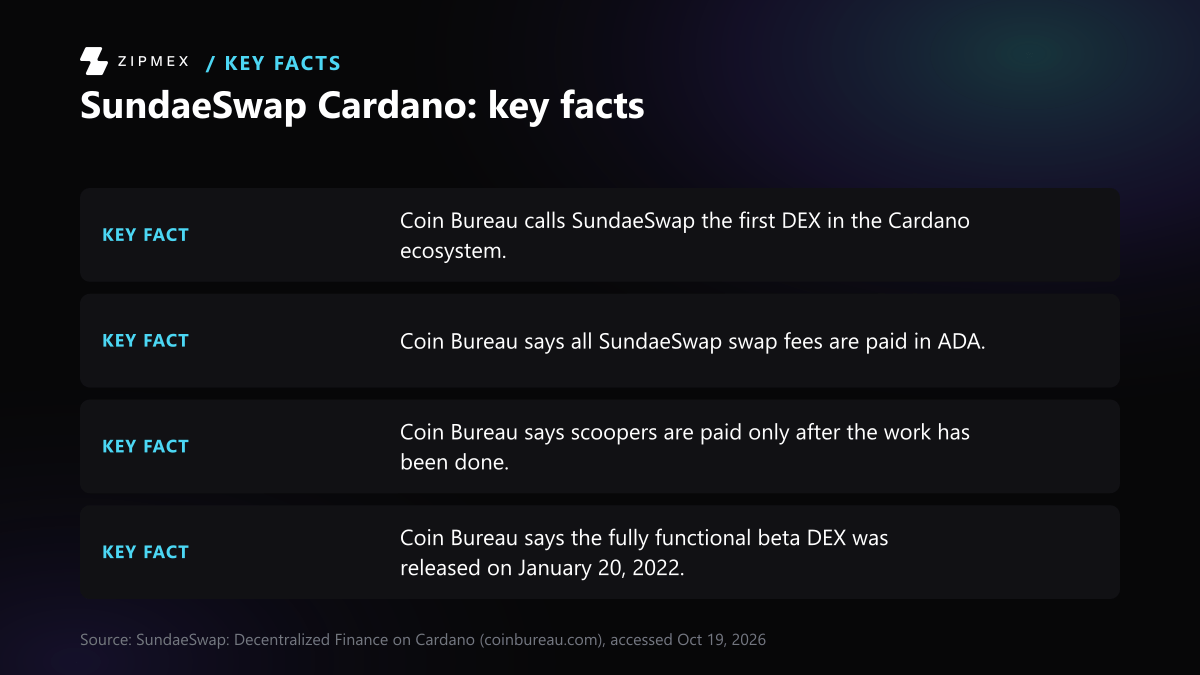
According to Coin Bureau's 2022 review:
- Scoopers must win enough community votes to get a license.
- They are paid only after the work is done.
- If a scooper acts as a bad actor, its payment can be redirected to the community treasury.
- During the 2022 launch period, 30 community-elected stake pools served as scoopers.
The Jan. 15, 2022 launch post from Sundae Labs said orders are processed in the order received and can be cancelled before scoopers process them.
How batching improved between versions
Sundae Labs engineer Pi Lanningham posted on the Sundae governance forum on Dec. 13, 2023. He wrote that v3 contracts had been benchmarked at 25 orders per batch, compared with 2–4 orders per batch in v1. That figure is a benchmark, not a measured live average. The July 2026 v4 post says v3 scaled throughput "by a factor of 10".
What a trader pays
There are two layers of cost:
- The scooper fee, in ADA. In v1 the fee "has always been set at 2.5 ADA", according to the Dec. 13, 2023 forum post, and scoopers ignored orders that offered less. In v3 the fee has two parameters controlled by the DAO, a base fee and an incremental fee. That post did not give current values.
- The pool's liquidity-provider fee. This fee goes to liquidity providers, and it differs from pool to pool. Two examples from governance proposals: an Apr. 22, 2024 proposal would have moved protocol-owned SUNDAE/ADA liquidity into a 0.3% pool, and a Jan. 5, 2026 proposal set a 5-basis-point LP fee for an ADA/USDM stableswap pool.
Keep extra ADA in your wallet beyond the amount you plan to swap, because every fee is settled in ADA. Each order also has a price tolerance. In January 2022, SundaeSwap told CoinDesk that its slippage limits block orders that would execute outside the acceptable price range. When demand is heavy, orders can fail on that check instead of filling at a worse price.
Before you sign a Cardano swap or LP deposit
Answer a few questions to see what the article says to check before you swap or add liquidity on this protocol.
Do you plan to swap tokens, or to deposit liquidity into a pool?
- Swap tokens → next question
- Deposit or move liquidity → next question
Have you checked whether the pool runs on v1, v3 or v4, and read both the scooper fee and the pool's LP fee in the app?
- Not yet → Check version and fees first
- Yes → next question
Do you hold extra ADA beyond the amount you plan to swap, and have you set a price tolerance you accept?
- Not yet → Prepare ADA and a price tolerance
- Yes → What happens after you submit
Are you thinking of moving liquidity from v3 to v4?
- Yes → next question
- No, a new deposit → What liquidity providers take on
Have v4 audit results and a v3 migration plan been published on the project's site?
- Not that I can find → Migration details were still open
- Yes, I have read them → What liquidity providers take on
Fees and order behaviour differ between versions. In v1 the scooper fee was set at 2.5 ADA; in v3 the DAO controls a base fee and an incremental fee. LP fees differ by pool: governance proposals mention a 0.3% pool and a 5-basis-point stableswap pool. Fees set by the DAO can change.
Every fee is settled in ADA, so the article says to keep extra ADA beyond the swap amount. Each order has a price tolerance: a tighter one means a higher chance the order fails rather than fills at a worse price when demand is heavy.
Your order waits for a scooper, a third party that batches pending orders and executes them against the pool for a fee in ADA. Orders are processed in the order received and can be cancelled before a scooper processes them.
As of the July 30, 2026 announcement, there were no v4 fee schedule, no audit results and no v3 migration plan. The announcement said those details would come later, and the homepage does not say which v4 features are live.
Providers deposit a 50:50 pair of assets and receive LP tokens for their share of trading fees. Coin Bureau lists impermanent loss and smart-contract risk as the main drawbacks.
This walks through the article's checklist only: it does not show live fee values or which v4 features are live, and it says nothing about whether a swap or deposit is worth making.
SundaeSwap is a decentralized exchange (DEX) built for the Cardano blockchain.
What liquidity providers get
Liquidity providers deposit a 50:50 pair of assets into a pool and receive LP tokens for their share. They earn a share of trading fees. In the 2022 setup they could also stake LP tokens in yield farms for SUNDAE rewards. Coin Bureau lists impermanent loss and smart-contract risk as the main drawbacks.
The SUNDAE token
SundaeSwap's documentation gives a total supply of 2 billion SUNDAE, minted when the DEX started. The allocation is:
| Group | Share | Tokens |
|---|---|---|
| Public | 55% | 1,100,000,000 |
| Team | 25% | 500,000,000 |
| Investors | 13% | 260,000,000 |
| Future hires | 5% | 100,000,000 |
| Advisors | 2% | 40,000,000 |
The documentation describes governance as "a completely on-chain experience" that started at DEX launch. Tokens can be delegated for voting, and team members and advisors may vote only with vested tokens. The docs list profit sharing and reduced fees for holders as future work, with fees "To Be Announced". Protocol changes such as the v3 contract endorsement go through temperature checks on the Sundae governance forum.
The January 2022 launch
- Jan. 15, 2022. Sundae Labs set Jan. 20 as launch day for a "fully-functional beta decentralized exchange". It said the "Beta" label reflected Cardano transaction size limits that blocked fully decentralized governance at that point. It also said the contracts had been audited, and it warned of slow performance and order backlogs in the first weeks. The Initial Stake Pool Offering (ISO) ran over Cardano epochs 316–320 and paid out 5% of the SUNDAE supply, 1% per epoch.
- Jan. 21, 2022. CoinDesk, republished by Yahoo Finance, reported that some users said they had waited "over nine hours" for SUNDAE after swapping ADA. These were user reports on social media, not measured times. SundaeSwap's site showed this notice: "The network is extremely congested at the moment. Swaps may fail or not go through until congestion decreases." The company said congestion was "creating queues at various breakpoints throughout the system".
- Jan. 30, 2022. Sundae Labs' launch recap said demand was "even higher than we anticipated", and that many trades were still waiting to be scooped. It reported no downtime for SundaeSwap or Cardano. First-week figures it gave: $71.69 million in total value locked and more than 300 active pools.
The sundae.fi homepage now reports more than ₳1.96 billion traded since January 2022, a figure it attributes to Float, its own analytics product.
Before you use it
- Check which protocol version a pool runs on (v1, v3 or v4). Fees and order behaviour differ between versions.
- Read the scooper fee and the pool's LP fee in the app before you sign. Fees set by the DAO can change.
- Set a price tolerance you accept. A tighter tolerance means a higher chance that the order fails rather than fills.
- Look for v4 audit results and the v3 migration plan on sundae.fi before moving liquidity. Neither had been published as of the July 30, 2026 announcement.
Limitations: the v4 rollout status, current fee values and the v3 launch date could not be confirmed from primary sources. Most mechanism details come from Sundae Labs' own posts and a single 2022 review.
