A liquidity pool is a smart contract holding two or more tokens that enables decentralized trading - no order books, no counterparties, no intermediaries. You trade against pooled capital that anyone can contribute to and earn from. That single mechanism underpins the entire decentralized finance ecosystem, from token swaps to lending protocols to on-chain derivatives. If you're serious about DeFi, understanding how liquidity pools work isn't optional - it's foundational.
⚡ Key Takeaways
- A liquidity pool is a smart contract holding a pair of tokens that facilitates permissionless trading on decentralized exchanges (DEXs), replacing the traditional order book model.
- Liquidity providers (LPs) deposit assets into pools and earn a proportional share of trading fees in return - with no intermediary required.
- The primary risk for LPs is impermanent loss - a reduction in value caused by price divergence between deposited assets while they're locked in the pool.
What Is a Liquidity Pool in Crypto?
A liquidity pool is a crowdsourced collection of cryptocurrencies locked inside a smart contract. Anyone can deposit assets into the pool, and anyone can trade against it - 24 hours a day, without requiring a counterparty on the other side of their order.
Think of it like a shared community fund. Two participants each contribute different assets - say, ETH and USDC - and the combined pool becomes the market. A trader who wants to swap ETH for USDC doesn't need to find someone willing to sell USDC right now. They trade directly against the pool's reserves.
This model flips the traditional exchange structure on its head. On a centralized exchange (CEX), an order book lists every open buy and sell order. Matching software pairs you with a counterparty at an agreed price. That process works well with high liquidity, but breaks down for smaller tokens or off-peak hours when few participants are active. Liquidity pools solve this by making the protocol itself the counterparty at all times.
Liquidity providers (LPs) who deposit assets into the pool receive LP tokens - on-chain receipts that represent their proportional share of the pool's total reserves. Those LP tokens are how you track and reclaim your position - and how you earn from the pool's activity.
How Liquidity Pools Work: The AMM Mechanism
The engine behind every liquidity pool is an Automated Market Maker (AMM) - a mathematical formula that sets prices algorithmically instead of relying on human traders placing limit orders.
Uniswap pioneered the most common variant: the Constant Product Formula, expressed as x . y = k. Here, x and y are the quantities of the two tokens in the pool, and k is a constant that must remain unchanged after every trade.
When a trader buys Token A, its quantity in the pool decreases and Token B's increases. To maintain k, the price of Token A rises automatically. Here's how that plays out with real numbers:
A larger buy - say 10 ETH - causes a much steeper shift. That's price slippage, and it's directly tied to pool depth. Arbitrage traders close this gap: when the pool's internal ETH price diverges from the global market rate, they buy the underpriced asset in the pool and sell it elsewhere until prices realign. That constant arbitrage pressure keeps DEX prices accurate without any centralized oversight.
LP Tokens and How Liquidity Providers Earn Fees
When you deposit assets into a liquidity pool, the protocol mints LP tokens proportional to your share. Deposit $10,000 into a $1,000,000 pool and you receive LP tokens representing 1% of all reserves - and 1% of every trading fee collected.
Every swap generates a fee - typically 0.3% on Uniswap's standard pools. That fee distributes proportionally to all LP token holders, continuously, for as long as your deposit remains active. To exit, you redeem LP tokens: the protocol burns them and returns your share of assets plus accumulated fees.
The process in sequence:
- Deposit token pair → pool mints LP tokens to your wallet
- Hold LP tokens → earn a proportional share of all trading fees automatically
- Optional: stake LP tokens in the protocol's yield farming contracts for additional governance token rewards
- Redeem LP tokens → receive original deposit + accumulated fees (LP tokens burned)
- Optional: compound earned fees back into the pool to grow your position
Fee earnings are real - but they don't come without trade-offs. The risks deserve equal attention.

Types of Liquidity Pools in DeFi
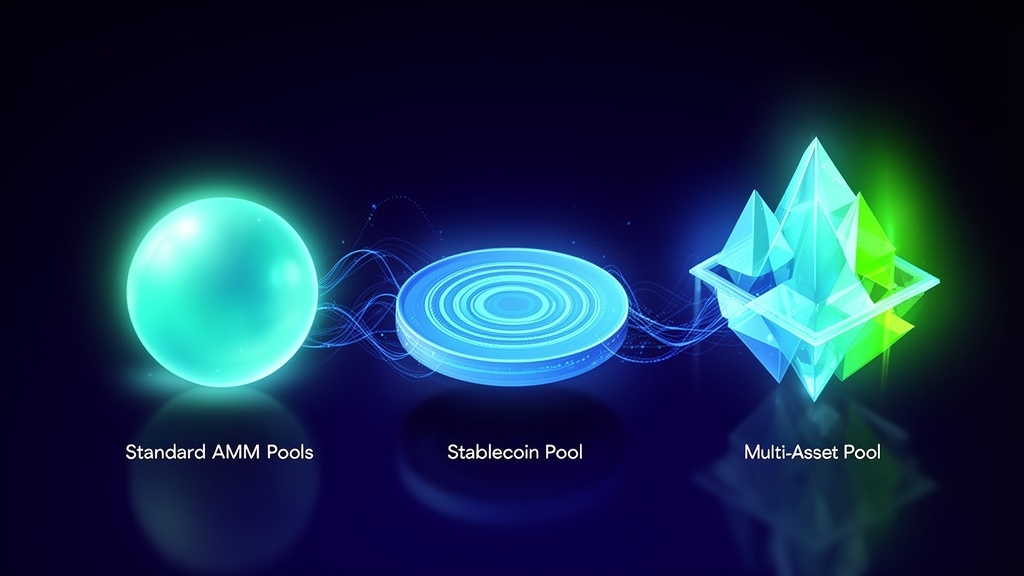
Not all liquidity pools share the same design. As DeFi matured, developers built specialized pool architectures to solve specific inefficiencies in the original 50/50 model. Understanding the differences matters before you commit capital.
Stablecoin pools like those on Curve Finance use the StableSwap algorithm - a modified pricing curve that concentrates liquidity near the 1:1 peg. Because USDC and USDT are both designed to hold $1.00, extreme price moves are rare. That design slashes slippage for large stablecoin swaps and dramatically reduces impermanent loss for LPs.
Multi-asset pools on Balancer allow up to eight tokens in a single pool with custom weightings. An 80/20 ETH/USDC pool behaves more like holding 80% ETH than a standard 50/50 pool - which changes both the risk profile and the impermanent loss exposure significantly.
Concentrated liquidity, introduced in Uniswap v3, lets LPs specify a price range within which their capital is active. A provider who sets liquidity between $1,800 and $2,200 per ETH only earns fees when ETH trades within that band - but their capital efficiency can be orders of magnitude higher than a full-range deposit. Outside the range: zero fee income until they rebalance.
Risks of Liquidity Pools: What Every Provider Must Know
Liquidity pools offer a genuine passive income mechanism, but the risks are specific, well-documented, and worth taking seriously before committing capital.
⚠ Key Risks at a Glance
- Impermanent Loss → value erosion from price divergence between deposited assets
- Price Slippage → unfavorable execution in low-liquidity pools
- Smart Contract Vulnerability → bugs or exploits in pool code
- Rug Pulls / Exit Scams → malicious pools designed to drain LP deposits
Impermanent Loss Explained (With Examples)
Impermanent loss is the most important risk concept for any LP to internalize. It occurs because the AMM formula constantly rebalances the ratio of assets in the pool as prices change - and that rebalancing means LPs often hold more of the depreciating asset and less of the appreciating one compared to simply holding both tokens in a wallet.
Here's the math with real numbers. You deposit 1 ETH + $2,000 USDC into a pool. ETH price then doubles from $2,000 to $4,000.
📊 Impermanent Loss by Price Change
Formula: IL = 2 . √(price_ratio) / (1 + price_ratio) - 1
. 1.25x price move → IL ≈ -0.6%
. 1.5x price move → IL ≈ -2.0%
. 2x price move → IL ≈ -5.7%
. 4x price move → IL ≈ -20.0%
. 10x price move → IL ≈ -42.5%
The term "impermanent" matters. If ETH returns to exactly $2,000, the loss disappears entirely - the pool rebalances back to its original ratio. The loss locks in only if you withdraw while the price divergence exists.
Fee income can offset impermanent loss over time. The key variable is whether fee APY outpaces the price divergence for your specific pair. Stablecoin pools minimize divergence almost completely - which is exactly why they suit conservative LP strategies.
Mitigation options:
- Choose stablecoin pairs (USDC/USDT) - minimal price divergence, near-zero impermanent loss
- Use concentrated liquidity ranges strategically - higher fees within range can compensate for tighter exposure
- Assess the fee APY vs. historical price volatility of your target pair before depositing
Smart Contract Risks and Rug Pulls
Smart contracts govern every liquidity pool - and smart contracts can contain bugs. A single vulnerability in pool code can expose all deposited assets to theft. Even audited protocols have suffered exploits; the difference is that well-audited, battle-tested protocols carry substantially lower risk than freshly deployed, unverified contracts.
Rug pulls are a more deliberate variant. A malicious team deploys a pool with an attractive APY, attracts LP deposits, then exploits a backdoor in the contract to drain all funds - often within hours of launch.
⚠ Red Flags Before Depositing into Any Liquidity Pool
- ❌ No audit by a reputable firm (CertiK, Trail of Bits, OpenZeppelin)
- ❌ Anonymous team with no verifiable public presence
- ❌ APY above 500% for non-stablecoin pairs with no clear fee source
- ❌ LP token withdrawal locked or restricted in contract code
- ❌ Protocol launched less than 3 months ago with no public audit report
- ✅ Open-source contracts with verified on-chain deployment
- ✅ Audit reports publicly available and recent
- ✅ Established protocol with 6+ months of track record and no major incidents
Major protocols - Uniswap, Curve, Balancer - carry extensive audit histories and years of on-chain track records. The risk profile for a new, anonymous DeFi protocol is categorically different. With the risks mapped, the next question is practical: how do you actually participate?

How to Join a Liquidity Pool: Step-by-Step Guide
The process is more accessible than it looks. Using Uniswap as the reference protocol - the most widely used DEX - here's how to go from zero to LP in seven steps.
What you'll need before starting:
- A non-custodial wallet (MetaMask is the standard choice)
- Both tokens of your target pair - equal value of each
- A small amount of ETH (or native gas token) for transaction fees
Step-by-step:
- Set up and fund MetaMask. Download from metamask.io, create a wallet, and store your seed phrase securely offline. Fund with ETH from a centralized exchange.
- Acquire both tokens in the pair. If depositing into an ETH/USDC pool, you need equal dollar values of both. Buy USDC via your CEX or swap on a DEX, then withdraw both to your MetaMask wallet.
- Connect wallet to the Uniswap app. Navigate to app.uniswap.org, click "Connect Wallet," and approve the connection request in MetaMask.
- Navigate to the Pool section. Click "Pool" in the top navigation, then "New Position."
- Select your token pair and fee tier. Choose your two tokens. Select the fee tier: 0.05% for stable pairs, 0.3% for most standard pairs, 1% for exotic or high-volatility pairs.
- Set your price range (Uniswap v3). For a full-range position, select "Full Range." For concentrated liquidity, set the minimum and maximum price bounds.
- Approve token spending and confirm deposit. Two approval transactions will appear in MetaMask - one per token. After approvals, confirm the deposit. LP tokens appear in your wallet confirming your position.
On gas fees: Ethereum mainnet gas can run $20-$80 per transaction during peak periods. Layer-2 networks like Arbitrum or Polygon offer the same Uniswap experience with fees typically under $1. The pool mechanics are identical - only the network costs differ. Your funds remain under your full custody via your wallet private keys throughout.
How to Evaluate a Liquidity Pool Before Depositing
Not every pool deserves your capital. A pool's APY headline tells you almost nothing useful on its own - the metrics that actually matter are deeper.
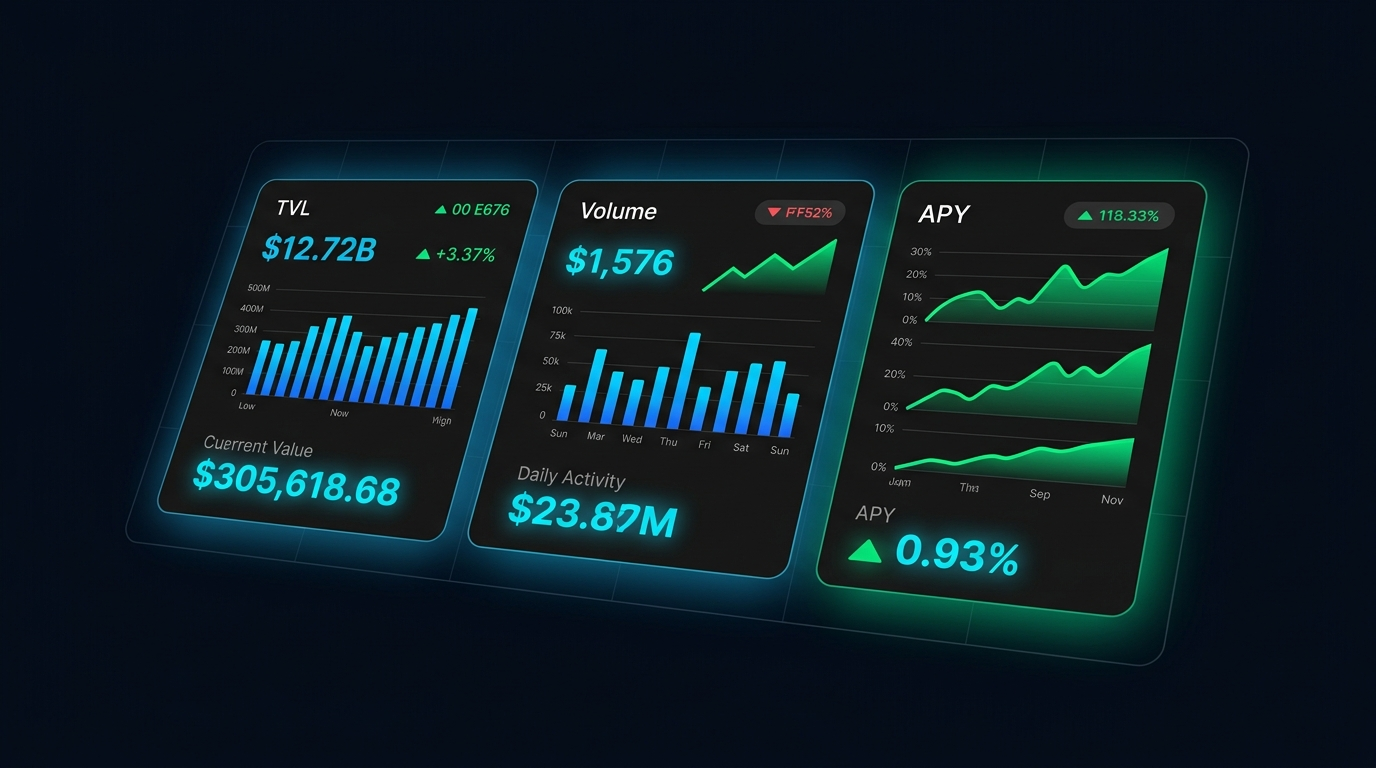
Minimum TVL threshold: Pools below $1M in TVL carry meaningful slippage risk for most trade sizes. The volume/TVL ratio is one of the most useful signals: a pool with $5M TVL generating $2M in daily volume (40% daily turnover) is extremely active - that ratio translates directly to higher fee income. Compare that to a $5M pool generating $100K in daily volume (2% ratio) - the fee APY will be dramatically lower despite identical TVL.
Key Metrics: TVL, Volume, APY, and Fee Tiers
APY figures in DeFi come in two flavors, and conflating them is an expensive mistake.
Fee APY reflects actual trading fees earned by the pool. This is organic income - it exists as long as traders use the pool. A consistent 15-25% fee APY on a major pair like ETH/USDC is a more durable proposition than a pool advertising 400% APY driven entirely by temporary governance token rewards that collapse when the program ends.
Use DeFiLlama's pool tracker and Uniswap's native analytics to pull all these metrics before committing. Both are free and require no account.
Standard LP vs. Protocol-Incentivized Pools vs. Managed Vaults
Three participation models exist, each suited to a different type of LP:
Each layer of complexity is also a layer of potential failure. Managed vaults like those offered by Yearn Finance automate the entire LP strategy - useful for hands-off capital, but they interact with multiple underlying protocols, so an exploit in any one of them can affect vault returns.
Yield Farming and Liquidity Mining: Maximizing LP Returns
Yield farming builds directly on the LP token mechanism. Once you hold LP tokens representing your pool share, you can stake those tokens in a protocol's farming contract to earn additional rewards - typically the protocol's own governance token - on top of the base trading fees you're already collecting.
⚡ The Yield Farming Loop
- Deposit ETH + USDC → Uniswap pool
- Receive UNI-V3-LP tokens (your pool share receipt)
- Stake LP tokens in protocol's farm contract
- Earn governance tokens (e.g., UNI, CRV, BAL) proportional to stake
- Claim rewards → hold, sell, or compound back into the pool
- Exit: unstake LP tokens → redeem from pool → recover assets + fees
Liquidity mining is the specific subset of yield farming where a protocol distributes its own governance tokens to LPs to bootstrap initial liquidity. This incentive was instrumental in DeFi's early growth - protocols used liquidity mining to attract billions in TVL by rewarding early LPs with governance tokens that carried real value.
The critical variable is reward token sustainability. A governance token with genuine utility - fee-sharing, meaningful governance rights - holds value over time. A token with no utility beyond being the reward token itself tends toward zero as selling pressure overwhelms demand. Evaluate the reward token as you would any other asset before using its APY as a reason to deposit.
Compounding earned rewards back into the pool accelerates returns but increases exposure. On Ethereum mainnet, frequent compounding can erode smaller positions through gas costs. Layer-2 deployments reduce this friction significantly.
Beyond Token Swaps: Other Uses of Liquidity Pools in DeFi
Token swaps are the most visible application, but liquidity pools power a substantially broader set of financial primitives across DeFi.
5 DeFi Use Cases Powered by Liquidity Pools:
- Lending and Borrowing (Aave, Compound): Users deposit a single asset to earn interest. Borrowers draw against posted collateral. The pool handles all matching algorithmically - interest rates adjust based on utilization of the pool's reserves.
- Synthetic Assets: Protocols use pooled collateral to mint synthetic representations of real-world assets - stocks, commodities, foreign currencies - without requiring custody of the underlying.
- On-Chain Derivatives: Perpetual futures protocols use liquidity pools as the counterparty to all leveraged positions. LPs earn fees from every trade but assume the aggregate risk of the trader book - a fundamentally different risk profile from standard DEX pools.
- Prediction Markets: Liquidity pools facilitate automated market making for binary and multi-outcome prediction markets, enabling continuous price discovery on everything from crypto prices to real-world events.
- Real-World Asset (RWA) Tokenization: An emerging frontier - pools are beginning to hold tokenized representations of bonds, receivables, and real estate, enabling DeFi-native liquidity for traditional financial assets.
The common thread is trustless, on-chain execution. Smart contracts replace the intermediary in every case - and pool liquidity is what makes the mechanism function at scale. As DeFi matures into institutional use cases, the liquidity pool architecture scales with it.
Conclusion: Are Liquidity Pools Right for You?
Liquidity pools solve a real problem - they make decentralized markets function without intermediaries, creating passive income opportunities for anyone willing to supply capital. But not every pool, and not every participation model, suits every type of user.
A few principles hold regardless of experience level: verify audit status before depositing into any new protocol, treat reward APY as temporary until proven otherwise, and size positions with the understanding that crypto trading involves substantial risk of loss.
The underlying architecture of DeFi - self-custodial, on-chain verifiable, permissionless - continues absorbing more financial activity: lending, derivatives, real-world assets, prediction markets. Platforms built on genuine transparency and trustless mechanics, where all pool mechanics and outcomes are verifiable on-chain, reflect the direction the space is heading. Liquidity pools are the infrastructure that makes this possible.
Start conservative. Understand impermanent loss in numbers, not just in concept. Then scale.
Crypto trading and liquidity provision involve substantial risk of loss and are not suitable for all participants. This article is for informational purposes only and does not constitute financial advice.
Last updated: April 2026.
Frequently Asked Questions
What is a liquidity pool in simple terms?
A liquidity pool is a smart contract holding two tokens so that traders can swap between them on a decentralized exchange - no buyer or seller required on the other side. Anyone can deposit assets to become a liquidity provider (LP) and earn a share of trading fees. The pool price adjusts automatically via a mathematical formula (x . y = k), making trading available 24/7. This mechanism underpins the entire DeFi ecosystem, from basic token swaps on Uniswap to lending protocols like Aave.
What is impermanent loss and how does it work?
Impermanent loss occurs when the price ratio of your deposited tokens changes after you enter a pool. The AMM formula continuously rebalances the pool's token ratio, meaning LPs hold more of the depreciating asset and less of the appreciating one compared to simply holding. If you deposit 1 ETH + $2,000 USDC and ETH doubles, your pool position recovers $5,657 versus $6,000 from holding - a 5.7% loss. The loss is "impermanent" because it reverses if prices return to the original ratio, but it locks in permanently upon withdrawal.
How does a liquidity pool make money for providers?
Every swap through the pool generates a trading fee - typically 0.3% on standard Uniswap pools. That fee distributes proportionally to all LP token holders based on their share of the pool's reserves. If a pool generates $30,000 daily in fees and you hold 1% of the LP tokens, you earn $300 per day passively. Some protocols also offer liquidity mining rewards - governance tokens distributed on top of base fee income to incentivize deeper pool participation. Always verify whether APY comes from fee income (sustainable) or token rewards (often temporary).
Can you lose money in a liquidity pool?
Yes. Impermanent loss can erode your position value if the price ratio of deposited tokens diverges significantly, and this loss can exceed fee income - particularly in low-volume pools or high-volatility conditions. Smart contract vulnerabilities are a separate, distinct risk: bugs in pool code can expose deposits to theft. Rug pulls are a real danger in unaudited protocols, where malicious teams drain LP funds through contract backdoors. Mitigate these risks by using audited, battle-tested protocols, choosing pairs with lower IL exposure, and never depositing more than you can afford to lose. Crypto trading involves substantial risk of loss.
What is an automated market maker (AMM)?
An AMM is a decentralized exchange protocol that uses mathematical formulas - rather than human market makers and order books - to set prices and execute trades. When a trader swaps tokens, they interact directly with the pool's smart contract. The most widely used formula is the constant product formula (x . y = k), where the product of the two token quantities must remain constant after every trade. This mechanism ensures liquidity is always available at any hour without centralized infrastructure. Uniswap popularized this model; Curve Finance adapted it specifically for stablecoin pairs with near-zero slippage.
How do I join a liquidity pool?
Set up a non-custodial wallet like MetaMask, fund it with both tokens of your target pair in equal dollar values, and connect to a DEX like Uniswap (app.uniswap.org). Navigate to the Pool section, select your token pair and fee tier, set your price range if using Uniswap v3's concentrated liquidity, then approve token spending and confirm your deposit. LP tokens representing your position will appear in your wallet. Gas fees on Ethereum mainnet run $20-$80; Layer-2 networks like Arbitrum offer the same experience for under $1. Your funds remain under your full custody throughout - no exchange holds them.
What is the difference between providing liquidity and staking?
Providing liquidity means depositing a pair of tokens into a DEX pool so traders can swap between them - you earn trading fees and bear impermanent loss risk. Staking typically refers to depositing a single token to secure a proof-of-stake blockchain or into a protocol's vault to earn interest. Liquidity provision requires two tokens and actively participates in market making; staking generally requires one token and is more passive. LP positions are subject to impermanent loss in ways that single-asset staking is not. Both generate yield, but the underlying mechanics and risk profiles are structurally different. Learn more about how staking works if you're comparing options.