Bitcoin just lost half its value from the October 2025 all-time high - yet its share of the total crypto market keeps climbing. That paradox confuses newcomers and frustrates altcoin holders in equal measure.
The metric behind it is called BTC dominance, and understanding how it works can reshape the way you read the entire crypto market. Whether you are deciding between holding Bitcoin or rotating into altcoins, BTC dominance is the compass that experienced traders watch before making a move.
⚡ Quick Answer
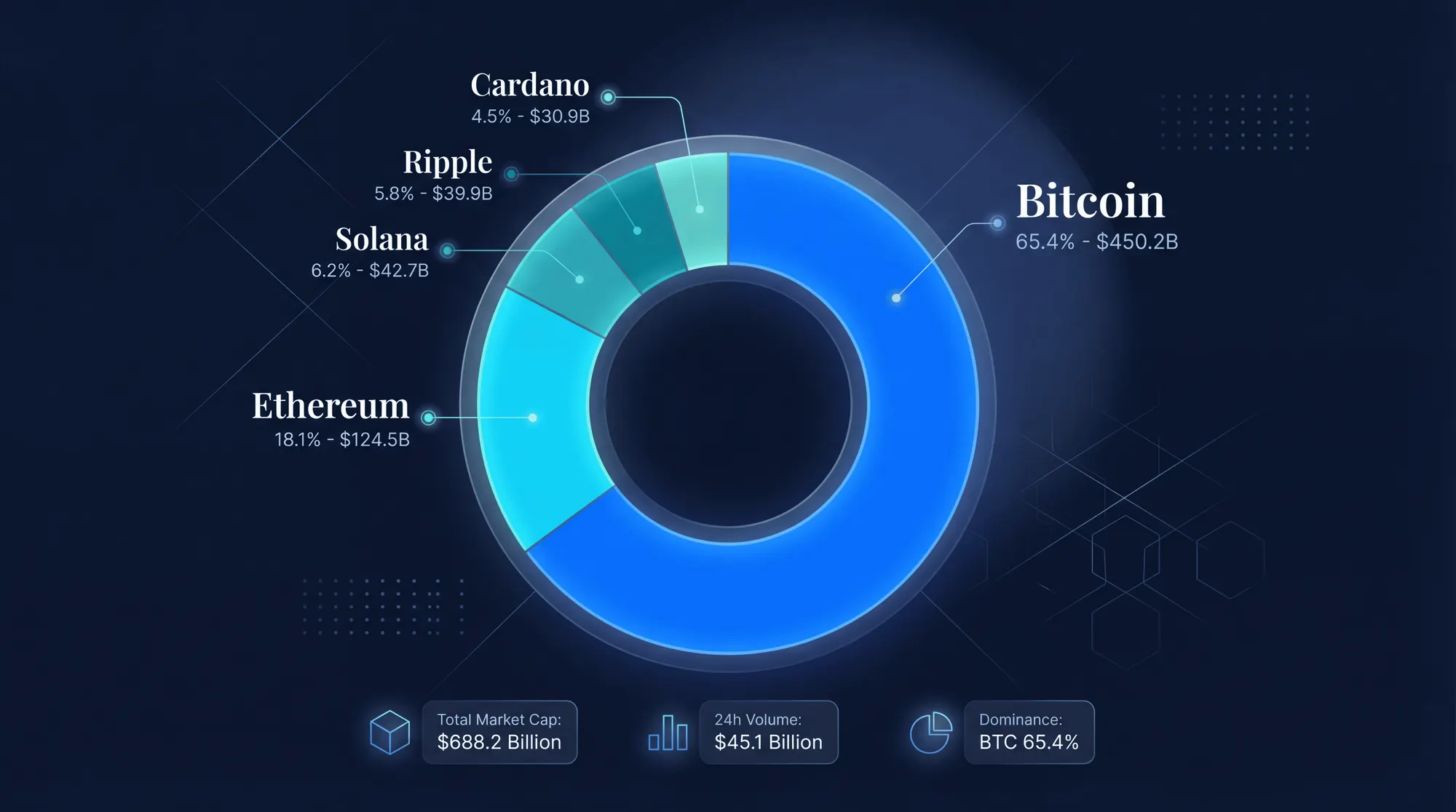
BTC dominance measures Bitcoin's market capitalization as a percentage of the entire crypto market. As of February 2026, it sits near 58-59%, meaning Bitcoin accounts for more than half of all crypto market value. When dominance rises, Bitcoin is outperforming altcoins. When it falls, capital is rotating into altcoins - a shift traders call altcoin season.

BTC Dominance Meaning: How the Metric Actually Works
At its core, the btc dominance meaning is straightforward: it is the ratio of Bitcoin's market capitalization to the total market capitalization of every cryptocurrency combined. The formula looks like this:
BTC Dominance = (Bitcoin Market Cap ÷ Total Crypto Market Cap) . 100%
With Bitcoin trading near $63,000 and holding a market cap of roughly $1.26 trillion, while the total crypto market hovers around $2.2 trillion, BTC dominance currently reads approximately 58%.
But that number deserves context. Total crypto market cap includes stablecoins like Tether (USDT) and USDC, wrapped tokens, and thousands of newly listed projects. Every time a new token launches and acquires market cap, the denominator grows - which can push BTC dominance down even if demand for Bitcoin itself has not changed. Some analysts therefore prefer to calculate BTC dominance excluding stablecoins to get a cleaner read on how Bitcoin competes against other risk-on crypto assets.
Why the Denominator Matters
When Bitcoin launched in 2009, it was essentially the only cryptocurrency, so dominance was close to 100%. As thousands of altcoins entered the market, that number declined structurally. A reading of 58% today means something very different from 58% in 2017 because the market composition has changed dramatically. Long-term comparisons remain useful, but the trend within a specific timeframe tells you more than comparing absolute values across different eras.
What Is an Altcoin? Understanding the Other Side of Dominance
Before diving deeper into dominance charts and indicators, it helps to clarify a fundamental term. An altcoin - short for "alternative coin" - is any cryptocurrency other than Bitcoin. Ethereum, Solana, XRP, Cardano, and the thousands of smaller tokens that trade on exchanges are all classified as altcoins.
Some altcoins were designed to improve upon Bitcoin's limitations by offering faster transactions or different consensus mechanisms. Others, like Ethereum, introduced entirely new capabilities such as smart contracts and decentralized applications. The altcoin market is enormously diverse - it spans everything from DeFi protocols and layer-2 scaling solutions to meme coins and gaming tokens.
The relationship between Bitcoin and altcoins is at the heart of the dominance metric. When BTC dominance rises, it generally means capital is concentrating into Bitcoin and away from the broader altcoin market. When dominance falls, the opposite is happening: investors are taking on more risk by spreading capital into alternative cryptocurrencies.
Bitcoin Dominance Chart: Historical Patterns and What They Reveal
The bitcoin dominance chart is one of the most studied charts in crypto because it maps the cyclical tug-of-war between Bitcoin and altcoins. You can track btc dominance live on several platforms:
- TradingView - search for the ticker BTC.D for real-time data with technical analysis tools
- CoinMarketCap - the Global Charts section includes a dedicated crypto dominance chart
- CoinGecko - the Market Cap Dominance tab provides historical and current data
Key Historical Milestones on the Chart
Understanding past patterns helps you interpret the present. Here is a timeline of how BTC dominance has shifted through major market cycles:
📅 BTC Dominance Timeline
2013 - Early Days
BTC dominance exceeded 95%. Bitcoin was virtually the entire crypto market.
Jan 2018 - All-Time Low (~38%)
The ICO boom caused capital to flood into Ethereum and new altcoins, pushing BTC dominance to its lowest point ever.
Aug 2019 - Bear Market Recovery (~70%)
After the 2018 crash wiped out most ICO tokens, capital flowed back to Bitcoin as a safer bet. Dominance rebounded sharply.
May 2021 - DeFi & Meme Coin Mania (~40%)
DeFi protocols, NFT frenzy, and meme coins like Dogecoin drew massive liquidity away from Bitcoin.
Feb 2026 - Current (~58-59%)
Following Bitcoin's pullback from its $126K ATH, dominance has climbed as altcoins have fallen even harder. BTC.D has been trending in the 57-61% range.
How to Read the BTC Dominance Chart
Reading the chart becomes practical when you combine dominance direction with Bitcoin's price movement:
- Dominance rising + BTC price rising → Strong Bitcoin season. Investors favor BTC over everything else. Altcoins tend to stagnate or decline.
When the entire market enters a severe risk-off environment, capital rapidly exits smaller alternative tokens and seeks the relative safety of Bitcoin or stablecoins. To survive these brutal macroeconomic downturns and understand the systemic liquidity cascades behind them, explore our expert breakdown on why is crypto crashing.
- Dominance rising + BTC price falling → Risk-off mode. Even though Bitcoin is dropping, altcoins are dropping harder. This is often seen during bear markets.
- Dominance falling + BTC price rising → Early signs of altcoin season. The entire market is bullish, but altcoins are gaining faster than Bitcoin.
- Dominance falling + BTC price falling → Rare scenario that may indicate flight to stablecoins. Both BTC and alts are selling off, but alts are holding up slightly better.

Altcoin Season Indicator: When Capital Rotates Away from Bitcoin
The altcoin season indicator is the natural counterpart to BTC dominance - while dominance tells you Bitcoin's share of the market, the altcoin season index tells you whether altcoins are actually outperforming Bitcoin.
How the Altcoin Season Index Works
The most widely referenced version is the CoinMarketCap Altcoin Season Index. Here is how it operates:
- The index evaluates the top 100 cryptocurrencies by market cap, excluding stablecoins and wrapped tokens.
- It compares each altcoin's price performance against Bitcoin's over a rolling 90-day window.
- The result is a score from 0 to 100.
The score thresholds break down like this:
Other platforms that provide similar data include CoinGlass, Blockchaincenter.net, and CryptoRank.
How BTC Dominance and the Altcoin Season Index Work Together
These two metrics are closely related but not identical. BTC dominance is a structural metric - it measures market cap shares. The altcoin season index is a performance metric - it measures which side is outperforming over a defined period.
A falling BTC dominance chart combined with a rising altcoin season index creates the strongest signal for an altcoin season. When BTC dominance declines below roughly 50% and the altcoin season index climbs past 75, the conditions for a broad altcoin rally are typically in place. Historically, these altcoin seasons have lasted anywhere from 2 to 8 months, with an average of 4-5 months.
⚠ Risk Warning
The altcoin season index is a lagging indicator based on the past 90 days. It reflects what has already happened, not what will happen next. By the time the index confirms altseason, much of the initial move may have already occurred. Always combine it with other analysis tools before making investment decisions.

Bitcoin vs Altcoins: How Dominance Shapes the Market Cycle
Understanding the dynamic between bitcoin vs altcoins through the lens of dominance reveals a recurring market rotation pattern that crypto markets have followed through multiple cycles.
The Capital Rotation Sequence
Crypto bull markets tend to unfold in a fairly predictable order:
Phase 1 - Bitcoin Leads. Fresh capital enters the market through Bitcoin first. Institutional buyers, ETF inflows, and mainstream interest drive BTC price up. Dominance rises.
Monitoring institutional capital movement is essential during the early stages of a market cycle. As spot ETFs serve as a primary gateway for Wall Street, keeping an eye on daily liquidity metrics such as Bitcoin ETF outflows can help you gauge whether institutional demand is sustaining the rally or if large entities are beginning to take profits.
Phase 2 - Large-Cap Altcoins Catch Up. Once Bitcoin's momentum slows, capital begins rotating into established altcoins like Ethereum, Solana, and other large-cap assets. Dominance flattens or starts declining.
Phase 3 - Altcoin Season. Capital cascades further into mid-cap and small-cap altcoins. Dominance falls noticeably. The altcoin season index climbs past 75. This is the phase where 2x-10x gains on individual tokens are most common - but also where risk is highest.
Phase 4 - Risk-Off. The cycle reverses. Either Bitcoin dominance rises again as investors seek safety, or stablecoin dominance increases as investors exit the market entirely.
What February 2026 Looks Like
As of late February 2026, BTC dominance hovers near 58-59% after Bitcoin corrected roughly 50% from its October 2025 ATH of $126,210. Altcoins have fallen even harder - Ethereum dropped below $1,800, and many mid-caps have lost 60-80% from their highs. This is classic Phase 1/Phase 4 overlap: a risk-off environment where Bitcoin, despite falling, is still outperforming most alternatives.
Analysts on TradingView and X have noted that BTC.D recently broke below a rising wedge pattern on the weekly chart, which some interpret as a potential early signal for altcoin rotation - though this remains unconfirmed.
📈 Bullish Signals for Altcoins
- BTC.D Wedge Breakdown: Weekly chart showing potential breakdown from a rising wedge that has been building since early 2023
- Extreme Fear Sentiment: The Crypto Fear & Greed Index dropped below 10, a level that has historically coincided with major market bottoms
- Stablecoin Dominance Rejection: USDT dominance rejected near multi-year resistance, suggesting sidelined capital may start rotating back in
📉 Bearish Signals for Altcoins
- Macro Headwinds: New tariff policies and equity market sell-offs continue to pressure risk assets including crypto
- Institutional Outflows: Bitcoin ETFs have experienced a historic five-week outflow streak totaling $3.8 billion
- Dominance Still Above 57%: A sustained break below 55% would be needed to confirm capital rotation into altcoins
How to Use BTC Dominance in Your Trading Strategy
BTC dominance is most useful as a strategic lens rather than a standalone trading signal. Here are practical approaches traders use:
Watch for trend changes, not absolute levels. A dominance reading of 58% on its own means little. What matters is the direction - is it trending up, down, or sideways over the past few weeks? A rising trend suggests staying overweight Bitcoin. A declining trend suggests selectively adding altcoin exposure.
Combine with other indicators. The Crypto Fear & Greed Index measures overall market sentiment, while BTC dominance specifically measures where that sentiment is directed. Using them together provides a more complete picture. For example, extreme fear plus falling dominance may signal a capitulation event where even Bitcoin longs are exiting.
Successful traders rarely rely on a single metric to time their market entries. Integrating dominance shifts with classical technical analysis on high timeframes can confirm major trend reversals early on. Learn how to spot the ultimate bullish confirmation signal by reading our comprehensive guide on what is a golden cross and how moving averages validate macro shifts.
Diversify gradually, not all at once. When you see dominance starting to decline, resist the urge to go all-in on altcoins immediately. Infrastructure tokens and large-cap DeFi projects typically lead early altseason rallies. Gaming tokens perform well mid-cycle. Meme coins tend to mark late-cycle euphoria and carry the highest risk.
While the final stages of an altcoin season can yield massive percentage gains, they are also incredibly volatile and unpredictable. If you are looking to navigate the riskier, high-reward sectors of the market during peak retail euphoria, it is crucial to evaluate the top meme coins and understand the community dynamics driving their explosive valuations.
Take profits during peak altseason. Sharp declines in BTC dominance rarely last long. Historical altcoin seasons have averaged 4-5 months. When the altcoin season index pushes above 80-90, consider gradually rotating profits back into Bitcoin or stablecoins.
🎯 Key Takeaways
- BTC dominance measures Bitcoin's share of total crypto market cap - currently near 58-59% in February 2026
- Rising dominance = Bitcoin season. Falling dominance = altcoin season
- The altcoin season index confirms rotation when 75%+ of top altcoins outperform BTC over 90 days
- Always combine BTC.D with price action and sentiment indicators - dominance alone is not a buy or sell signal
- Track BTC.D live on TradingView (ticker: BTC.D), CoinMarketCap, or CoinGecko for real-time data
Frequently Asked Questions
What is a good BTC dominance level?
There is no single "good" level - what matters is the trend. Dominance above 60% generally indicates a strong Bitcoin market where altcoins may underperform. Dominance below 45% historically signals active altcoin season conditions. Between 45-60% is a transitional zone where the market can swing either way.
Can BTC dominance predict altcoin season?
BTC dominance alone cannot predict the future, but it is one of the most useful tools for identifying when conditions favor altcoin outperformance. A sustained decline in dominance, especially when combined with a rising altcoin season index and increasing trading volume in altcoin pairs, creates the strongest indication that an altcoin season may be forming.
Where can I check BTC dominance live?
The most popular platforms for tracking btc dominance live are TradingView (ticker BTC.D), CoinMarketCap, CoinGecko, and CoinCodex. TradingView offers the most advanced charting tools, while CoinMarketCap and CoinGecko provide a quick overview alongside other market metrics.
Has BTC dominance ever dropped below 30%?
No. The historical all-time low for BTC dominance was approximately 38%, reached in January 2018 during the peak of the ICO boom. While some analysts project dominance could eventually drop to 30-35% in a future altcoin supercycle, this has never been observed in practice.
Is Ethereum included in altcoin dominance calculations?
Yes. Despite being the second-largest cryptocurrency and having its own robust ecosystem, Ethereum is technically an altcoin - meaning any crypto that is not Bitcoin. Ethereum is included in the altcoin season index calculations and counts as part of altcoin dominance.
What happens to altcoins when BTC dominance rises?
When BTC dominance rises, altcoins generally underperform relative to Bitcoin. In USD terms, they may still go up during a broad bull market, but they will typically gain less than Bitcoin. During bear markets, rising BTC dominance usually means altcoins are losing value faster than Bitcoin, as investors consolidate into what they perceive as the safest crypto asset.
How often should I check BTC dominance?
For long-term investors, checking dominance weekly is sufficient. Dominance trends play out over weeks and months, not hours. For active traders, monitoring the daily or weekly chart on TradingView alongside BTC price can help time entries and exits between Bitcoin and altcoin positions.
Final Thoughts
BTC dominance is not just another metric - it is the pulse of the crypto market's capital flow. In February 2026, with Bitcoin having pulled back from $126K and dominance sitting near 58%, the market is sending a clear message: investors are still favoring the relative safety of Bitcoin while macro uncertainty persists.
Whether dominance breaks higher toward 65% or rolls over toward 50% will shape the trajectory for thousands of altcoins. Track BTC.D alongside price and sentiment, and let the data - not emotions - guide your allocation decisions.
ZIPMEX promotes trading on trade.zipmex.com. Promotions are labelled and kept separate from news coverage, which is selected and checked without regard to them. Perpetual futures are leveraged derivatives. Prices can move fast and you can lose all of your margin. Not available in every jurisdiction. Not investment advice.