The global cryptocurrency market sits at approximately $2.36 trillion as of February 2026, spread across more than 17,700 actively tracked tokens. Yet a single Bitcoin trades near $67,340, and even tokens with no physical backing can command multi-billion-dollar valuations. So why are crypto tokens worth money if you cannot hold them in your hand, store them in a vault, or use most of them at a corner shop?
The short answer involves the same forces that give any form of money its value: collective agreement, utility, and scarcity. But the long answer is far more interesting - and understanding it is the difference between investing with conviction and gambling in the dark.
⚡ Quick Answer
Crypto tokens are worth money because market participants agree they are valuable, just like fiat currencies. That agreement is driven by concrete factors: utility (what you can do with the token), scarcity (limited supply controlled by code), demand (how many people want it), and the security of the underlying blockchain. Some tokens also gain value from governance rights, revenue-sharing mechanisms, or backing by real-world assets.
What Gives Crypto Value in the First Place?
To understand why crypto tokens have value, it helps to first ask a more fundamental question: why does any form of money have value? The U.S. dollar is not backed by gold anymore - it is backed by the trust in the U.S. government and the economy behind it. Before paper money, societies used shells, beads, and stone discs as currency. The common thread is consensus: money is worth something because enough people agree it is.
Cryptocurrencies extend this principle into the digital realm. The Reserve Bank of Australia puts it plainly: "Cryptocurrencies have no legislated or intrinsic value; they are simply worth what people are willing to pay for them in the market." That statement is true, but it is only part of the story. The reasons people are willing to pay are what matter - and those reasons are far more concrete than you might expect.
Unlike fiat currencies, most crypto tokens do not get a boost from being legal tender. Instead, what gives crypto value comes down to several quantifiable drivers that any investor can evaluate before putting money into a token.
Utility: The Foundation of Token Value
Token utility is perhaps the most tangible reason a crypto token commands a price. When a token lets you do something - pay for a transaction, access a service, participate in a protocol - that functionality creates demand.
Consider Ethereum. Every transaction on the Ethereum network requires Ether (ETH) to pay for gas fees. Every smart contract execution, every DeFi swap, every NFT mint costs a small amount of ETH. According to Fidelity, utility creates a self-reinforcing loop: "Some cryptocurrencies allow you to access blockchain-related functions, like smart contracts, DeFi applications, and real-world asset tokenization." The more people who use the network, the more ETH they need, and the more demand-side pressure builds on the token price.
This concept generalizes across the entire crypto ecosystem. Filecoin lets users pay for decentralized storage. Chainlink compensates node operators who provide off-chain data. Render Network tokens purchase GPU computing power. In every case, the token is not valuable in a vacuum - it is valuable because it unlocks access to a service that people actually use.
Scarcity: Coded Supply Limits
Physical gold is valuable partly because there is a finite amount on Earth. Bitcoin mirrors this principle with a hard-coded maximum supply of 21 million coins, of which approximately 19.96 million have already been mined. The Charles Schwab research team notes that "only 21 million bitcoins can be mined, with new supply of bitcoin ending in the year 2140," and that the halving mechanism cuts new issuance roughly every four years.
Scarcity only matters when paired with demand. A token with a supply cap of one million is not inherently valuable - but a token with a supply cap of one million that also serves as the only way to access a popular DeFi protocol is. This is where understanding tokenomics explained in full context becomes critical: it is the study of how supply schedules, burn mechanisms, and distribution plans interact to shape a token's economic profile.
Network Effects: More Users, More Value
A social media platform with ten users is essentially worthless. The same platform with a billion users is one of the most valuable companies on Earth. The same network effect applies to cryptocurrencies. Fidelity's crypto research highlights that "a social media platform with hundreds of millions of users is worth more than one with only hundreds of users. The same phenomenon applies to the cryptocurrency market."
Metcalfe's Law - the principle that a network's value grows proportionally to the square of its connected users - has been applied to model Bitcoin's price with notable accuracy. As adoption grows, the utility of the network grows even faster, creating a compounding effect that rewards early participants.

Why Do Tokens Have Value? The Six Core Drivers
Now that we have covered the philosophical foundation, let us break down the specific mechanisms that explain why tokens have value in concrete, measurable terms.
1. Supply and Demand: The Price Engine
Every cryptocurrency price ultimately comes down to the intersection of supply and demand. The Motley Fool explains: "The value of cryptocurrency is determined by supply and demand, just like anything else. If demand increases faster than supply, the price goes up."
On the supply side, each crypto project publishes its minting and burning schedule. Bitcoin adds new coins at a fixed, diminishing rate through mining. Ethereum introduced EIP-1559 in August 2021, which burns a portion of every transaction fee. According to beaconcha.in, over 5.3 million ETH have been burned under this mechanism - permanently removed from circulation, creating deflationary pressure during periods of high network activity.
On the demand side, multiple factors converge: the growth of decentralized applications, the expanding use of stablecoins (whose total market cap reached $309 billion in February 2026 according to DefiLlama), institutional adoption, and pure speculation. When demand rises and supply is constrained, the price moves up. When demand falls - as during bear markets - it moves down, sometimes violently.
2. Cost of Production
Mining Bitcoin requires real-world resources: electricity, specialized hardware, and cooling infrastructure. Proof-of-work systems tie a cryptocurrency's floor price to its cost of production. If the price of Bitcoin falls below the cost of mining it, miners shut down, supply growth slows, and eventually the price stabilizes.
This dynamic works differently for proof-of-stake networks like Ethereum post-Merge, where validators stake existing ETH rather than burning electricity. Here, the "cost" is the opportunity cost of locking up capital - validators need the staking rewards to justify not deploying that ETH elsewhere.
3. Token Utility and Ecosystem Demand
Beyond raw supply demand crypto dynamics, token utility creates a structural floor of recurring demand. There are several distinct categories.
Payment tokens function as a medium of exchange. Bitcoin, despite skeptics noting it has not yet achieved widespread merchant adoption, is accepted by a growing number of businesses and is legal tender in El Salvador.
Utility tokens grant access to specific products or services. The Zipmex glossary defines utility tokens as digital assets that "provide people with early access to a new product or service" and are "largely utilized by businesses to generate interest in their products, as well as for application and value generation in blockchain ecosystem services."
Stablecoins like USDT and USDC are pegged to fiat currencies and serve as the backbone of crypto trading and remittances. Their combined market cap exceeding $309 billion underscores the sheer demand for a stable digital dollar.
Security tokens represent ownership in real-world assets - stocks, bonds, real estate - and comply with regulatory frameworks. The tokenized real-world asset (RWA) market reached over $34 billion in early 2026, with projections for significant further growth.
4. Governance Token Value
Governance tokens represent a unique category that illustrates what makes a token valuable beyond mere speculation. Holders of tokens like Uniswap's UNI, MakerDAO's MKR, or Aave's AAVE can vote on protocol changes - fee structures, treasury allocations, and technical upgrades.
As Kraken's research explains, governance tokens like UNI and MKR "have both experienced strong price rallies in the past." The value proposition is straightforward: if a DeFi protocol manages billions in total value locked, the right to steer its direction carries economic weight. When Uniswap activated its fee switch through a governance vote, UNI holders gained a direct claim on protocol revenue - transforming the token from a pure voting instrument into something closer to a revenue-sharing asset.
5. Market Sentiment and Speculation
Crypto markets are heavily influenced by narrative and sentiment. Positive news - a major partnership announcement, regulatory breakthroughs, or prominent institutional buyers - can drive prices sharply higher. Negative news can crater them just as fast.
Coursera's crypto analysis notes that "mass adoption has the potential to drive up the price of cryptocurrency and cause significant price changes." The 2020-2021 bull market demonstrated this clearly: the U.S. Federal Reserve's decision to cut interest rates fueled appetite for risk assets, and Bitcoin surged from roughly $10,000 to an eventual all-time high.
Speculation is not inherently bad - all financial markets contain a speculative element. But in crypto, speculation can become the dominant driver for tokens with weak fundamentals, leading to extreme volatility and eventual collapse.
6. Regulation and Legal Clarity
Regulatory developments can either validate or undermine crypto token values. The approval of spot Bitcoin ETFs in the United States provided a regulated on-ramp for institutional investors. U.S. spot Bitcoin ETFs saw $506.5 million in net inflows on a single day in late February 2026, with BlackRock's IBIT leading the charge.
The Motley Fool notes that "regulation is required to allow for easier ways to trade cryptocurrency" and that products like ETFs and futures contracts "provide more access to cryptocurrency for investors, increasing its value." The clearer the legal framework, the more comfortable large pools of capital become with entering the market.
🎯 Key Takeaways: Six Drivers of Token Value
- Supply and demand - fixed or deflationary supply schedules combined with growing demand create upward price pressure.
- Production costs - mining expenses and validator staking requirements set a soft price floor.
- Utility - tokens that unlock real services have structural demand beyond speculation.
- Governance rights - voting power over valuable protocols translates into indirect economic value.
- Market sentiment - narratives, news cycles, and macroeconomic conditions amplify or suppress demand.
- Regulation - legal clarity attracts institutional capital; hostile regulation drives it away.
How Are Crypto Prices Determined? The Market Mechanics
Understanding the theory is one thing. Understanding how prices actually move in practice is another. Let us walk through the mechanics that determine what you see on a price chart at any given moment.
Order Books and Exchange Liquidity
Crypto tokens are traded on exchanges - centralized platforms like Binance and Coinbase, as well as decentralized exchanges (DEXs) like Uniswap and Raydium. On a centralized exchange, buyers place bids and sellers place asks. The price at which these orders overlap becomes the market price.
Liquidity - how easily a token can be bought or sold without significantly affecting the price - plays a critical role. CoinLedger highlights the importance of liquidity through the FTX collapse case study: "When many tokenholders tried to sell at once, the token's price suddenly collapsed." Thin order books mean that even modest selling pressure can cause dramatic price drops.
When a cryptocurrency gets listed on additional exchanges, it reaches more potential buyers. That increased accessibility drives demand, which drives price higher. This is why new exchange listings often trigger immediate price rallies.
The Role of Tokenomics in Price Discovery
Tokenomics is the economic blueprint of a crypto token. It covers total supply, circulating supply, emission schedule, vesting periods for team and investor allocations, and any burn or buyback mechanisms. According to Fidelity Digital Assets, "at its core, tokenomics is the economic design of a digital asset - how it is issued, used, and sustains or accrues value over time."
Poor tokenomics can destroy value even if the underlying technology is solid. If a project allocates 50% of tokens to insiders with a short unlock schedule, the market braces for sell pressure when those tokens become liquid. Conversely, well-designed tokenomics - like Ethereum's burn mechanism or Bitcoin's halving schedule - create predictable scarcity that the market can price in advance.
When analyzing any new crypto project or token, start with three questions: What is the maximum supply? How much is currently in circulation? And what happens to the supply over the next one to four years?
Macroeconomic Factors
Crypto does not exist in a vacuum. Interest rate decisions by the U.S. Federal Reserve, inflation data, and geopolitical events all influence crypto prices. During 2020, the Fed's rate cuts and stimulus measures pushed investors toward risk assets, fueling a historic crypto rally. In 2022, aggressive rate hikes had the opposite effect.
Crypto-stock correlation has strengthened as institutional participation grows, meaning broader market sentiment now flows directly into digital asset prices. Forbes identified "further institutionalization" as the number-one crypto trend for 2026, confirming that macro factors will continue to play a dominant role in how crypto prices are determined.
⚠ Risk Warning
Crypto markets operate 24/7, and prices can fluctuate dramatically at any hour. According to CoinDesk reporting on CoinGecko research, over 53% of all crypto tokens launched since 2021 are now inactive, with 2025 alone accounting for 86% of total project failures. Always research tokenomics, team credibility, and real utility before investing.
What Makes a Token Valuable? A Practical Framework
With millions of tokens in existence and more than half historically failing, the ability to distinguish genuinely valuable tokens from speculative noise is the most important skill any crypto investor can develop.
The Cryptocurrency Intrinsic Value Debate
The concept of cryptocurrency intrinsic value is fiercely debated. Traditional finance defines intrinsic value as the present value of future cash flows - a metric that applies neatly to stocks and bonds but awkwardly to most crypto tokens, which do not generate cash flow in the conventional sense.
Skeptics argue that without cash flows, crypto prices are driven primarily by speculation. Fidelity's balanced analysis acknowledges this directly: skeptics point out that "unlike stocks (which represent company ownership) or bonds (which promise specific payments), most cryptocurrencies don't generate cash flows or have tangible assets backing them."
This criticism has merit for many tokens, but it applies less to the growing number of DeFi protocols that do generate measurable revenue. Aave, Lido, MakerDAO, and Uniswap all produce fees that benefit token holders. As Binance's 2026 Cryptocurrency Market Outlook observes, "the market's focus will shift from 'chasing liquidity' to measuring the intrinsic yield and cash flow of assets."
A more productive framing is to ask: what problem does this token solve, and how sustainable is the demand for that solution? Bitcoin solves the problem of trustless, censorship-resistant value transfer. Ethereum solves the problem of programmable, decentralized computation. Stablecoins solve the problem of volatility in crypto-native payments. Tokens that solve real problems tend to survive; tokens that exist purely to ride a narrative cycle tend to join the 53% graveyard.
Real-World Examples: How Different Tokens Derive Value
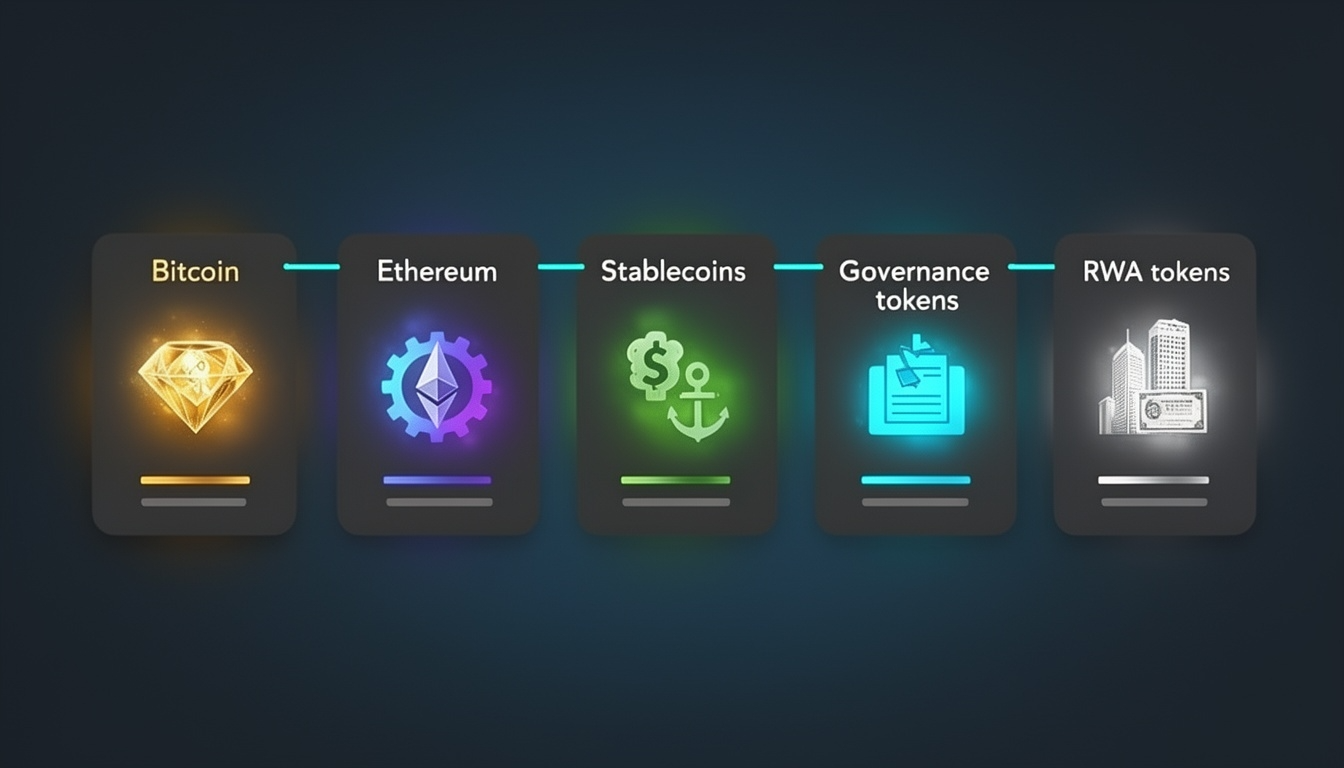
Bitcoin (BTC): Scarcity as the core thesis. With a hard cap of 21 million coins and approximately 19.96 million already mined, Bitcoin's supply schedule is the most predictable in all of finance. JP Morgan Private Bank notes that "scarcity is the foundation of the 'bitcoin as digital gold' argument." Bitcoin does not earn yield or power smart contracts. Its value comes almost entirely from being a credible store of value with immutable monetary policy and the strongest network effect in crypto.
Ethereum (ETH): Utility drives demand. Every action on the network requires ETH for gas. The introduction of EIP-1559's burn mechanism added a deflationary element - with over 5.3 million ETH burned since August 2021, Ethereum can actually reduce its total supply during high-activity periods. ETH combines utility-driven demand with scarcity-driven supply reduction.
Stablecoins (USDT, USDC): Trust and pegging. Their value is straightforward: one token equals one dollar, maintained through reserves and arbitrage. The crypto ecosystem's need for a reliable medium of exchange keeps demand consistently high.
Governance tokens (UNI, MKR, AAVE): Voting power as value. When the protocol you govern manages billions in assets and generates revenue, the ability to influence its direction commands a price premium - even though governance token value is indirect rather than direct.
RWA tokens: Bridging physical and digital value. Tokenized real-world assets represent ownership stakes in Treasury bonds, real estate, or private credit on the blockchain. The RWA market reached over $34 billion in early 2026 and is growing rapidly as institutions like BlackRock expand tokenized fund offerings.
The Five-Dimension Evaluation Checklist
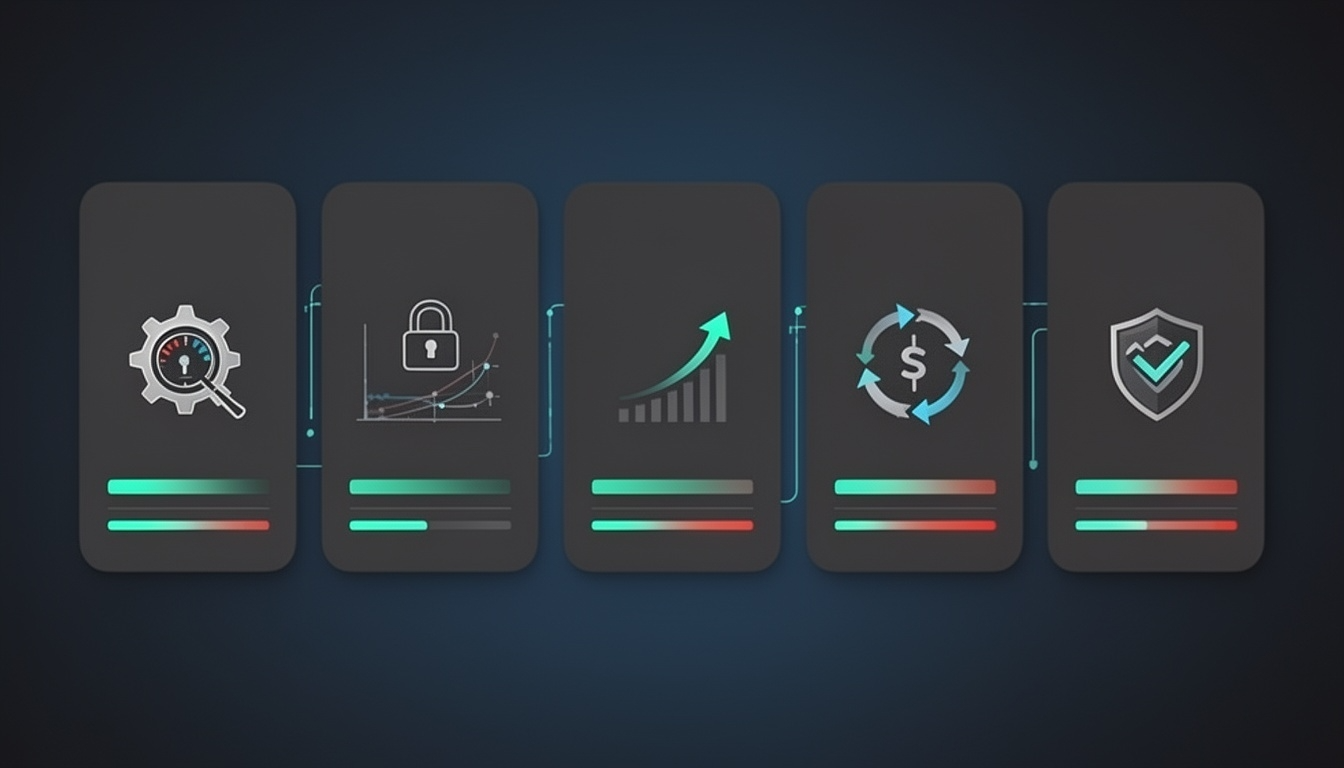
When assessing whether a token is likely to hold or grow its value, consider these five dimensions:
Utility depth. Does the token serve an essential function within its ecosystem, or is it an optional add-on? ETH is essential to every Ethereum transaction. A meme token with no use case beyond trading is not.
Supply discipline. Is the token supply fixed, deflationary, or inflationary? Bitcoin's 21-million cap and Ethereum's burn mechanism are examples of supply discipline. Tokens with unlimited minting and no burn mechanism present higher inflation risk.
Adoption metrics. How many daily active users does the protocol serve? How much total value is locked in its smart contracts? Real adoption is visible on-chain through tools like DefiLlama and DappRadar.
Revenue generation. An increasing number of DeFi protocols generate actual revenue that flows to token holders through buybacks, burns, or staking rewards. Revenue-generating tokens are beginning to look more like digital equities.
Team and governance quality. Who is building? Are they anonymous or public? How are decisions made? Decentralized governance with broad participation is generally more resilient than decisions made by a small founding team.
The Bear Case: Why Skeptics Say Crypto Is Overvalued
Any honest examination of why crypto tokens are worth money must also present the strongest counterarguments. Understanding the bear case makes you a better investor.
The "no cash flow" argument is the most common criticism. Most crypto tokens do not produce earnings, pay dividends, or generate revenue that flows directly to holders. Traditional valuation models - discounted cash flow analysis, price-to-earnings ratios - simply do not apply to most tokens. Skeptics argue this means crypto prices are driven primarily by speculation.
The failure rate reality reinforces this concern. According to CoinDesk reporting on CoinGecko research, over 53% of all crypto tokens launched since 2021 are now inactive. The 2020-2021 bull market saw thousands of projects launch with lofty promises and little substance - approximately 70% of tokens listed on CoinGecko during that period have since shut down.
The "not yet a medium of exchange" argument targets Bitcoin specifically. Despite being nearly two decades old, Bitcoin is rarely used for everyday purchases. If it fails to achieve widespread merchant adoption, skeptics question whether its valuation is justified by its "store of value" narrative alone.
Scam prevalence remains a legitimate concern. Smaller tokens - especially memecoins - are frequently used for pump-and-dump schemes. Fidelity notes that skeptics argue this "is a black mark on crypto's legitimacy and will hurt its chances of wider mainstream adoption."
These counterarguments are important not because they invalidate all crypto investment, but because they highlight the critical importance of selectivity. The tokens that survive and thrive tend to be those with genuine utility, disciplined supply mechanics, strong governance, and real adoption. The ones that fail tend to lack all four.
🎯 Bull vs. Bear: A Balanced View
- Bulls say: Decentralization, inflation resistance, programmable money, and institutional adoption justify growing valuations.
- Bears say: No cash flows, 53%+ failure rate, rampant speculation, and unresolved regulatory uncertainty mean most tokens are overpriced.
- Reality: Both sides have valid points. The key is distinguishing the top-tier tokens with real utility from the vast majority that will not survive.
How to Apply This Knowledge: Practical Steps for Investors
Understanding why crypto tokens are worth money is step one. Applying that understanding is step two. Here is a practical approach for anyone looking to put real money into crypto.
Start by identifying the value driver. Before buying any token, determine which of the six value drivers (supply/demand, production cost, utility, governance, sentiment, regulation) most strongly applies. If you cannot clearly articulate why the token should have value, you are speculating - not investing.
Research the tokenomics. Use resources like CoinGecko or the project's official documentation to understand supply mechanics. Check what percentage of tokens are held by insiders and when unlock dates occur. A heavy concentration of tokens in the hands of early investors with upcoming unlocks often leads to selling pressure.
Verify real adoption. On-chain data does not lie. Check daily active addresses, transaction volumes, and total value locked using tools like DefiLlama. Rising adoption with stable or growing TVL is a positive signal. Declining metrics despite a rising price is a warning.
Diversify across value types. A portfolio containing Bitcoin (scarcity play), ETH (utility play), stablecoins (stability), and exposure to revenue-generating DeFi tokens spreads risk across different value mechanisms. Learning how to diversify your crypto portfolio is as important in crypto as it is in traditional investing.
Manage risk deliberately. Never invest more than you can afford to lose. The 53% failure rate among crypto projects is not a scare statistic - it is a measured reality. Use proven risk management strategies including position sizing, stop losses, and portfolio rebalancing.
Frequently Asked Questions
Does cryptocurrency have intrinsic value?
This depends on how you define "intrinsic value." In the traditional finance sense of discounted future cash flows, most cryptocurrencies do not. However, tokens with real utility - like ETH required for Ethereum transactions or stablecoins backed by dollar reserves - have measurable, functional value. The debate is ongoing, but the more useful framing is: does this token solve a real problem for which people will consistently pay?
What makes one crypto token more valuable than another?
The primary differentiators are utility (what you can do with it), supply mechanics (how scarce it is), network effects (how many people use it), and governance quality. A token with strong utility on a widely-used blockchain with disciplined supply and decentralized governance will generally command higher value than one lacking these attributes.
Can a crypto token lose all its value?
Yes. According to CoinGecko research, over 53% of tokens launched since 2021 have already become inactive. Tokens can lose all value if the project is abandoned, the team exits (rug pull), the technology fails, or demand simply evaporates. This is why diversification and due diligence are essential.
How do stablecoins maintain their value?
Stablecoins maintain their peg to fiat currencies through reserve assets (cash, Treasury bonds, or other collateral) and market-maker arbitrage. If the price dips below $1, arbitrageurs buy the discounted token and redeem it for $1 from the issuer, pushing the price back up. The stability mechanism varies by stablecoin type - fiat-backed, crypto-collateralized, or algorithmic.
Are governance tokens a good investment?
Governance tokens can be valuable if the protocol they govern manages significant assets and generates real revenue. Tokens like UNI and MKR carry influence over billion-dollar DeFi protocols. However, governance power alone - without revenue distribution or tangible protocol control - may not sustain long-term price appreciation. Evaluate each governance token based on the value and growth trajectory of its underlying protocol.
Why does Bitcoin have value if it is not backed by a government?
Bitcoin's value comes from its fixed supply (21 million coins), decentralized network security, censorship resistance, and growing adoption by both individuals and institutions. The U.S. dollar itself has not been backed by gold since 1971 - its value rests on trust in the issuing government. Bitcoin substitutes government trust with mathematical certainty and decentralized consensus.
How do I evaluate if a new token is worth buying?
Check five things: (1) what problem does the token solve, (2) what are its tokenomics (supply cap, emission schedule, burn mechanism), (3) who is building it and how is it governed, (4) what on-chain adoption metrics show (daily users, TVL, transaction volume), and (5) how does it compare to competitors solving the same problem. If any of these areas raise red flags, reconsider.
Conclusion
The question "why are crypto tokens worth money?" has a layered answer. At the most basic level, tokens are worth what people collectively agree to pay - the same principle underlying every form of money throughout human history. But beneath that surface agreement lies a web of concrete mechanisms: supply scarcity enforced by code, utility that creates recurring demand, governance rights over valuable protocols, network effects that compound with adoption, and increasingly, real revenue flowing back to token holders.
The crypto market of 2026 is maturing. Institutional investors manage billions through regulated ETF products. Stablecoins process trillions in annual volume. Real-world assets worth tens of billions have been tokenized on-chain. These are not speculative fantasies - they are measurable realities that underpin token values.
At the same time, the 53% failure rate among crypto projects serves as a sobering reminder that not all tokens are created equal. The tokens that survive and appreciate over time are those with genuine utility, responsible tokenomics, growing adoption, and transparent governance. The rest - no matter how compelling their marketing - tend to zero.
Understanding these dynamics transforms you from a speculator into an informed participant. And in a market that rewards knowledge and punishes ignorance, that understanding may be the most valuable asset of all.
Ready to Start Your Crypto Journey?
Explore top crypto tokens with real utility, transparent tokenomics, and growing adoption on Zipmex.
Start Trading Now →⚠ Disclaimer: The information provided in this article is not intended to provide investment or financial advice. Investment decisions should be based on the individual's financial needs, objectives, and risk profile. We encourage readers to understand the assets and risks before making any investment entirely. Cryptocurrency investments are subject to high market risk. Past performance does not guarantee future results.