
Yes, you can still create an NFT without paying gas up front, but there are fewer ways to do it than older guides suggest, and "free" usually means someone else pays the cost later. The two methods that work are lazy minting, where nothing is written onchain until a buyer pays, and sponsored gas, where a platform or a "paymaster" contract pays the network fee for you. Two tools that older guides recommend have changed since 2022. Mintable has announced it is sunsetting its site. Zora now turns every post into a tradeable coin instead of a classic NFT.
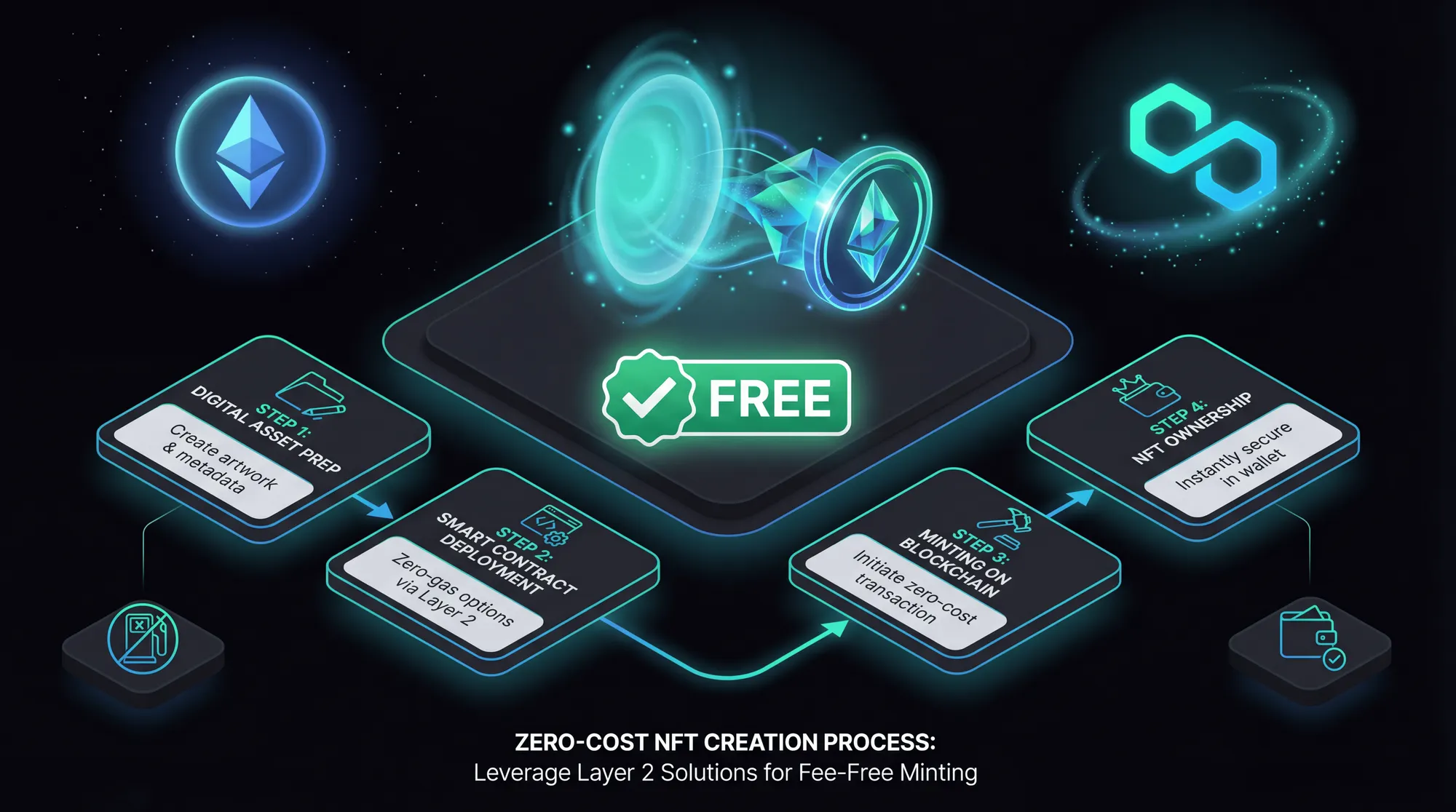
How "free" minting works
Lazy minting: the buyer pays at the point of sale
With lazy minting, the creator signs a minting authorisation in their wallet, which costs nothing. The item is then listed while its data sits off-chain. Rarible introduced this on 19 October 2021. Its announcement says the NFT is minted "at the moment of purchase" and that the buyer pays the gas for the minting transaction. Until then the item data is stored on IPFS.
The signature is usually a structured message under EIP-712, "a procedure for hashing and signing of typed structured data". The standard has Final status. The signature proves the creator approved the mint, so the contract can mint for the buyer later.
What this means for you:
- Nothing is onchain until a sale. Rarible's help centre says lazy-minted items do not appear on other marketplaces until a transaction happens.
- Some actions still cost gas. Rarible's 2021 announcement says the creator pays gas to burn a lazy-minted NFT.
- The rules depend on the platform. Rarible's help centre says lazy minting is only possible on Ethereum and only into Rarible's own collection. An update on its 2021 blog post says owned collections later gained the free option. The two official pages disagree, so check the create screen before you rely on either.
Sponsored gas: the NFT is minted now, and someone else pays
In this model the token is written onchain right away, but the creator does not pay the fee. On Ethereum-compatible chains this is often built on ERC-4337 (Final status). It defines a paymaster as "a helper contract that agrees to pay for the transaction, instead of the sender itself." Sponsorship is a business decision by the platform, so it can have limits or be withdrawn at any time.
Lazy minting and sponsored gas compared
| Lazy minting | Sponsored gas | |
|---|---|---|
| When the token goes onchain | At first sale | Immediately |
| Who pays the mint gas | The buyer | The platform or a paymaster |
| Visible on other marketplaces before a sale | No | Yes, on marketplaces that support that chain |
| Main risk | Platform rules on collections and chains | Sponsorship can be capped or ended |
What changed for the tools older guides recommend
Zora: posts are now coins, not classic NFTs
Older guides describe Zora as a free NFT minter. Zora's current developer documentation describes something else: "Every post becomes an instantly tradeable cryptocurrency token." The documentation lists three types: Creator Coins (one per profile), Content Coins (one per post) and Trend Coins. It also says trading is "currently only" supported on Base mainnet, an Ethereum layer 2.
The figures in Zora's documentation:
- Trading fee: 1% on Creator Coins and Content Coins, split among creator, referrers, protocol and liquidity providers.
- Content Coins: the creator receives 10 million tokens at launch.
- Creator Coins: 50% of the supply goes to the creator, vested over five years.
The "Make your first post" and "Activate your creator coin" steps in older guides therefore create a coin, a fungible token whose price can move, rather than a one-of-one artwork NFT. Zora's older NFT developer pages now sit under a "Legacy NFT Docs" link.
Mintable: sunsetting announced
Mintable offered gasless ERC-721 minting on Ethereum mainnet. Its April 2022 press release describes minting "thousands of ERC-721 tokens on the Ethereum main net instantly." Mintable's homepage now announces it is "Sunsetting Mintable.com and Mintology.app". It cites the decline in NFT use since 2022. The company says it will keep hosting NFT metadata "until our company shuts down", and users can move custodial wallets off the platform. No closing date is given. If you hold NFTs created there, move them to a wallet you control.
Polygon's NFT Minter: no longer available
On 3 June 2022 Polygon announced an NFT Minter that was "completely gas-free, thanks to Biconomy". It supported ERC-721 and ERC-1155, soulbound or transferable tokens, and unlockable content. The tool's address from that announcement, mintnft.today, no longer resolves, so the minter is gone.
Manifold: no platform fee, but you pay the gas
Manifold says it charges no fee to deploy a contract or mint through Manifold Studio. On 2 February 2023 the team wrote that this "will ALWAYS BE FREE". That refers to Manifold's own fee. The creator still pays network gas to deploy the contract and to mint. In the same thread Manifold announced a fee of 0.00069 ETH per token. Collectors pay it when they mint through its Claim Pages and Burn Redeem apps, "whether or not the token is a free mint". Manifold suits creators who want their own contract, but it is not a no-cost option.
Which free minting route fits you?
Answer a few questions to see whether lazy minting, sponsored gas or paying your own gas fits what you want to make.
What do you want to create?
- A one-of-one artwork or an edition NFT → next question
- A post that becomes a tradeable coin → This is a coin, not a classic NFT
Does the token need to be onchain and visible on other marketplaces before anyone buys it?
- No, it can wait until the first sale → Lazy minting
- Yes, it should be onchain right away → next question
Do you want your own contract, and can you pay network gas yourself?
- Yes, I want my own contract and can pay gas → Your own contract, your own gas
- No, I want someone else to pay the mint fee → Sponsored gas
You sign a minting authorisation for free and the buyer pays the mint gas at the moment of purchase. Until a sale, the item is not onchain and does not show on other marketplaces. Burning it can still cost you gas, and platform rules on chains and collections apply.
The token is written onchain immediately while the platform or a paymaster contract pays the fee. Sponsorship is a business decision, so it can be capped or ended at any time. Ask what happens when you transfer, burn or list the token.
Some tools charge no platform fee to deploy a contract or mint, but you still pay network gas to deploy and to mint, and collectors may pay a per-token fee such as 0.00069 ETH on some mint apps. This is not a no-cost option.
Under the current protocol described in the article, every post becomes a fungible, tradeable token whose price can move, with a 1% trading fee. It is not a one-of-one artwork NFT. Whether creating the post costs gas was not verified.
This sorts the minting routes the article describes; it does not check any platform's current rules, sale fees, royalties or gas prices, so confirm them on the live create screen.
A practical checklist before you mint
- Decide what you are making. A one-of-one artwork, an edition, or a tradeable coin are different products with different risks. Read the create screen before you sign.
- Read every signature request. A free mint still asks your wallet to sign. Check the domain and the message, and never sign a request you do not understand.
- Find out who pays later. With lazy minting the buyer pays at sale. With sponsored gas, ask what happens when you transfer, burn or list the token.
- Check the chain. A token minted on a layer 2 shows up only on marketplaces and wallets that support that network.
- Plan for the platform closing. Mintable shows that platforms close. Prefer tokens whose metadata is on IPFS or onchain, and keep tokens in a wallet you control.
- Expect fees at sale. Platform service fees and royalties apply when an item sells, even if creating it cost nothing. Check the current rates on the platform.
Frequently asked questions
Is free NFT minting really free?
Creating the item can cost you nothing. Under lazy minting, the buyer pays the mint gas at sale. Under sponsorship, the platform pays. Burning, transferring or moving tokens between chains can still cost gas, and sale fees still apply.
Why doesn't my lazy-minted NFT show up on other marketplaces?
It does not exist onchain yet. Rarible's help centre says lazy-minted items appear on other marketplaces only after a transaction.
Is a Zora post an NFT?
Under Zora's current protocol, a post becomes a coin that can be traded on Base. Zora's documentation for that protocol describes ERC-20 coins, not NFTs.
Do I need cryptocurrency to start?
For lazy minting you need a wallet to sign the authorisation, but no funds. Other actions, and platforms without sponsorship, need the network's gas token.
