
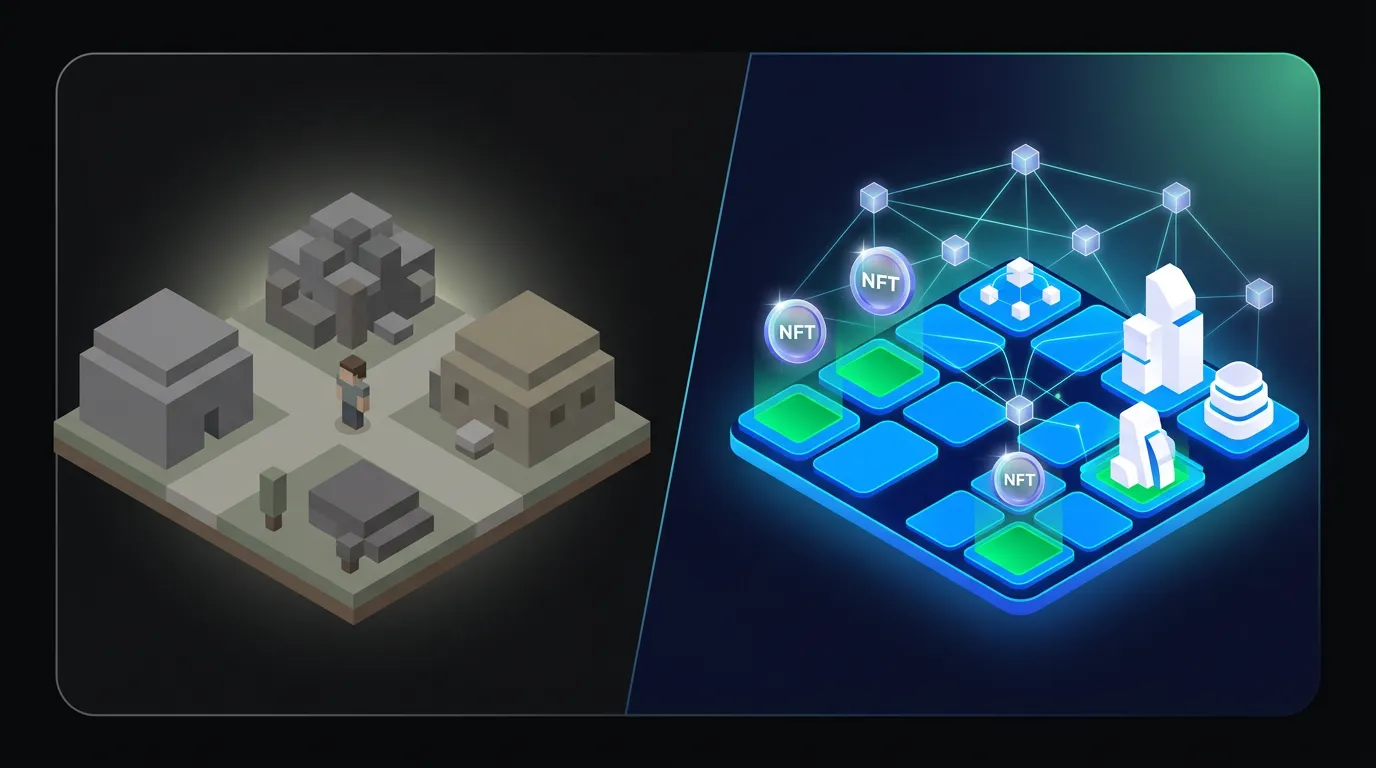
The Sandbox is the closest blockchain-based relative of Minecraft. It is a block-built (voxel) world where players make items and games. The difference is ownership: plots of land and creations are tokens on Ethereum that players hold and can trade. Minecraft has banned that model since July 2022. For a Minecraft player in October 2026, it is an option for building things you can sell, not a replacement for survival play. Two things have happened recently. The company is moving to an AI-assisted creation tool called The Sandbox Studio. And in August 2026 its SAND bridge on two secondary chains was exploited.
What changed in 2026
The Sandbox Studio replaces the no-code focus
In June 2026 The Sandbox announced The Sandbox Studio, an AI-centred creation environment. In a 7 September 2026 interview with BlockchainGamer.biz, CEO Robby Yung said it is aimed at developers who already know engines such as Unity and Unreal. He said it automates debugging, testing, content updates and porting rather than generating whole games from prompts: "The goal here is not to automate game creation. Because that's how you get AI slop." According to the same interview:
- A public launch was provisionally planned for October 2026, after closed alpha and beta game jams. The alpha opened to about 30 community creators.
- LAND owners are promised advantages in discovery, placement and monetisation for content published in The Sandbox. The exact benefits were still being worked out.
Press coverage of the October 2026 roadmap reports more than 100 games built during closed testing.
The August 2026 bridge exploit
On 22 August 2026 The Sandbox disclosed an exploit of its SAND cross-chain bridge on Base and BNB Smart Chain. Its later post-mortem gives the cause: the SAND token contract on those chains also acted as the bridge's registered application, so the messaging layer treated instructions coming from the token as instructions from The Sandbox. The attacker minted unbacked SAND on both chains. The company said SAND on Ethereum and Polygon was not affected, and it switched off bridging to and from Base and BNB Smart Chain.
The figures in reports vary. Press estimates put the SAND that reached usable wallets at about 14.75 million. The Sandbox's first estimate was "less than 0.01% of the total SAND token supply". The company says it is compensating holders of legitimately bridged SAND on those chains 1:1 in SAND on Ethereum, paid from its treasury. It says no new SAND will be minted and the 3 billion total supply is unchanged. The claim window for individual wallets ran from 8 to 22 September 2026. People who held through a trading venue were told no action was needed.
Leadership and restructuring (2025)
In late August 2025 several outlets reported that Animoca Brands had restructured The Sandbox. They reported that Animoca executive Robby Yung had become CEO, co-founder Sébastien Borget had moved to an ambassador role and more than half of about 250 staff had been laid off. The Sandbox disputed parts of that account. By September 2026 Yung was being interviewed as CEO.
How The Sandbox compares with Minecraft
| Minecraft | The Sandbox | |
|---|---|---|
| Look | Voxel blocks | Voxel blocks |
| Ownership of land and items | Not tokenised; NFTs and blockchain banned since July 2022 | LAND is an ERC-721 token; ASSETs are ERC-1155 tokens |
| In-world currency | None on-chain | SAND, an ERC-20 token |
| Creation tools | In-game building, mods, servers | VoxEdit (models), Game Maker (no-code games), The Sandbox Studio (AI-assisted, 2026) |
| Main risk to what you build | Platform rules and server policy | Token prices, platform health, wallet security |
The Minecraft ban came on 20 July 2022. Mojang barred blockchain technology from Minecraft's client and server applications and banned the use of in-game content to create scarce digital assets. It said NFTs "create a scenario of the haves and the have-nots". NFT Worlds, a project built on Minecraft servers, saw its WRLD token fall 65% after the announcement.
Background: from mobile game to blockchain
- May 2011: Pixowl is founded by Arthur Madrid, Sébastien Borget and Adrien Duermaël.
- 2012: The Sandbox is released as a mobile game.
- 27 August 2018: Animoca Brands announces it has acquired Pixowl for US$4.875 million upfront. Coverage at the time reported 40 million downloads for the franchise.
- 29 November to 20 December 2021: The blockchain version runs its first public alpha, which attracted more than 200,000 users according to Wikipedia's summary.
Where do you stand with The Sandbox?
Answer two or three questions to see which part of The Sandbox applies to you: the August 2026 bridge exploit if you already hold SAND, or which creation tool fits what you want to build.
Do you already hold SAND?
- Yes, I hold SAND → next question
- No, I'm a Minecraft player looking at it → next question
Which chain is your SAND on?
- Ethereum or Polygon → Not affected by the exploit
- Base or BNB Smart Chain → next question
How did you hold that SAND on Base or BNB Smart Chain?
- In my own wallet → Compensation was by claim
- Through a trading venue → No action was needed
What do you want to make?
- Voxel models: characters, props, equipment → Start with VoxEdit
- Games or experiences, without code → Start with Game Maker
- Games, and I already work in Unity or Unreal → Look at The Sandbox Studio
The Sandbox said SAND on Ethereum and Polygon was not affected by the August 2026 bridge exploit. Bridging to and from Base and BNB Smart Chain was switched off. Watch for impostors: The Sandbox and Animoca Brands said they will never message holders first with offers to recover or unlock tokens.
The company said holders of legitimately bridged SAND on Base and BNB Smart Chain would be compensated 1:1 in SAND on Ethereum, paid from its treasury. The claim window for individual wallets ran from 8 to 22 September 2026. Use only the official sandbox.game domain, and ignore anyone who messages you first offering to recover tokens.
People who held SAND through a trading venue were told no action was needed for the 1:1 compensation in SAND on Ethereum. Unsolicited offers to recover or unlock tokens are not from The Sandbox or Animoca Brands.
VoxEdit is for building and animating voxel models, which can be sold as ASSETs (ERC-1155 tokens). You do not need to own LAND. Selling requires a self-custody wallet, and earnings come in SAND, whose price moves with the crypto market.
Game Maker is the original no-code editor for building experiences on LAND. You can try the tools and visit published experiences before buying anything; owning LAND is what lets you publish an experience on your own parcel.
The Sandbox Studio, announced in June 2026, is aimed at developers who already know engines such as Unity and Unreal. It automates debugging, testing, content updates and porting rather than generating whole games. A public launch was provisionally planned for October 2026; LAND owners are promised discovery, placement and monetisation advantages whose details were still being worked out.
This sorts you by the article's facts only: it cannot check your wallet or balance, confirm whether a claim was paid, or say whether buying SAND, LAND or ASSETs makes sense for you.
How the economy works
SAND
SAND is the platform's ERC-20 utility and governance token. The official docs describe it as the currency for buying and selling LAND and ASSETs, and say holders need it to take part in governance. Total supply is 3 billion. SAND also exists on Polygon, and the official docs cover staking on Polygon.
LAND
LAND is a parcel of the map. There are 166,464 LAND in total, each an ERC-721 non-fungible token. Adjacent parcels can be merged into an ESTATE. A DISTRICT is an ESTATE owned by one or more people. Public LAND sales have also run on Polygon, and the docs cover buying LAND on secondary NFT marketplaces.
ASSETs
ASSETs are voxel content, such as characters, props and equipment. They become ERC-1155 tokens when uploaded to The Sandbox marketplace. GEMs and CATALYSTs are supporting tokens that set an ASSET's attributes.
The creator pipeline
- VoxEdit: build and animate voxel models, then sell them as ASSETs. You do not need to own LAND.
- Game Maker: the original no-code editor for building experiences on LAND.
- The Sandbox Studio: the 2026 AI-assisted environment for experienced developers, described above.
Practical points for a Minecraft player
- Start without spending. You can try the tools and visit published experiences before buying anything. Owning LAND is what lets you publish experiences on your own parcel.
- Selling requires a self-custody wallet. Treat the recovery phrase as the only key to your holdings.
- Check which chain your SAND is on. The Base and BNB Smart Chain bridges were switched off after August 2026. Ethereum and Polygon SAND were unaffected.
- Watch for impostors. After the exploit, Animoca Brands and The Sandbox warned they will never message holders first with offers to recover or unlock tokens. Only use the official sandbox.game domain.
- Price income in fiat, not SAND. Earnings from ASSET sales or experiences come in SAND, whose price moves with the crypto market. A sale can be worth much less by the time you convert it.
Risks
- Token volatility: the values of SAND, LAND and ASSETs can fall sharply.
- Platform dependency: your tokens stay on-chain if activity declines, but their value depends on people using the platform. The 2025 restructuring and the 2026 move to AI tools show that strategy can change quickly.
- Bridge and contract risk: the August 2026 exploit shows that tokens on secondary chains carry risk on top of Ethereum itself.
- Scams and phishing: fake marketplaces and approval requests target NFT holders.
Details of Studio's launch and the exploit come mostly from company posts and trade press, and the exploit figures differ between sources. Nothing here is investment advice.
