The UNI token is sitting at an interesting crossroads. At roughly $3.58 as of March 2026, Uniswap's governance token has pulled back sharply from its late-2024 highs - and right now, the crypto community is split between those who see a deeply discounted DeFi blue-chip and those who question whether UNI can sustain a premium valuation without a clearer revenue model.
My take: the UNI price prediction story over the next four years will hinge on a handful of binary catalysts - the fee switch governance vote chief among them. This guide covers everything you need to form your own view: year-by-year forecasts, current technical indicator readings, the key drivers pulling in both directions, and practical strategies for each investor profile.
⚡ Key Takeaways
- Current UNI price: ~$3.58 (March 2026)
- 2026 forecast range: $2.88 (bear) - $22.00 (bull), base case $5.00-$8.00
- 2030 forecast range: $1.00 (deep bear) - $150.00 (ultra-bull), base case $20-$30
- Overall outlook: Neutral-to-cautiously bullish - technical setup is coiled, the fee switch catalyst is real, but macro headwinds and regulatory uncertainty make short-term direction genuinely uncertain
What Is Uniswap and the UNI Token?
Uniswap launched in November 2018 as the Ethereum ecosystem's first fully automated, permissionless decentralised exchange. Its creator, Hayden Adams, was directly inspired by a conceptual post from Vitalik Buterin - and the result was a protocol that let anyone swap ERC-20 tokens without an order book, without a central operator, and without giving up custody of their funds.
That non-custodial architecture is fundamental. Unlike Binance or Coinbase, there's no company holding your assets. The smart contracts execute trades algorithmically, and you retain control of your wallet at every step.
How Uniswap's AMM and Liquidity Pools Work
Uniswap's engine is an Automated Market Maker (AMM). Instead of matching buyers with sellers, it maintains pools of token pairs. When you want to swap ETH for UNI, you're trading against the pool - not against another human counterparty.
The pricing algorithm is elegant in its simplicity: x . y = k, where x and y are the quantities of each token in the pool and k is a constant. As one token is withdrawn, its price rises automatically to maintain the balance. According to the Uniswap protocol documentation, liquidity providers earn 0.3% on every swap routed through their pool.
Uniswap v4, the most recent protocol version, introduced "hooks" - customisable smart contract extensions that let developers build bespoke pool logic on top of the base protocol. The practical effect is that institutional liquidity providers can now implement custom fee structures, dynamic pricing curves, and conditional execution logic. That's a significant technical moat.
A Uniswap Swap in 3 Steps:
- User initiates swap (e.g., ETH → UNI) via the Uniswap interface or any integrated DEX aggregator
- Smart contract queries the pool's current token ratio and calculates the output using the x . y = k formula
- Trade executes atomically; the 0.3% fee is distributed to liquidity providers in the pool
UNI Token: Governance, Tokenomics, and Utility
According to CoinGecko, UNI launched on 16 September 2020 - initially as a retrospective airdrop to early Uniswap users (400 UNI per qualifying wallet). The total supply is fixed at 1 billion UNI, with approximately 630 million in circulation as of early 2026.
The most consequential near-term UNI story is the fee switch. Currently, 100% of protocol swap fees flow to liquidity providers. If governance votes to activate it, UNI holders would receive a share of protocol revenue - transforming UNI from a pure governance token into an income-generating asset. Standard valuation frameworks would suddenly become applicable. That's a structural re-rating event, and most analyst forecasts don't fully price in the probability. It's the single most asymmetric catalyst in the UNI story right now.

UNI Price History: Key Milestones and Lessons
Understanding where UNI has been makes the range of price predictions far more legible. The token has moved through distinct cycles - each teaching a clear lesson about what drives UNI's price and what kills it.
All-Time High, Bear Market Lows, and What They Signal
According to CoinMarketCap, UNI's all-time high of $44.97 came in May 2021, driven by the DeFi bull run and a surge in DEX activity. The subsequent crash was brutal: by June 2022, UNI was trading below $4.00 - a 91% drawdown from ATH.
What does that teach? UNI amplifies macro crypto cycles. It outperforms violently in bull markets and gives back gains just as violently when risk appetite dries up. The $44.97 ATH now functions as a long-term resistance ceiling - any bull case for 2030 requires first clearing $10, then $20, then testing the old high.
From a technical standpoint, Fibonacci Retracement of the 2020-2021 rally places the 0.618 level as a key support zone - and UNI has repeatedly bounced from this area during both the 2022 and 2025 corrections. Traders watching the 200-day Simple Moving Average (SMA) as a trend filter will note that UNI has been trading below it since mid-2025, keeping the structural bias bearish until proven otherwise.
Year-by-Year Price Summary
The pattern is consistent: UNI surges during periods of elevated Ethereum activity and DeFi TVL growth, then retraces when on-chain volumes drop. Recognising these cycles is exactly what technical indicators attempt to quantify - which brings us to the forecasts.
UNI Price Prediction 2026-2030: Year-by-Year Forecasts
⚠ Disclaimer
- All price predictions → speculative, for educational purposes only
- Crypto markets → highly volatile; substantial risk of capital loss
- This section → does not constitute financial advice or a recommendation to buy or sell any asset
UNI forecasts vary dramatically across analyst platforms - and the spread isn't a sign of sloppy methodology. It reflects genuine uncertainty about DeFi's medium-term trajectory, Ethereum's scalability timeline, and the binary outcome of fee switch governance.
UNI Price Prediction 2026
2026 is the most actionable timeframe for current holders. The technical backdrop is mixed: price is below the 200-day SMA, RSI is neutral at approximately 47-53, and Bollinger Bands are showing compression - a setup that typically precedes a sharp directional move.
The key 2026 resistance zone sits between $5.00 and $7.60. On-chain data adds a cautiously bullish note: exchange-held UNI balances have been declining since late 2025, suggesting long-term holders are accumulating rather than distributing.
UNI Price Prediction 2027-2028
The medium-term picture brightens as structural tailwinds accumulate. The Bitcoin halving of April 2024 typically generates its strongest altcoin spillover effects 18-24 months post-event, pointing to 2026-2027 as a potential altseason window.
For 2027, analyst consensus clusters between $7 and $13: Changelly models $8.67-$11.04, CoinPedia estimates $7.00-$12.50, and more optimistic models push toward $15. The structural driver beyond macro timing is Layer-2 expansion. Optimism, Arbitrum, and Coinbase's Base network have dramatically reduced Uniswap's effective transaction costs - a $5 swap on Ethereum mainnet now costs $0.05-$0.20 on L2. That cost reduction expands Uniswap's addressable market to retail traders previously priced out by gas fees.
UNI Price Prediction 2029-2030
This is where projections diverge most sharply - and for good reason. A 4-year forecast in crypto is scenario planning rather than prediction.
✓ BULL CASE - $60-$85 by 2030
DeFi TVL exceeds $500B; fee switch activates; UNI re-rated as yield-bearing asset with P/E framework. Required: sustained DeFi expansion + governance quorum.
✕ BEAR CASE - $1-$5 by 2030
DeFi TVL stagnates; fee switch fails; regulatory crackdown limits DEX access. Governance apathy remains the most likely catalyst for this outcome.
The base case sits between $20 and $30 - roughly 5-8x from current levels - contingent on DeFi TVL recovery and fee switch activation. Ultra-bull projections of $100-$150 (PricePrediction.net, StealthEx) assume Ethereum becomes a dominant global settlement layer.
Expert Forecast Comparison Table (2026-2030)
The spread between the most conservative and most bullish 2030 projections reflects how polarised the DeFi outlook remains. These forecasts are outputs of algorithmic models that often incorporate the same technical indicators traders use daily - understanding those signals directly gives you an edge over relying solely on aggregators.
UNI Technical Analysis: Indicators and Signals for 2026
Technical analysis grounds forecast speculation in observable data. Here's the current signal picture for UNI, based on market data as of Q1 2026 sourced from TradingView:
Verify live readings on TradingView before making any trading decisions. Indicator readings change daily.
Moving Averages, RSI, and Momentum Signals
RSI sitting at 47-53 is genuinely neutral - not the screaming oversold condition below 30 that historically marks UNI's best accumulation entries, but also not the overheated reading above 70 that precedes corrections. Historically, UNI's most reliable long-term buy signals have come when RSI dipped below 35 with rising volume - the June 2022 bottom and the late-2025 correction both saw this pattern before multi-month recoveries.
The moving average picture tells a clearer story. UNI is trading below both the 50-day SMA (~$4.10) and the 200-day SMA (~$5.20). That double-below configuration is a bearish structural signal - the long-term trend remains down until UNI closes above both on meaningful volume. A golden cross - the 50-day SMA crossing back above the 200-day - would be a significant bullish signal for long-term holders. The Exponential Moving Average (EMA) weights recent price changes more heavily; the 50-day EMA currently sits closer to $3.90, suggesting marginal short-term recovery even while the broader trend remains bearish.
Bollinger Bands, MACD, and Fibonacci Levels
The Bollinger Band compression is the most technically interesting setup in UNI right now. Bands have narrowed significantly - upper approximately $3.61, lower approximately $3.30 on the 4-hour chart. Statistically, compressed Bollinger Bands precede a sharp directional expansion. The current setup means a breakout above $3.61 would signal bullish momentum (target: prior resistance at $5.00), while a break below $3.30 opens downside toward $2.88-$3.00.
MACD on the daily chart shows a flattening histogram with the signal line converging - a potential bullish crossover is forming, though it hasn't confirmed. If the MACD line crosses above the signal line with positive histogram momentum, that's the momentum-shift confirmation swing traders wait for.
Fibonacci Retracement of the 2020-2021 bull run places the 0.618 level at $3.20-$3.40 - and UNI has bounced from this zone multiple times during both bear cycles. The confluence of Fibonacci support, Bollinger Band lower bound, and declining exchange balances creates what traders call a coiled spring setup. Three confirmation signals to watch:
- Break above upper Bollinger Band ($3.61+) with volume → bullish breakout signal
- MACD bullish crossover on daily chart → momentum confirmation
- RSI moving above 60 → trend shift confirmation
Bullish vs. Bearish Scenarios for UNI in 2026
✓ BULLISH TRIGGERS
. Fee switch proposal reaches governance quorum
. DeFi TVL recovers above $80B (recovery signal)
. UNI breaks above 50-day SMA (~$4.10) on volume
✕ BEARISH TRIGGERS
. Broader crypto risk-off sentiment persists through H2 2026
. SEC enforcement action targeting DEX front-ends
. Fee switch vote fails or delayed indefinitely
Key Factors That Will Drive UNI's Price
Several structural forces will determine whether the bull or bear scenario materialises for UNI over the next four years. Understanding them isn't optional - it's the difference between informed conviction and speculative noise.
Bullish Catalysts - DeFi Growth, Layer-2, and Uniswap v4
Five independent drivers could push UNI significantly higher:
- DeFi TVL recovery: A recovery toward $100B+ in decentralised finance total value locked signals rising protocol usage and strengthens the fee switch case.
- Layer-2 expansion: Base, Arbitrum, and Optimism collectively processed more transactions than Ethereum mainnet in 2025. Lower-cost swaps on L2 bring Uniswap's fee structure in line with centralised exchange rates - removing the primary barrier for cost-sensitive retail traders.
- Uniswap v4 hooks: Institutional liquidity providers can deploy custom pool logic, attracting deeper liquidity and more sophisticated volume. Each catalyst is independently capable of moving UNI materially.
- Fee switch activation: If governance votes to redirect 1/6 of swap fees to UNI stakers, the token transforms from a governance instrument into a cash-flow asset. That's a valuation framework change, not just a price catalyst.
- Regulatory clarity: A clearly defined framework for DeFi removes the regulatory overhang suppressing institutional DeFi investment globally.
The fee switch deserves particular attention: governance requires a quorum, so community engagement directly determines one of UNI's most significant price levers.
Bearish Risks - Regulation, Competition, and Smart Contract Risks
Honest risk assessment is as important as identifying upside. Here's what keeps me cautious on the near-term:
- Regulatory pressure: A sweeping enforcement action against DEX front-ends could restrict access and suppress the volume metric UNI's valuation depends on.
- Competitive erosion: SushiSwap, PancakeSwap, Curve Finance, dYdX, and GMX all compete for DeFi liquidity. None have displaced Uniswap from its TVL leadership yet, but the competitive landscape is intensifying.
- Smart contract risk: No smart contract system is immune to exploits. A significant security breach would damage trust at the protocol layer.
- ETH price correlation: UNI correlates with ETH at approximately 0.75 historically. A sharp Ethereum decline drags UNI down regardless of protocol-specific fundamentals.
- Governance apathy: Low voter participation makes fee switch quorum harder to achieve. If governance stays dormant, the primary UNI bull catalyst stalls indefinitely.
UNI vs. SushiSwap vs. PancakeSwap - DEX Token Comparison
For pure Ethereum DEX exposure, UNI has no direct substitute. SushiSwap's multi-chain architecture makes it the closest structural alternative, though SUSHI development momentum lagged in recent years. Platforms emphasising self-custody and on-chain verifiability - the same architectural principles underlying Uniswap - represent where the DeFi infrastructure stack is heading.
Is UNI a Good Investment? Strategies for Every Profile
⚠ Risk Disclosure
- Crypto trading and investing → involves substantial risk of loss and is not suitable for all participants
- Past price performance → does not guarantee future results
- Nothing below → constitutes financial advice or a recommendation to buy or sell any asset
Whether UNI fits your portfolio depends entirely on your profile, time horizon, and risk tolerance - not on anyone's price target.
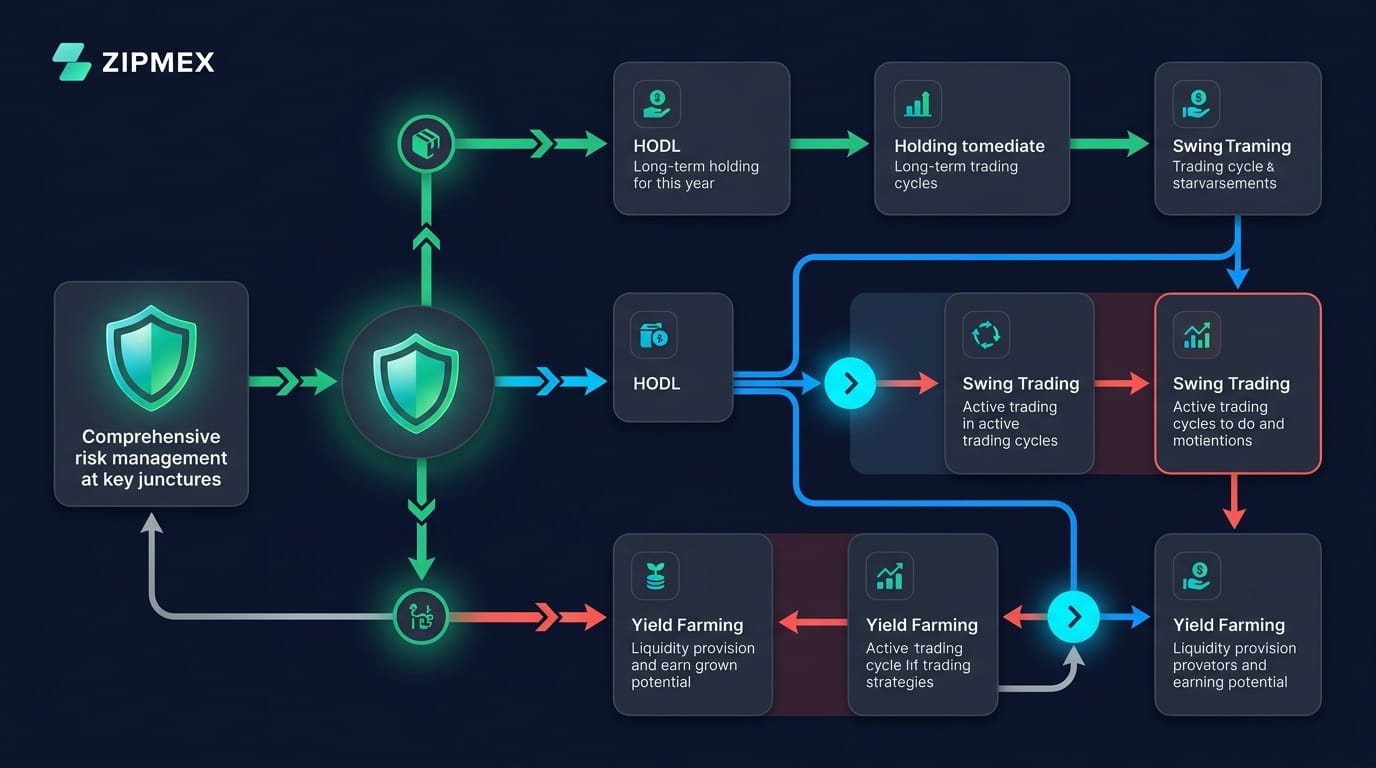
Popular Strategies - HODLing, Swing Trading, and Yield Farming
HODLing: Dollar-cost averaging during RSI < 35 periods removes the pressure of timing a bottom precisely. Historically, those conditions have marked UNI's strongest accumulation zones. Here's a concrete DCA illustration:
Swing trading: A UNI swing trader might enter at $3.50 on an RSI bounce from 32, set a stop-loss below $3.20 (lower Bollinger Band + Fibonacci support), and target $5.00 for approximately a 2.5:1 risk-reward ratio. MACD crossover confirmation before entry significantly improves win rate but also means missing the exact bottom.
Yield farming: Depositing UNI + ETH into a Uniswap v3/v4 concentrated liquidity position earns the 0.3% swap fee - but impermanent loss is a critical consideration. A 2x UNI price move relative to ETH produces approximately 5.7% impermanent loss on a standard 50/50 pool position. This strategy suits DeFi participants who view LP fees as additional income rather than their primary return.
Risk Management Essentials for UNI Investors
UNI Risk Management Checklist:
- Position sizing: Keep UNI at 5-10% of total crypto portfolio maximum. Mid-cap altcoins carry amplified downside risk relative to BTC/ETH
- Stop-loss placement: Set hard stops below key Fibonacci support levels - currently $3.00-$3.20. If the structure breaks, downside to $2.50 is open
- Correlation awareness: UNI correlates ~0.75 with ETH. Holding substantial ETH alongside UNI amplifies sector concentration risk
- Impermanent loss monitoring: If providing liquidity, track IL using a dedicated calculator. A sharp UNI rally can make LP provision less profitable than simply holding
- Regulatory monitoring: Follow DeFi-specific regulatory news. SEC statements on decentralised exchange platforms directly affect Uniswap's operating environment
How to Buy UNI Token: Step-by-Step Guide
UNI is one of the most widely listed tokens in crypto, available via both centralised and decentralised routes.
Path 1 - Centralised Exchange (Simpler, Custodial):
- Register on a CEX (Binance, Coinbase, Kraken, or MEXC) and complete KYC verification
- Deposit funds via bank transfer, debit card, or existing crypto
- Search for the UNI/USDT or UNI/USD trading pair
- Execute a market order (immediate fill) or limit order (fills at your specified price)
- For long-term holdings, withdraw UNI to a personal wallet rather than leaving it on the exchange
Path 2 - Uniswap DEX (Self-Custody, No KYC):
- Install MetaMask (or any ERC-20 compatible wallet) and fund it with ETH
- Navigate to app.uniswap.org and connect your wallet
- Select ETH → UNI and enter the amount; review the price impact
- Confirm the transaction and approve the gas fee
- UNI appears in your wallet within seconds of on-chain confirmation
The DEX path maintains self-custody at every step - the defining principle of DeFi. The tradeoff is Ethereum mainnet gas fees, which can run $5-$30 per transaction depending on network congestion. Routing the swap through Uniswap on Arbitrum or Base reduces that cost to under $0.50. For holdings you plan to keep long-term, transfer UNI to a hardware wallet (Ledger Nano X, Trezor Model T). Self-custody is only meaningful if your private keys are genuinely secure.
Crypto-native traders who already use DeFi platforms - like Zipmex for perpetual futures and on-chain yield - will find the DEX path straightforward since it uses the same MetaMask setup they already have.
Alternatives to UNI: Other DEX and DeFi Tokens Worth Watching
UNI isn't the only way to gain DeFi exposure. Several alternative tokens offer different risk-reward profiles:
Whether focused on UNI or the broader DeFi landscape, having a clear framework for evaluation is essential.
Conclusion: Should You Bet on UNI in 2026 and Beyond?
Let me give you a straight answer by investor profile, because "should you invest in UNI?" depends entirely on what you're trying to accomplish.
The UNI price prediction story for 2026-2030 comes down to one central question: does Uniswap's protocol revenue eventually flow to token holders? If the fee switch activates - which requires governance participation, not just optimism - UNI transitions from a voting token with speculative value to a cash-flow asset with quantifiable fundamental backing. That's the kind of structural shift that drives re-ratings, not just rallies.
The technical setup adds near-term intrigue: Bollinger Band compression, a potential MACD bullish crossover forming on the daily, and declining exchange balances all point to a coiled market. The direction of the breakout from this compression zone will likely set the tone for the entire 2026 price action.
Platforms built on trustless on-chain mechanics - whether they're DEXs like Uniswap or DeFi trading platforms like Zipmex - represent where the architecture of finance is heading. The trend toward verifiable, non-custodial financial infrastructure is a macro tailwind for the entire space, UNI included.
Base case: $20-$30 by 2030, conditional on DeFi TVL recovery and fee switch activation. Bull case: $60-$85 with Ethereum becoming a dominant settlement layer. Bear case: $1-$5 if DeFi stagnates and regulatory pressure intensifies.
Last updated: March 2026.
Crypto trading and investing involves substantial risk of loss and is not suitable for all participants. Past price performance does not guarantee future results. This article is for educational and informational purposes only and does not constitute financial advice or a recommendation to buy or sell any asset.
Frequently Asked Questions
What is the UNI price prediction for 2026?
The UNI price prediction for 2026 spans a wide range depending on market conditions. Conservative models (CoinCodex) place UNI between $2.88 and $4.90, moderate forecasts cluster around $5.00-$8.00, and bullish projections reach $10-$22. The critical near-term threshold is $5.00-$7.60 resistance - a sustained break above this zone would shift the short-term technical bias from bearish to bullish. The fee switch governance outcome remains the single most asymmetric catalyst not yet priced into most 2026 models.
What is the long-term UNI price prediction for 2030?
The 2030 UNI price prediction ranges from under $5 in a bear scenario to $150 in an ultra-bullish one. The base case sits between $20 and $30 - roughly 5-8x from current levels - contingent on DeFi TVL reaching $200B+, the fee switch activating, and Ethereum's L2 ecosystem maturing. The bull case ($60-$85) requires UNI to be re-rated as a yield-bearing asset. Returning to the $44.97 all-time high falls within several platforms' 2029-2030 projections under moderate bull assumptions.
What is the fee switch and why does it matter for UNI?
The fee switch is a governance parameter that, if activated by UNI holders, would redirect a portion of Uniswap's swap fees to UNI stakers. Currently, 100% of the 0.3% swap fee flows to liquidity providers. Activation would fundamentally change UNI's valuation framework - from a speculative governance token to a cash-flow asset that standard earnings-based models can value. The catch: activation requires a governance quorum, meaning passive UNI holders directly suppress one of the token's most significant potential value drivers. Community participation is a direct lever on UNI's long-term price.
What do technical indicators say about UNI right now?
As of Q1 2026, UNI's technical picture is cautiously bearish with a coiled setup. Price sits below both the 50-day SMA (~$4.10) and 200-day SMA (~$5.20) - a bearish structural signal. RSI is neutral at approximately 47-53, not indicating oversold conditions yet. Bollinger Bands are compressed on the 4-hour chart (upper ~$3.61, lower ~$3.30), signalling an imminent volatility expansion. MACD is forming a potential bullish crossover on the daily chart. The Fibonacci 0.618 support zone at $3.20-$3.40 has held through multiple tests.
How does impermanent loss affect UNI yield farming?
Impermanent loss occurs when the price of one token in your liquidity pool position moves significantly relative to the other. For a standard UNI/ETH 50/50 pool, a 2x price move by UNI relative to ETH produces approximately 5.7% impermanent loss compared to simply holding both tokens. The loss only becomes permanent when you withdraw from the pool. Fee APRs on major UNI/ETH pools typically range from 5-40% depending on trading volume and volatility - but in high-volatility periods, impermanent loss can outpace fee earnings. Always calculate IL exposure before entering a pool.
Is Uniswap a good investment in 2026?
Whether UNI suits your portfolio depends on your risk profile and conviction in the DeFi thesis. For long-term DeFi believers with high risk tolerance, UNI near Fibonacci support with declining exchange balances and a potential fee switch catalyst represents a structurally interesting setup. For risk-averse investors, UNI's volatility profile - 80%+ drawdowns within cycles are normal - and the binary governance outcome make it unsuitable for capital preservation objectives. None of this constitutes a buy or sell recommendation; it's a framework for aligning UNI's risk characteristics with your own criteria.
How can I buy UNI token?
UNI can be purchased via two primary paths. For beginners: register on a centralised exchange (Binance, Coinbase, Kraken, MEXC), complete identity verification, deposit funds, and execute a UNI/USDT trade. For DeFi-native users: connect a MetaMask wallet to app.uniswap.org, fund with ETH, and swap directly on-chain - no KYC required. The DEX path maintains full self-custody (no third party holds your UNI), while the CEX path is simpler for those new to crypto wallets. For long-term holdings, always transfer UNI off any exchange to a personal wallet - preferably hardware-based - to maintain genuine ownership.