On September 22, 2022, the Cardano blockchain underwent one of the most technically significant upgrades in its history - the Vasil hard fork. Named in tribute to a beloved community member, this upgrade reshaped how smart contracts execute, how blocks propagate across the network, and how developers build on Cardano. If you've been trying to understand what the Vasil hard fork actually did - beyond the headlines - this guide breaks it down with the technical depth it deserves.
⚡ Key Takeaways
- The Vasil hard fork launched on September 22, 2022, after several delays from an originally planned June 2022 date
- Named after Vasil Dabov, a prominent Cardano community member who passed away
- Introduced four Cardano Improvement Proposals: CIP-31, CIP-32, CIP-33, and CIP-40
- Diffusion pipelining was the headline performance improvement - reducing block propagation time across nodes
- The upgrade was part of Cardano's Basho era (scalability phase) and laid the groundwork for Layer 2 scaling via Hydra
What Is a Hard Fork in Blockchain?
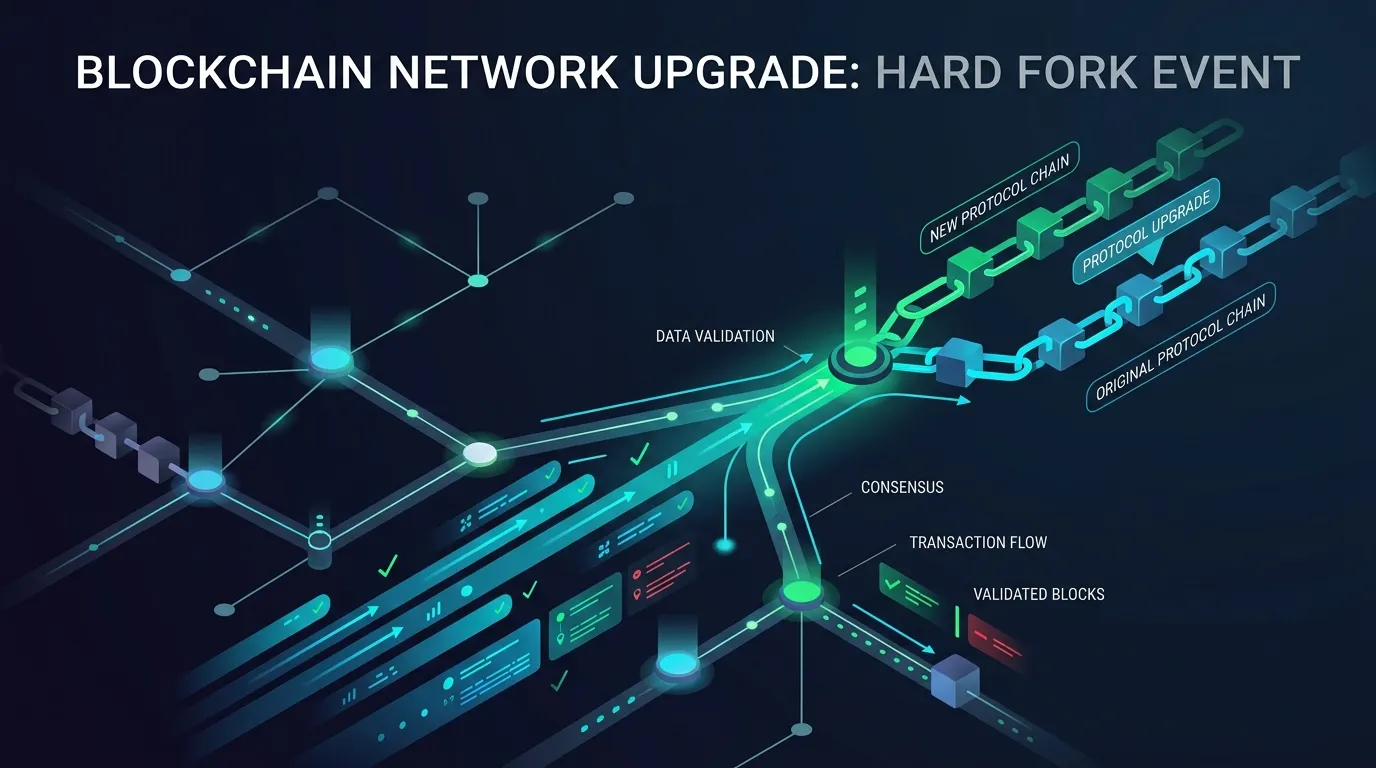
A hard fork is a permanent, backward-incompatible change to a blockchain's protocol rules. When a hard fork activates, nodes that haven't upgraded to the new software can no longer participate on the updated chain - they're operating under different rules. The result is a clean break from the previous version of the network.
Hard forks aren't inherently chaotic events. Think of it like updating the official rulebook for a sport: once the new edition takes effect, you can't play the old way at official games. Planned hard forks, like Vasil, are coordinated upgrades where the entire node ecosystem upgrades together. Contentious hard forks - like the 2017 Bitcoin/Bitcoin Cash split - happen when the community disagrees and two separate chains continue existing in parallel.
Cardano uses what it calls a Hard Fork Combinator - a mechanism that allows the network to transition between protocol eras smoothly, without requiring a full chain restart. The Vasil upgrade follows this same pattern: a deliberate, community-coordinated hard fork for Cardano.
What Is the Vasil Hard Fork? Origins and Naming
The Vasil hard fork is Cardano's second major network upgrade - the follow-up to the Alonzo hard fork that introduced smart contracts to the blockchain in September 2021. Where Alonzo opened the door to programmability, Vasil was about making that programmability fast, affordable, and scalable enough to matter.
The upgrade takes its name from Vasil Dabov, a Bulgarian mathematician and Cardano community figure who passed away before seeing it launch. IOG (Input Output Global), the development organization responsible for Cardano's core protocol, named the upgrade in his honor - a reflection of the deep community culture that characterizes how Cardano is built and governed.
Charles Hoskinson, co-founder of Cardano and CEO of IOG, announced in early June 2022 that the upgrade would go live by the end of that month. It didn't. Testing uncovered issues that required more time to resolve properly - IOG made the deliberate choice to delay rather than ship something unstable. The hard fork ultimately launched on September 22, 2022, coinciding almost exactly with the Ethereum Merge window, which meant it received somewhat less media coverage than it deserved.
VASIL HARD FORK - KEY TIMELINE
June 2022
Charles Hoskinson announces target launch date - end of June 2022
July 2022
First delay - testnet issues identified; IOG prioritizes quality over schedule
August 2022
Second delay - additional testing required before mainnet deployment
September 15, 2022
Ethereum Merge activates - absorbs most crypto media attention
September 22, 2022
Vasil Hard Fork activates on Cardano mainnet - upgrade goes live
Core Objectives of the Vasil Upgrade
Three concrete problems motivated the upgrade - and all three were measurable:
- Reduced transaction fees: Smaller transaction sizes as a result of the CIP improvements would mean lower on-chain fees for end users, especially for dApp interactions
- Improved dApp scalability: Cardano's concurrency model had real limitations for complex dApps - Vasil addressed these through reference inputs and inline datums
- Faster transaction throughput: Diffusion pipelining allowed the network to process blocks more efficiently, increasing overall transaction speed
DeFi protocols, NFT platforms, and governance applications on Cardano were the direct beneficiaries. Developers who had struggled with the UTXO concurrency problem finally had architectural solutions that didn't require workarounds. These goals were achieved through four key protocol-level innovations.
Diffusion Pipelining Explained
Block propagation time is one of the core performance constraints in any blockchain. Before Vasil, a node had to fully validate a block before forwarding it to other nodes - sequential processing that created bottlenecks as network traffic increased.
Diffusion pipelining changes that sequence. Blocks are now sent to other nodes before full validation is complete, with validation and propagation happening in parallel. The consensus layer was also adjusted to accommodate this change. A rough analogy: rather than waiting to fully proofread a document before emailing it, you send a draft and finalize it in transit - the recipient starts reading while you're still refining.
The real-world outcome: faster transaction finality, reduced slot waste, and a network that scales better as more dApps deploy on Cardano. This wasn't a theoretical improvement - it was the infrastructure layer that made the CIP improvements actually usable at scale.

Cardano Improvement Proposals (CIPs) in Vasil
Cardano Improvement Proposals are the formal governance mechanism by which protocol changes are proposed, debated, and implemented - analogous to Bitcoin's BIPs or Ethereum's EIPs. Vasil introduced four CIPs that collectively transformed the smart contract execution environment on the network.
CIP-31 (Reference Inputs) and CIP-32 (Inline Datums)
Before CIP-31, reading the state of a Cardano dApp required actually spending the UTXO that held that state data, then immediately recreating it. This process - called UTXO churning - added unnecessary transaction overhead and fees every time a developer needed to check what was happening on-chain.
CIP-31 solves this by introducing Reference Inputs: the ability to view an output without consuming it. A concrete example: imagine a stablecoin protocol that maintains its current reserve state in a UTXO. Under the old model, any dApp that needed to check that state had to spend and recreate it. With CIP-31, the reserve state UTXO sits untouched while other transactions simply reference it - no spending, no churning, no wasted fees.
✕ OLD MODEL (WITHOUT CIP-31)
[Read state] → spend UTXO → recreate UTXO → pay fees for both operations. Cost: 2 UTXO operations + double transaction overhead every time you need to read on-chain data.
✓ NEW MODEL (WITH CIP-31)
[Read state] → reference UTXO (unspent). Cost: zero UTXO operations for reading. The output stays intact while any number of transactions reference it simultaneously.
CIP-32 (Inline Datums) is the complementary fix. Previously, when developers attached data to a transaction output, they could only include a hash of the datum - the actual datum value had to be supplied separately by the transaction spending it. That created a coordination requirement where both parties needed the datum content available. CIP-32 lets the datum itself be attached directly to the output, making dApp state fully visible on-chain without off-chain lookups. For dApp developers, this eliminates an entire category of architectural complexity.
Together, CIP-31 and CIP-32 mean that building a Cardano dApp no longer requires engineering workarounds just to read your own contract's state.
CIP-33 (Reference Scripts) and CIP-40 (Collateral Outputs)
Every time a Cardano smart contract executed under the pre-Vasil model, the full validation script had to be attached to the spending transaction. For complex dApps, these scripts are large - and attaching them repeatedly inflated transaction sizes and, therefore, fees.
CIP-33 (Reference Scripts) changes that. Scripts can now be attached to outputs on-chain and referenced by transactions that need to validate against them, rather than re-attached in full each time. A DEX that runs hundreds of swaps per day no longer needs to include the full AMM logic script in every single transaction.
CIP-40 (Collateral Outputs) addresses a different problem: how the network handles failed smart contract execution. When a Plutus script transaction fails, collateral - a portion of ADA locked by the sender - is forfeited. Before CIP-40, if a transaction failed, the entire collateral amount went to the network. CIP-40 introduces a new collateral output type that allows excess collateral above the required amount to be returned to the user. This reduced the financial risk of smart contract execution and improved the overall scalability of the network's transaction model.
Together, these four CIPs transformed how smart contracts operate on Cardano.
Impact on Smart Contracts and dApps
The combined effect of the four CIPs plus diffusion pipelining wasn't incremental - it changed the economics of building on Cardano. Smart contract execution became meaningfully cheaper, faster, and architecturally simpler.
Transaction throughput for smart contract execution increased. Security improved - specifically around the collateral mechanism for failed transactions via CIP-40. Support for multi-signature and governance contracts became more practical. Developers gained more robust testing frameworks that reflected the new capabilities. On Cardano's technical forums and developer communities post-September 2022, the volume of new dApp launches accelerated as builders took advantage of the improved infrastructure.
The upgrade also positioned Cardano more competitively against Ethereum and Solana ecosystems, where lower fees and faster execution had long been selling points. Vasil narrowed that gap materially.
The technical improvements brought by the Vasil hard fork have significantly reduced script sizes, allowing for much more complex decentralized applications to thrive on Cardano without hitting network limits. As the ecosystem matures and more developers migrate to the chain, we expect a surge in native projects. To stay ahead of the next wave of innovation, you should regularly monitor the upcoming ICOs, TGEs, and new crypto narratives that are defining the 2026 market landscape.
Ecosystem Impact and Market Reception
The Cardano community's reaction to Vasil was broadly positive - but the launch timing was complicated. The Ethereum Merge activated just one week earlier (September 15, 2022), consuming the vast majority of crypto media attention. Vasil launched somewhat in its shadow, which meant market reaction was more muted than the technical significance warranted.
- New project attraction: Cardano's dApp ecosystem expanded post-Vasil as developers who had been waiting for the CIP improvements began building in earnest
- DeFi TVL growth: On-chain DeFi activity on Cardano increased in the months following the upgrade as lower transaction costs made protocols more economically viable
- NFT market activity: The Cardano NFT market benefited from reduced minting and trading costs - a direct consequence of reference scripts and smaller transaction sizes
- Developer tooling: IOG shipped updated Plutus tooling and documentation alongside the upgrade, reducing onboarding friction for new developers
- Community engagement: The naming of the upgrade after Vasil Dabov resonated strongly - it reinforced Cardano's identity as a project built by and for its contributors
ADA's price performance around the Vasil launch reflected broader market conditions rather than the upgrade itself - September 2022 was deep in a crypto bear market. Technical upgrades rarely move prices in isolation; their impact is felt over the longer arc of ecosystem development. Being honest about one constraint: Cardano's overall DeFi ecosystem remained smaller than Ethereum's in absolute terms post-Vasil. The upgrade improved the platform's competitive standing, but ecosystem scale differences take time and application development to close.
While technical upgrades like Vasil reinforce Cardano's position as a leading Layer-1, they also change how investors value ADA as a utility asset. In a rapidly evolving market, relying on technical milestones alone isn't enough to build a resilient portfolio. To better understand how to balance fundamental network growth with disciplined trading, explore our expert guide on how to navigate the crypto market in 2026 for advanced investment strategies.
What Came After Vasil - Cardano's Ongoing Roadmap
Vasil didn't emerge in isolation. Understanding its significance requires placing it on Cardano's five-era development roadmap.
Vasil was the headline delivery of the Basho era - Cardano's scalability phase. Within Basho, the next major development is Hydra: Cardano's Layer 2 scaling solution. Hydra uses isomorphic state channels to process transactions off the main chain while settling on it, with theoretical throughput in the thousands of transactions per second per head. The CIP-31 reference inputs that Vasil introduced are foundational to how Hydra state channels track and verify off-chain state. Similar Layer 2 approaches have proven transformative on other chains - Polygon's scaling architecture on Ethereum offers a useful reference point for understanding how L2s extend a base layer's capacity.
The Voltaire era follows Basho, introducing on-chain governance through a treasury and voting mechanism that gives ADA holders direct control over protocol parameters and development funding. This represents the final phase of Cardano's decentralization roadmap. Understanding how proof-of-stake consensus works is useful context here - Cardano's Ouroboros PoS protocol underpins both the staking economy and the governance layer being built in Voltaire.
Vasil wasn't the destination - it was infrastructure for what comes next. Every Hydra head that processes off-chain transactions settles back to a mainchain that Vasil made faster and cheaper to interact with.
Cardano’s transition toward the Voltaire era means the community will increasingly drive the protocol's governance and future upgrades. Keeping up with these complex proposals and the overall ecosystem expansion requires access to real-time information and expert discussion. For those looking to get instant updates on Cardano's progress and broader market shifts, joining some of the best crypto Telegram groups is an essential step to staying informed.
Conclusion
The Vasil hard fork delivered what Cardano's DeFi and dApp ecosystem genuinely needed: a smart contract environment architecturally sound enough to build on at scale. The four CIPs - reference inputs, inline datums, reference scripts, and collateral outputs - solved real engineering problems that had been limiting developer adoption. Diffusion pipelining addressed the network throughput constraint. Together, they moved Cardano from a platform with impressive theoretical properties to one with the practical execution characteristics to compete.
For developers building on Cardano, Vasil removed the most painful workarounds from UTXO-based smart contract development. Reference scripts alone meaningfully reduced transaction costs for any dApp running repeated interactions.
For investors following ADA, Vasil represents a technical maturity milestone - the kind of infrastructure delivery that precedes meaningful ecosystem growth, even if market timing didn't reflect it immediately. For deeper context on how blockchain tokens and native assets work within these upgraded ecosystems, that's worth exploring separately.
For blockchain enthusiasts, the Vasil upgrade is a compelling case study in how peer-reviewed, research-first protocol development actually works. The delays were frustrating for some - but IOG's choice to prioritize correctness over schedule resulted in a clean, technically sound upgrade.
Platforms that share Cardano's commitment to on-chain verifiability and transparent mechanics - where all outcomes are auditable and users maintain genuine control - reflect where the broader Web3 ecosystem continues to trend. Zipmex operates on these same principles: fully self-custodial, on-chain verifiable, and built without the opaque custodial structures that have failed users elsewhere in the industry.
As Cardano continues evolving through the Voltaire governance era, Vasil remains a landmark in its journey - the upgrade that made the infrastructure real.
⚠ Risk Disclaimer
- Crypto assets → involve substantial risk of loss; past network performance does not guarantee future outcomes
- This article → is for informational purposes only and does not constitute financial advice
- Leveraged trading and DeFi participation → may not be suitable for all users; assess your own risk tolerance
Last updated: April 2026.
Frequently Asked Questions
What is the Vasil hard fork?
The Vasil hard fork is a major protocol upgrade to the Cardano blockchain that activated on September 22, 2022. It introduced four Cardano Improvement Proposals (CIP-31, CIP-32, CIP-33, and CIP-40) alongside diffusion pipelining - a block propagation improvement that runs validation and distribution in parallel. The combined effect was significantly better smart contract performance: lower transaction fees, improved dApp scalability, and faster transaction throughput. It was the headline delivery of Cardano's Basho era, the scalability phase of the network's five-era development roadmap.
When did the Vasil hard fork go live?
The Vasil hard fork activated on Cardano's mainnet on September 22, 2022. Charles Hoskinson originally announced a target of late June 2022, but IOG delayed the launch twice after testing identified unresolved issues. The decision to prioritize stability over schedule was deliberate - and the final launch coincided almost exactly with the Ethereum Merge window on September 15, meaning Vasil received somewhat less media attention than its technical significance warranted.
Who is Vasil Dabov and why was the upgrade named after him?
Vasil Dabov was a Bulgarian mathematician and prominent member of the Cardano community who passed away before the upgrade launched. IOG named the hard fork in his honor as a tribute to his contributions to the ecosystem. The naming reflects a broader culture within the Cardano community - one that values the people who build and sustain the network, not just the technology. Several earlier Cardano milestones have similarly been named after contributors and historical figures meaningful to the project.
What is diffusion pipelining and how did it improve Cardano?
Diffusion pipelining is a block propagation technique introduced in Vasil that allows Cardano nodes to send blocks to peers before full validation is complete, running propagation and validation in parallel rather than sequentially. Previously, a node had to fully validate a block before forwarding it - creating bottlenecks under load. Pipelining reduces wasted slot time and improves transaction finality speed across the network. The consensus layer was also adjusted to accommodate the parallel processing model, resulting in a network that scales better as dApp deployment increases.
What is UTXO churning and how did Vasil solve it?
UTXO churning refers to the practice - necessary before CIP-31 - of spending a UTXO output just to read the data it contains, then immediately recreating the same output with the same data. Because Cardano's eUTXO model only allowed outputs to be read by spending them, accessing on-chain state created unnecessary transaction overhead: two UTXO operations (spend + create) and associated fees just to check a value. CIP-31's Reference Inputs solved this directly by allowing transactions to reference an output as read-only without spending it - reducing state-reading overhead to zero additional on-chain operations.
How did CIP-33 (Reference Scripts) reduce Cardano transaction fees?
CIP-33 allows Plutus validation scripts to be stored as reference outputs on-chain and referenced by transactions, rather than re-attached in full with every transaction that needs them. Before this, every smart contract interaction required including the full script code in the transaction - adding kilobytes of data and inflating fees proportionally. A DEX running hundreds of swaps per day previously included the full AMM script in every swap. With CIP-33, the script is stored once as a reference output and transactions point to it - fees reflect only the trade data, not the script overhead.
What is Hydra and how is it related to the Vasil hard fork?
Hydra is Cardano's Layer 2 scaling protocol, designed to dramatically increase transaction throughput by processing transactions in off-chain state channels ("heads") that settle back to the Cardano mainchain. The connection to Vasil is architectural: Hydra's state channels rely on reference inputs (CIP-31) to track and verify off-chain state against on-chain anchors. The improved mainchain execution environment that Vasil created - lower fees, faster finality, reference scripts - also makes the settlement layer that Hydra ultimately depends on more efficient, making Vasil a direct prerequisite for Hydra's practical deployment.
ZIPMEX promotes trading on trade.zipmex.com. Promotions are labelled and kept separate from news coverage, which is selected and checked without regard to them. Perpetual futures are leveraged derivatives. Prices can move fast and you can lose all of your margin. Not available in every jurisdiction. Not investment advice.