
On 22 October 2026 the Algorand Foundation named the winners of its Global x402 Challenge. 115 projects had put paid x402 endpoints live on Algorand MainNet, with payments settled in USDC. The other big changes of 2026 came earlier. William Herkelrath became CEO on 31 August, replacing Staci Warden. The v5.0.0 protocol release (13 August) added native post-quantum accounts, and those went live on the network on 20 August. The Foundation moved back to the United States in January. Below is what each change means for ALGO holders, node runners and builders, with dates and sources. Almost every item comes from the Foundation's own announcements, so treat it as the project's own account of itself.
The newest developments (August to October 2026)
22 October: x402 Challenge winners announced
The Foundation's Global x402 Challenge closed on 6 October 2026. On 22 October it reported that 115 projects had a paid x402 endpoint live on MainNet, with payments "settled in USDC on Algorand via x402". Prizes are split two ways:
- Leaderboard: 20 projects share a 500,000 ALGO prize pool.
- Finalists: Ten projects pitch in an online final on 30 October 2026 for a separate $100,000 USDC pool.
The challenge belongs to a wider Foundation push on payments made by software agents. In August the Foundation also introduced the AC2 Protocol, which it calls a security layer for AI agents. In September it published several posts on x402 applications.
31 August: William Herkelrath takes over as CEO
A press release from Algorand Foundation U.S. Inc., dated 9 September 2026, says Herkelrath became CEO on 31 August. He succeeds Staci Warden, who led the Foundation for nearly five years. The release says he co-founded K3 Labs, an AI automation platform, and held leadership roles at Chainlink and Curv. It sets two priorities: getting large financial institutions to adopt Algorand, and protecting against quantum-computing risk. His quoted reason for joining: "I joined Algorand because they are a leader in decentralized post-quantum cryptography."
Other leadership news, in date order:
- 18 March 2026: The Block reported that the Foundation was cutting 25% of its workforce "in response to the uncertain global macro environment."
- 14 October 2026: Crypto Briefing reported that the Foundation's marketing chief had resigned as the new CEO reshaped the leadership team.
13 to 20 August: v5.0.0 and native post-quantum accounts
The Foundation published the Algorand v5.0.0 upgrade guide on 13 August 2026. The release includes:
- Native quantum-resilient accounts. "Falcon-1024 accounts no longer require a LogicSig wrapper." Before v5, a Falcon-signed transaction needed a smart-signature workaround. That is how the November 2025 demonstration worked.
- Resource-based fees. Fees scale with what a transaction uses. The Foundation says routine transfers stay cheap, and the extra fees from heavy transactions go to the fee sink that funds payouts to node runners.
- Developer changes. Smart contracts can hold twice as much code, can opt in to shared box storage and can be upgraded in place. New opcodes support zero-knowledge applications.
The Foundation's August 2026 Algo Insights report says quantum-resilient accounts and transactions went live on 20 August. Between then and 7 September the network recorded 1,800 quantum-resilient accounts and 1.24 million quantum-resilient transactions. On 17 September Pera Wallet said its users had helped Algorand pass 1 million post-quantum transactions. Pera added that much of this volume came from commemorative NFTs, which users earn by sending transactions from a quantum account. Transaction counts are therefore a weak measure of real use.
How to create a quantum account in Pera
Tap your account, tap "+", then choose "Add Quantum Account". You can also rekey an existing account so it becomes quantum-capable while keeping the same address and history.
The post-quantum roadmap (announced 18 June 2026)
The roadmap targets broad quantum resilience by the end of 2027:
| Timing | Milestone |
|---|---|
| 2022 (done) | State Proofs signed with Falcon |
| Q3 2026 | Native post-quantum accounts in Pera and all SDKs (shipped with v5.0.0) |
| Later in 2026 | Post-quantum multisig, Foundation treasury moved to post-quantum accounts, staking from post-quantum accounts |
| End of 2027 | Broad quantum resilience |
| No date given | Post-quantum consensus and VRF, cryptographic agility |
Consensus still uses classical cryptography. A post-quantum account protects that account's signatures, but the network as a whole is not yet quantum-resistant. CTO Bruno Martins: "Post-quantum security cannot be retrofitted after Q-Day."
27 August: Rocca Wallet ships inside other products
Rocca was planned as a self-custody wallet that feels like a Web2 app. On 27 August 2026 the Foundation said Rocca now runs as the infrastructure under other wallets rather than as one standalone app. Pera Wallet 7.0 was rebuilt on it, and the AC2 Wallet uses it too. A Digital Chess ID built on Rocca is due later in 2026.
xGov: how community grants work now
xGov is Algorand's on-chain grants programme. Its platform launched on mainnet in October 2025. By 12 December 2025, nine proposals had been submitted and six had been approved and funded by xGovs. The Foundation said it would propose bringing general governance into xGov in 2026.
The forum minutes of a 5 August 2026 meeting between the xGov Council and the Foundation record twelve decisions, from a council scorecard for proposals to council pay and the election timetable. Three of them change how the programme is funded and run:
- Treasury funding. The Foundation will commit about 110 to 120 million ALGO to nodes and send their staking rewards directly to the xGov treasury. Transfers will be manual at first, about every two weeks, and automated later.
- One-off top-up. A top-up will cover proposals that are already approved or in progress. The amount was still to be confirmed.
- Administration. In principle, the programme will be run through the Ecosystem Advisory Council (EAC) instead of the Foundation. Money and legal matters stay with the Foundation for now.
These are meeting minutes, not a formal Foundation announcement; the Foundation said it would announce the changes publicly after talks with the EAC. To take part, use the portal at xgov.algorand.co.
Staking rules for ALGO holders
Governance rewards ended in 2025. The Foundation's 31 March 2025 recap gives the totals: 687,500,000 ALGO distributed, of which 526,782,728 ALGO were direct governance rewards. Governors committed 33.9 billion ALGO and voted on 80 measures. Staking rewards for consensus participation replaced the programme, and governance became a non-incentivised referendum process.
According to the Foundation's staking FAQ:
- Minimum stake: 30,000 ALGO to be eligible for staking rewards.
- Cap: The protocol does not reward accounts holding more than 70,000,000 ALGO.
- Lock-up: None. ALGO stays in your wallet while it participates.
- Hardware: At least 8 vCPU, 16 GB RAM and a 100 GB NVMe SSD (or equivalent). Bandwidth of at least 100 Mbps, ideally 1 Gbps.
- Bonus: The Foundation adds a bonus that starts at 10 ALGO per block and decays by 1% every millionth block. It is committed for about 24 months.
The August 2026 Algo Insights report gives these network figures:
- Total staked: more than 2.02 billion ALGO, of which the community holds 80.6% and Algorand 19.4%.
- Validator rewards: 6.74 million ALGO paid in August, and 53.63 million ALGO for 2026 so far.
- Circulating supply: 9.04 billion ALGO, or 90.4% of the maximum.
Holders below 30,000 ALGO cannot earn protocol staking rewards directly.
Can your ALGO earn protocol staking rewards?
Answer three questions about your account and setup to see where the Foundation's staking rules put you.
How much ALGO does the account hold?
- Less than 30,000 ALGO → Below the staking minimum
- 30,000 to 70,000,000 ALGO → next question
- More than 70,000,000 ALGO → Above the reward cap
Is the ALGO held in a post-quantum (quantum) account?
- Yes, a post-quantum account → Not yet: staking from post-quantum accounts is still on the roadmap
- No, a standard account → next question
Can you run a node with at least 8 vCPU, 16 GB RAM, a 100 GB NVMe SSD (or equivalent) and at least 100 Mbps bandwidth?
The staking FAQ sets 30,000 ALGO as the minimum to be eligible for staking rewards, so this account cannot earn protocol staking rewards directly. Third-party pooled and liquid staking services exist, but the article does not verify their terms.
The protocol does not reward accounts holding more than 70,000,000 ALGO, so this account would not earn staking rewards as it stands.
Post-quantum accounts went live on 20 August 2026, but the Foundation's roadmap lists staking from post-quantum accounts as a step for later in 2026. Watch for that release before expecting rewards from this account.
Your balance is inside the 30,000 to 70,000,000 ALGO range, but staking rewards are paid for consensus participation, and the staking FAQ lists at least 8 vCPU, 16 GB RAM, a 100 GB NVMe SSD and 100 Mbps bandwidth (ideally 1 Gbps) for that.
On the staking FAQ's terms, this account meets the balance range and the node requirement. There is no lock-up: ALGO stays in your wallet while it participates. The Foundation also adds a bonus that starts at 10 ALGO per block and decays by 1% every millionth block, committed for about 24 months.
This checks only the Foundation's published eligibility rules: it does not estimate how much you would earn, cover third-party staking services or tax, or say whether staking suits you.
Earlier in 2026: the return to the United States
On 14 January 2026 the Foundation announced its return to the US, with headquarters in Dover, Delaware, and a new board:
- Bill Barhydt (Chair): founder and CEO of a crypto finance company
- Alex Holmes: former MoneyGram CEO and Executive Vice Chairman of United Texas Bank Dallas
- Michael Mosier: former Acting Director at the US Treasury's FinCEN and co-founder of Arktouros PLLC
- Rebecca Rettig: Chief Legal Officer of Jito Labs
- Staci Warden: then CEO. She stepped down in August.
Paweł (Urtho) Pierścionek, founder of Nodely, was named chair of the Ecosystem Advisory Council and technical advisor to the board.
Real-world use: HesabPay
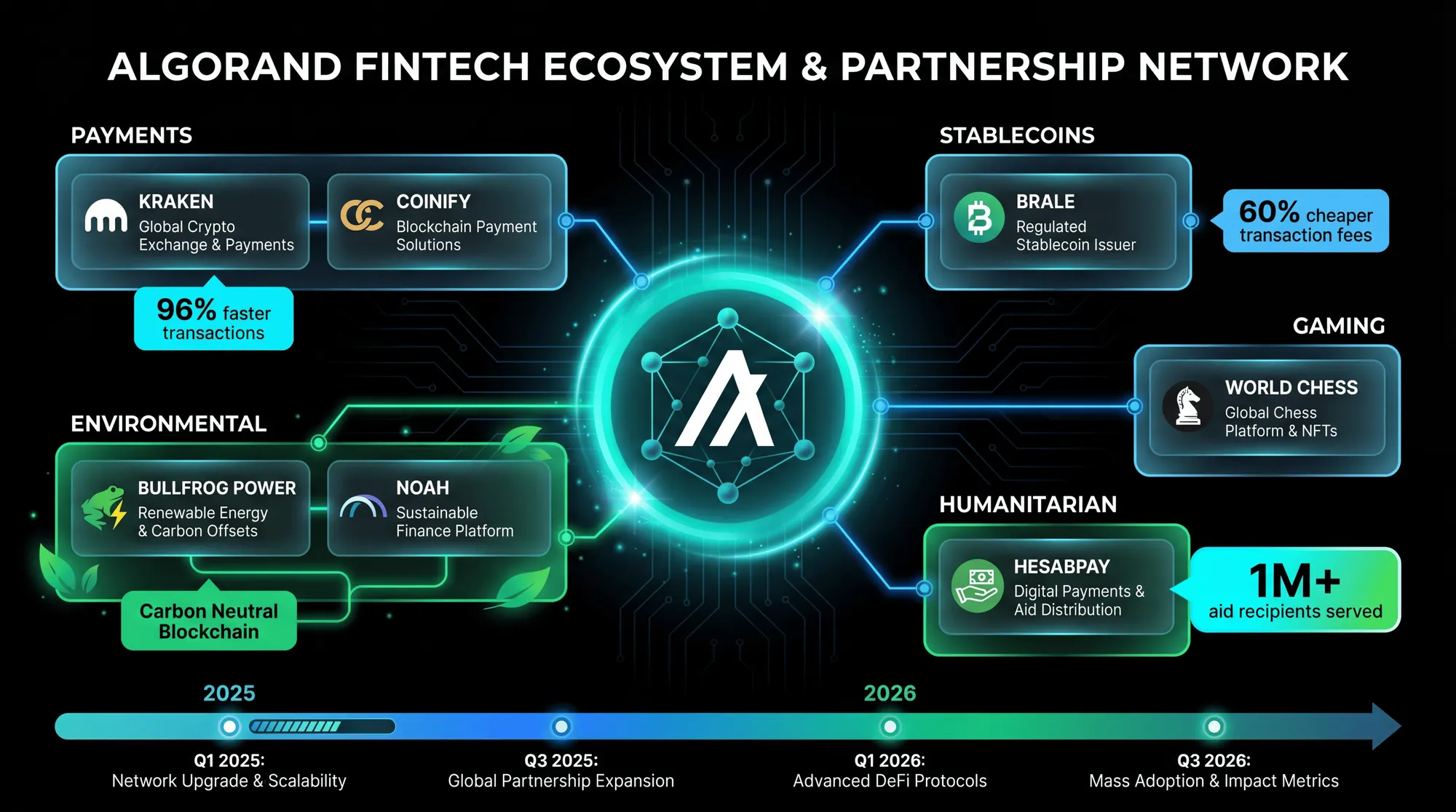
The Foundation said on 30 December 2025 that more than a million people received aid through HesabPay, a payment platform built on Algorand, during 2025. Cash support came from the UN World Food Programme, UNHCR and the World Bank. Use was concentrated in Afghanistan, with pilots in Syria.
What to watch next
- 30 October 2026: the x402 Challenge final.
- Later in 2026: post-quantum multisig, staking from post-quantum accounts and the migration of the Foundation treasury, as promised in the roadmap.
- xGov: whether the treasury-funding model and the move to EAC administration are formally announced.
- New CEO: whether Herkelrath's review of programmes and partnerships produces visible changes.
The CEO's background comes from a paid press release, and the staking, supply and post-quantum figures are the Foundation's own counts.
