
The IRS has issued no tax rules written specifically for DeFi. Its general digital-asset rules still apply to most of what people do on-chain. Swapping one token for another is a taxable disposal. Staking rewards are income once you control them. Moving tokens between your own wallets is not a taxable transaction, unless you pay the fee in crypto. Liquidity pool deposits, DeFi loans, liquidations, wrapped tokens and bridges have no direct IRS answer. For those cases, the guidance available comes from tax software firms and advisers, not from the IRS. The newest change affects record-keeping more than tax rates. Custodial brokers start reporting cost basis on Form 1099-DA for 2026 transactions, and Notice 2026-20 (March 18, 2026) lets taxpayers keep using their own records to identify which units they sold through Dec. 31, 2026.

What changed in 2026
- Basis reporting starts. Brokers must report gross proceeds on Form 1099-DA for transactions on or after Jan. 1, 2025. Basis reporting applies to certain transactions from Jan. 1, 2026 (IRS digital assets page, last updated Sept. 2, 2026).
- Lot identification relief extended. Notice 2026-20, released March 18, 2026, extends Notice 2025-7. Through Dec. 31, 2026, taxpayers can keep identifying the units they sell through a broker from their own books and records, for example with a standing order. They do not have to send instructions to the broker. The relief does not change what the broker reports on Form 1099-DA, so a broker's 2026 basis figures can differ from your own (EY summary of the notice).
- Electronic 1099-DA statements proposed. Proposed regulations REG-105064-25, issued March 5, 2026, would let custodial brokers send Form 1099-DA statements in electronic form only, starting with statements furnished on or after Jan. 1, 2027. Comments closed May 5, 2026 (IRS newsroom, Journal of Accountancy).
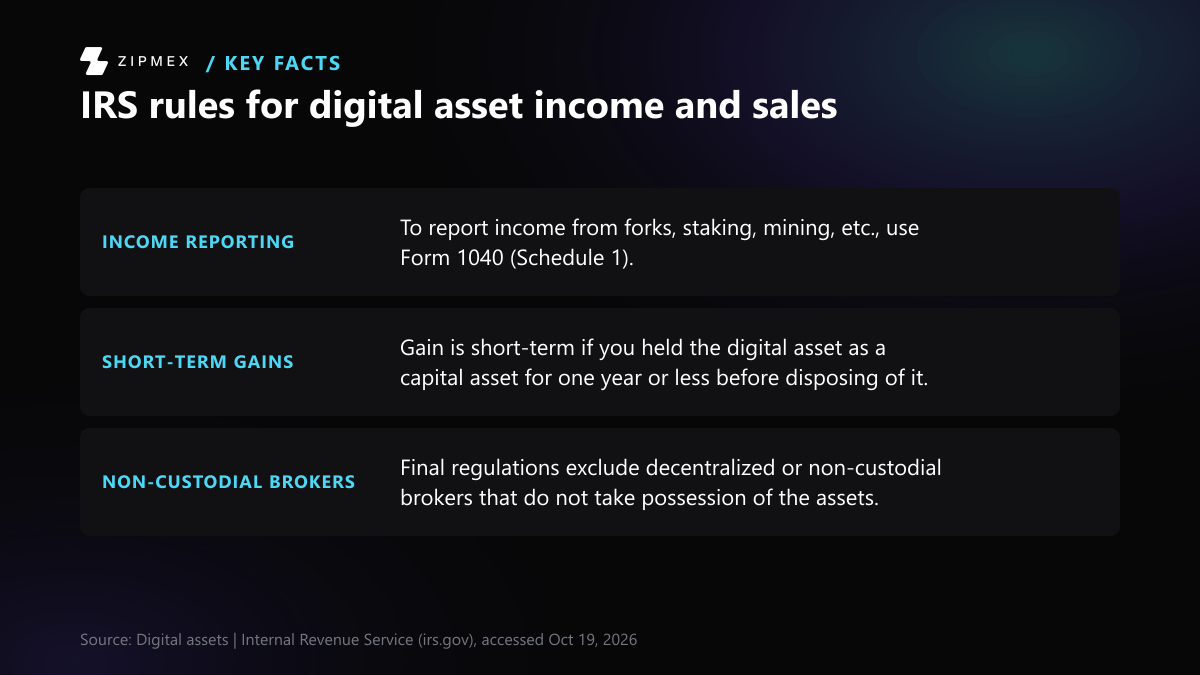
- No DeFi broker reporting. Congress repealed the IRS rules that would have required DeFi platforms to report as brokers. President Trump signed the repeal on April 10, 2025 (Public Law 119-5). The IRS final regulations "do not include reporting requirements for brokers commonly known as decentralized or non-custodial brokers." In practice, you get no 1099-DA for activity on non-custodial protocols, and keeping that record falls to you.
What the IRS rules clearly cover
Digital assets are property
"For U.S. tax purposes, digital assets are considered property, not currency," the IRS says. Every disposal is measured against your basis, which is generally the cost in U.S. dollars.
Swaps and sales
The IRS lists exchanging one digital asset for another as a transaction that requires a "Yes" on the Form 1040 digital-asset question. A token-for-token swap on a DEX counts as a disposal of the token you give up. Sales and exchanges of capital assets go on Form 8949. A gain is short-term if you held the asset for one year or less, and long-term if you held it for more than one year.
Staking rewards
Under Rev. Rul. 2023-14, a cash-method taxpayer includes the fair market value of staking rewards in gross income. The income counts in the year the taxpayer gains "dominion and control" over the rewards, valued at that date and time. The same applies to staking through an exchange. The IRS says to report staking, mining and fork income on Form 1040 (Schedule 1). The ruling covers proof-of-stake validation rewards. It does not address liquid staking tokens or protocol "yield" that comes from lending or fees.
Airdrops
The IRS addresses airdrops only when they follow a hard fork (Rev. Rul. 2019-24, IRS virtual currency FAQs 22–25). You have ordinary income equal to the fair market value when you receive the new coins and have dominion and control over them. That amount becomes your basis. A hard fork that gives you no new coins creates no income, and neither does a soft fork. For ordinary promotional or governance airdrops, CoinLedger reads the rule the same way: ordinary income at fair market value on receipt. That reading is not a direct IRS ruling.
Moving tokens between your own wallets
A transfer between wallets or accounts you own or control is not a digital-asset transaction. The exception is a transaction fee paid in digital assets, which makes it one.
Which units you sold
Your basis depends on which units you are treated as selling. The IRS FAQs allow specific identification if you can substantiate it, and FIFO applies by default. The IRS notes that these FAQs generally cover transactions before Jan. 1, 2025. From 2025, Rev. Proc. 2024-28 gives transitional rules for allocating basis to the units held in each wallet or account as of Jan. 1, 2025.
Which tax bucket does one move fall into?
Answer up to four yes-or-no questions about one move you made.
Did you sell, exchange or swap a digital asset you held for personal or investment use?
- Yes → Capital gain or loss
- No → next question
Did you receive tokens from staking, mining or an airdrop?
- Yes → Income
- No → next question
Did you deposit into a liquidity pool, take a loan, or have collateral sold in a liquidation?
- Yes → Unsettled
- No → next question
Did you pay a fee in digital assets to move tokens between your own wallets?
Source: Digital assets | Internal Revenue Service (irs.gov), accessed Oct 19, 2026
For a token held for personal or investment use, report the sale or swap on Form 8949 as a capital gain or loss. The gain is short-term if you held the token one year or less.
Source: Digital assets | Internal Revenue Service (irs.gov), accessed Oct 19, 2026Staking and mining income goes on Form 1040 (Schedule 1). CoinLedger says an airdrop is ordinary income at fair market value on receipt. For DeFi staking and interest, it says the result may be income or a capital gain, depending on the protocol.
Source: Digital assets | Internal Revenue Service (irs.gov), accessed Oct 19, 2026 · DeFi Taxes 101: Swaps, Loans, Liquidity, & Staking (2026) | CoinLedger (coinledger.io), accessed Oct 19, 2026CoinLedger says the IRS has not released clear guidance on these DeFi cases. It reads a pool deposit as possibly a trade of one crypto for another, a loan as generally not taxable, and a forced liquidation as a disposal.
Source: DeFi Taxes 101: Swaps, Loans, Liquidity, & Staking (2026) | CoinLedger (coinledger.io), accessed Oct 19, 2026A transfer between wallets you own is not a digital asset transaction when no fee is paid in digital assets.
Source: Digital assets | Internal Revenue Service (irs.gov), accessed Oct 19, 2026A transfer fee paid in digital assets makes the move a digital asset transaction.
Source: Digital assets | Internal Revenue Service (irs.gov), accessed Oct 19, 2026The outcomes follow the IRS's stated rules and CoinLedger's attributed readings, and are general information, not tax advice.
For U.S. tax purposes, digital assets are considered property, not currency.
Quick sort: which bucket a move falls into
| What you did | Treatment | Basis for the answer |
|---|---|---|
| Sold or swapped a token held as an investment | Capital gain or loss, Form 8949 | IRS |
| Received staking rewards | Ordinary income at fair market value when you gain control | Rev. Rul. 2023-14 |
| Received coins from a hard-fork airdrop | Ordinary income at fair market value when received | Rev. Rul. 2019-24 |
| Received a non-fork airdrop | Ordinary income at receipt, per CoinLedger | Industry reading |
| Moved tokens between your own wallets, fee paid in crypto | The fee payment is a digital-asset transaction | IRS |
| Deposited into a liquidity pool for LP tokens | Unsettled | No IRS guidance |
| Borrowed against crypto, or had collateral liquidated | Unsettled | No IRS guidance |
Where the IRS has not ruled
CoinLedger's DeFi guide (last updated Jan. 2, 2026) says "the IRS has not released clear guidance on specific DeFi transactions." A search for this rewrite found no DeFi-specific IRS notice or ruling issued in 2026. The readings below come from one tax software company, not from the IRS.
Liquidity pools
CoinLedger says a deposit in exchange for LP tokens "may be considered a crypto-to-crypto trade subject to capital gains tax." If so, each deposit and withdrawal could be a taxable disposal. A more conservative approach is to keep records that support either treatment.
Loans and liquidations
CoinLedger says that, generally, taking out a loan is not a taxable event. It notes that "some DeFi loan providers require executing a swap in order to take out the loan." That swap may itself be a disposal. It treats a forced liquidation of collateral as "a disposal subject to capital gains tax." You can owe tax on a liquidation even though the sale proceeds went to repay the loan and never reached you.
DeFi yield, wrapped tokens and bridges
CoinLedger says DeFi staking and interest rewards "may be taxed as income or capital gains," depending on how the protocol pays them. A reward paid as new tokens is different from a token that rises in value. It calls wrapping "a gray area in the tax code" and says bridging is "likely" not a taxable event. None of these points has an IRS ruling behind it.
Practical steps before you file
- Export your on-chain history yourself. Non-custodial protocols send no 1099-DA, so the wallet history is your only record.
- Record the fair market value at receipt for every staking reward and airdrop. That figure is both your income and your basis.
- Reconcile any 1099-DA against your own records. For 2026, a broker's basis figures can differ from the units you identified under Notice 2026-20.
- Note gas fees paid in crypto. Even a move between your own wallets creates a reportable transaction when the fee is paid in a digital asset.
- Write down your position on each unsettled case, such as LP deposits, loan-linked swaps and liquidations, and talk to a tax professional before you take it.
Limitations: this covers U.S. federal rules only. The DeFi-specific readings rely on a single industry source, and this is general information, not tax advice.
