
FOMO, short for "fear of missing out", is the worry that other people are getting something good while you are not. In crypto it usually means buying, or adding to a position, because a price is rising fast and others seem to be profiting. You buy because you're afraid of being left behind, not because you've checked anything. Regulators and researchers treat it as a real risk. A UK Financial Conduct Authority (FCA) survey published on 18 December 2024 found that 51% of investors aged 18 to 40 had put in more money than they first planned because of FOMO. In US regulators' warnings, the same urgency is the main tool of pump-and-dump schemes.
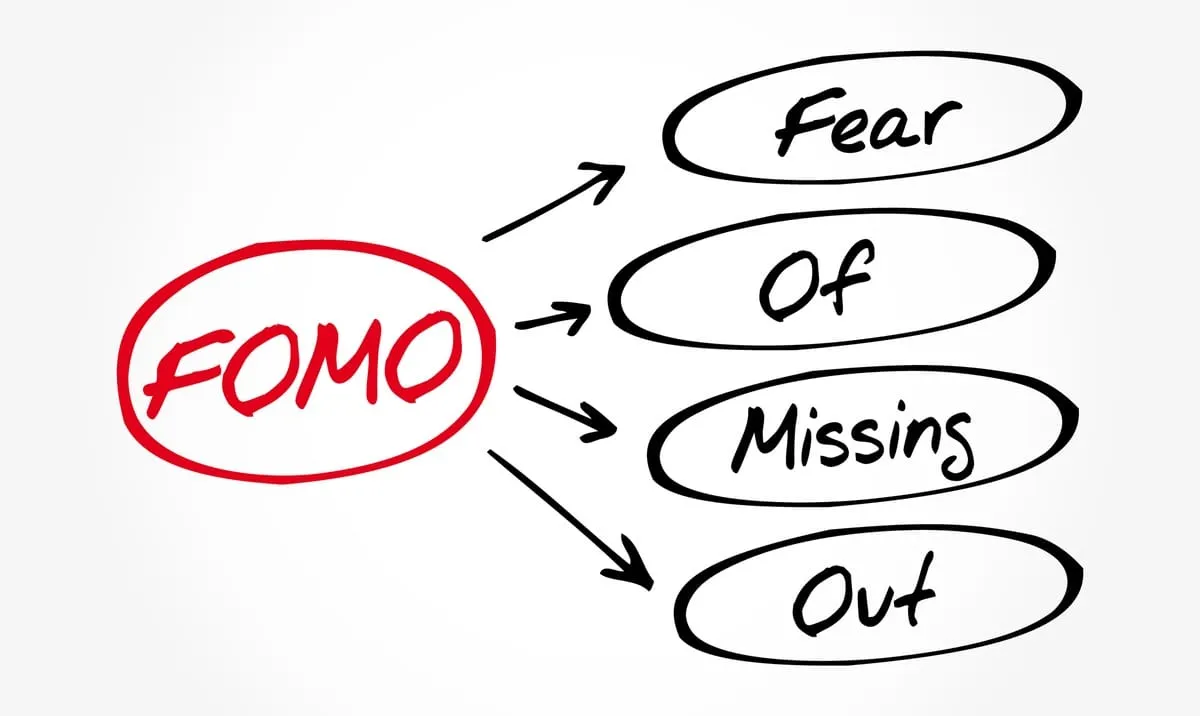
Where the term comes from
Patrick McGinnis used the acronym in "Social Theory at HBS: McGinnis' Two FOs", a column in The Harbus, the Harvard Business School student newspaper, on 1 May 2004. The column set FOMO beside FOBO, "fear of a better option". In McGinnis's telling, FOMO pushed his classmates to attend as many events as they could, and FOBO made them reluctant to commit to any one plan in case something better came along. The phrase "fear of missing out" is older than the acronym. Some writers credit the marketing strategist Dan Herman with using it around 2000.
The definition most often cited in research comes from Przybylski, Murayama, DeHaan and Gladwell, writing in Computers in Human Behavior in 2013. They describe FOMO as "a pervasive apprehension that others might be having rewarding experiences from which one is absent", tied to a wish to stay constantly connected to what others are doing. The same paper introduced a scale for measuring how strongly a person feels it.
What FOMO looks like in a market
Applied to trading, the "rewarding experience" is someone else's gain. A coin is up sharply, your feed is full of screenshots of profits, and staying out starts to feel like a loss in itself. The decision then rests on a feeling about other people's gains, not on what the asset is, who is behind it, or how much you can afford to lose.
What the evidence shows
- Decisions get faster and bigger. The FCA's survey (2,000 UK adults aged 18 to 40, run by Censuswide in August 2024, published 18 December 2024) found:
- 66% spend less than 24 hours deciding on an investment. - 14% decide in under an hour. - Only 11% take more than a week. - 51% invested more than they meant to because of FOMO.
- Social media sets the pace. In the same survey, 85% said platforms such as Instagram, TikTok and YouTube strongly influence their investment decisions, and 43% use them as their main research tool.
- The motive is often not financial. In earlier FCA research (517 self-directed investors surveyed between 18 August 2020 and 20 January 2021, published 23 March 2021), many investors said the thrill and the status of investing drove them. 38% did not name a single functional reason, such as saving for retirement, among their top three reasons. 78% agreed with the statement "I trust my instincts to tell me when it's time to buy and to sell".
- FOMO keeps people buying after losses. In "CRYPTO-MANIA: How fear-of-missing-out drives consumers' (risky) investment decisions" (Friederich, Meyer, Matute and Palau-Saumell, Psychology & Marketing, 2024, five studies with eight experiments), FOMO appeals from outside, such as marketing, changed people's crypto investment decisions. The effect worked through emotion and was stronger in more impulsive people. People exposed to FOMO appeals kept investing even after they had already lost money. Fear messages, which stress the risk of loss, reduced the effect.
Is FOMO driving this trade?
Answer a few questions about the decision in front of you to see which warning signs from the CFTC advisory and the FCA findings it shows.
Is the main reason to buy that the price is rising fast and other people seem to be making money?
- Yes → A classic FOMO sign
- No, my own view of the asset has changed → next question
Did the idea come from a single social media post, a group chat or an influencer?
- Yes → Acting on a single tip
- No → next question
Does the pitch include a countdown, a buy-now deadline or a claim that there is no risk of loss?
- Yes → Pump-and-dump warning signs
- No → next question
Is the coin new or thinly traded, and you cannot say who is behind it?
- Yes → Unknown, thinly traded coin
- No → next question
Are you about to put in more than the amount you decided on beforehand, or act within minutes or hours because the price is moving?
The decision rests on a feeling about other people's gains, not on what the asset is or how much you can afford to lose. The article suggests slowing the decision down and asking questions before you commit.
The CFTC says not to buy based on one tip, especially from social media, and to research the coin and the people behind it first.
Countdowns and buy-now messages are how the CFTC describes pump-and-dump schemes, and it tells customers to be sceptical of anyone who says an investment cannot lose money.
Organisers of pump-and-dumps often pick new or thinly traded coins. The CFTC advises researching the coin and the people or companies behind it before putting money in.
The FCA research shows how often people go past their planned amount once FOMO sets in. Setting the amount, and the loss you can accept, ahead of time takes that decision out of the moment.
None of the listed warning signs showed up in your answers. That does not make the trade safe or sound; it only means this checklist did not flag it.
This checklist only mirrors the warning signs listed in the article; it cannot judge whether an asset, price or trade is sound, and it is not advice to buy, sell or hold anything.
How schemes use FOMO
Created urgency is the mechanism of a pump-and-dump. In its advisory "Beware Virtual Currency Pump-and-Dump Schemes" (15 February 2018), the US Commodity Futures Trading Commission (CFTC) describes the pattern:
- Organisers in chat groups or on social media name a new or thinly traded coin.
- They run a countdown to the "pump" and post messages telling readers to buy now.
- Some add fake news stories, such as false partnerships with well-known companies or people.
- The price spike is usually short, and in the CFTC's words, "it is the people pulling the strings who get out first making the most in the scheme."
Later buyers, often the ones who felt the fear of missing out most, are left holding the coin when it falls.
The US Securities and Exchange Commission (SEC) makes the same link in its investor alert "Social Media and Investment Fraud": fraudsters may exploit investors' fear of missing out to draw them into crypto scams, and promises of high returns with little or no risk are classic warning signs of fraud.
Warning signs that FOMO is driving a decision
These warning signs are drawn from the CFTC advisory and the FCA's findings:
- You plan to act within minutes or hours because a price is moving, not because your view has changed.
- The main reason to buy is that other people are making money.
- The tip came from one social media post, a group chat or an influencer.
- The pitch includes a countdown, a "buy now" deadline, or a claim that there is no risk of loss.
- The coin is new or thinly traded, and you can't say who is behind it.
- You are about to put in more than you decided beforehand.
Slowing the decision down
Regulators' advice focuses on process, not on predicting prices:
- Do not act on a single tip. The CFTC says not to buy based on one tip, especially from social media. Research the coin and the people or companies behind it before you put money in.
- Treat "no risk" as a red flag. The CFTC tells customers to be sceptical of anyone who says an investment cannot lose money.
- Ask questions before you commit. The FCA's InvestSmart site offers "5 important questions to ask yourself before you invest". It is meant as a pause between seeing an opportunity and committing to it.
- Decide your limits before the market moves. The FCA's research shows how often people go past their own planned amount once FOMO sets in. Setting the amount, and the loss you can accept, ahead of time takes that decision out of the moment.
The survey figures above come from UK investors aged 18 to 40, so they describe that group rather than all traders. This article explains a behavioural term and is not advice to buy, sell or hold any asset.
