
Total supply is the number of coins or tokens that exist right now, minus any that have been verifiably burned. Locked tokens count toward it, and so do pre-mined coins kept out of circulation. That makes total supply larger than or equal to circulating supply, which counts only what can be used or traded. It is also no greater than max supply, the most coins that can ever exist. Total supply is not a ceiling. It describes only what exists today. CoinMarketCap and CoinGecko both define it this way.
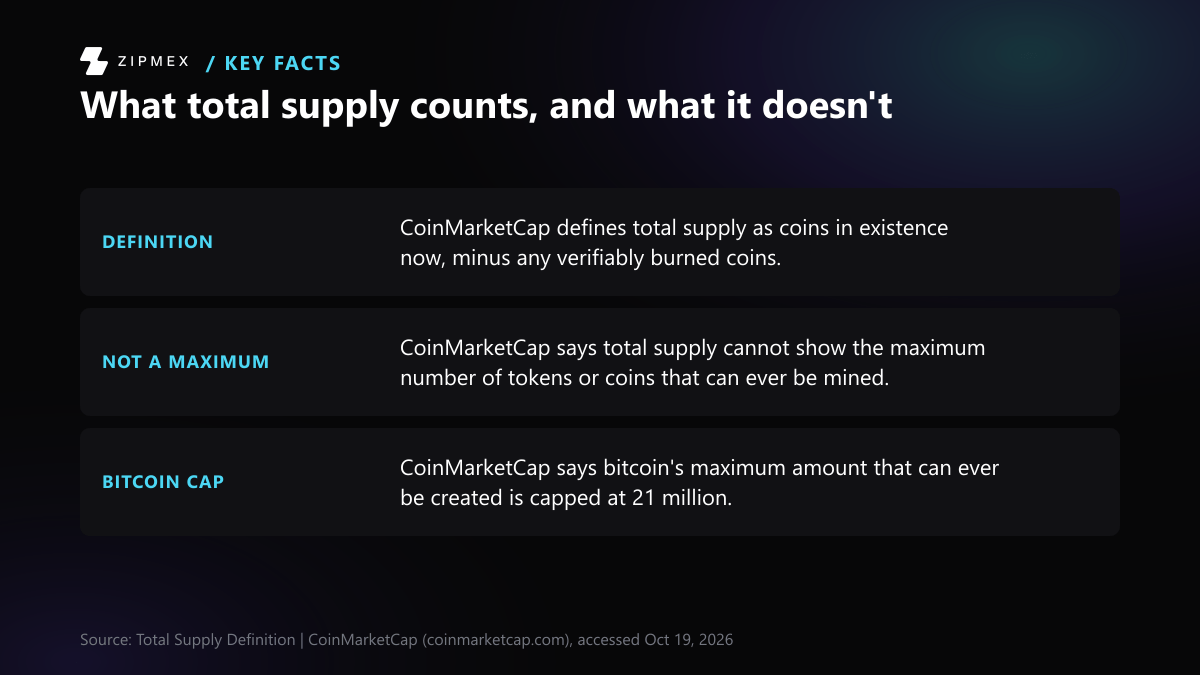

The definition, from the two largest data aggregators
CoinMarketCap's glossary defines total supply as "the total amount of coins in existence right now, minus any coins that have been verifiably burned." The glossary says the figure includes coins "locked as a result of either pre-mined coins intentionally kept out of circulation" and "tokens that are locked in smart contracts," such as tokens held until a stage of a token sale is reached.
CoinGecko's supply methodology says nearly the same thing: "the total amount of coins that have been minted, minus any coins that have been permanently removed from circulation (burned)."
So total supply rests on two rules:
- Burned coins are removed. A coin sent to an address that nobody can spend from, or destroyed by the protocol, no longer counts.
- Locked coins are kept. A token in a vesting contract, a treasury or a team wallet still exists, so it counts toward total supply even though nobody can sell it yet.
Total vs circulating vs max supply
| Figure | What it counts | Burned tokens | Locked or unallocated tokens |
|---|---|---|---|
| Circulating supply | Tokens available and trading in the public market | Excluded | Excluded |
| Total supply | Tokens minted or mined so far | Excluded | Included |
| Max supply | The most tokens coded to exist over the asset's lifetime | Counted (a cap does not shrink when coins burn) | Included |
Circulating supply
CoinGecko describes circulating supply as an estimate of "the number of tokens actively available and trading in the public market." Its formula is: Circulating Supply = Total Supply − Uncirculated Wallets. Uncirculated wallets include locked, vested and escrowed tokens, treasury and ecosystem holdings, and team and private-sale allocations. CoinGecko excludes team and foundation holdings even after they unlock.
CoinMarketCap calls circulating supply "the best approximation" of the coins circulating in the market. Both words matter: circulating supply is an estimate. Each data provider decides which wallets to exclude, so the same token can show different circulating figures on different sites.
Max supply
CoinGecko defines max supply as "the maximum number of coins that are coded to exist during the lifetime of the cryptocurrency." Bitcoin is the standard example. Bitcoin.org states that "only 21 million bitcoins will ever be created." Some assets have no max supply at all. CoinGecko's methodology lists Ethereum as having an infinite supply.
CoinMarketCap says total supply "cannot be used to determine the maximum number of tokens or coins that can ever be mined." Two figures answer two questions: total supply tells you how many coins exist now, and max supply tells you how many can ever exist.
Why the gap between the figures matters
Market cap uses circulating supply
CoinMarketCap gives the formula as Market Cap = Price × Circulating Supply. Its reasoning is that coins which are locked, reserved or not able to be sold on the public market "can't affect the price." The Alpharithms explainer by Zack West (Oct. 20, 2021) says the same thing: circulating supply is "generally used to calculate market capitalization."
Fully diluted valuation uses total supply, and its sources disagree
CoinGecko's support article on its Outstanding Token Value (OTV) metric defines fully diluted valuation (FDV) as "Total Supply multiplied by Current Market Price." Other CoinGecko learn and glossary pages describe FDV against max supply where one exists. Check which supply figure a page uses before you compare FDVs.
CoinGecko's OTV counts only tokens "confirmed to be circulating or imminently entering the market." It leaves out tokens "permanently locked, burned, or reserved without plans for circulation," such as treasury or foundation wallets with no distribution plan.
A worked example (illustrative numbers, not a real token)
A token has a max supply of 1,000 million and has minted 600 million. Of those, 10 million are burned and 340 million sit in team vesting and treasury wallets.
- Total supply = 600 − 10 = 590 million
- Circulating supply = 590 − 340 = 250 million
- At a price of $1, market cap is $250 million. FDV on total supply is $590 million. FDV on max supply would be $1 billion.
The 340 million locked tokens already exist, but nobody can trade them yet. The difference between total and circulating supply shows how much supply could still reach the market. It does not show when. Release dates come from the project's vesting schedule, not from the supply figure.
From minted coins to circulating supply
Enter how many tokens have been minted, how many are verifiably burned and how many sit in locked wallets to see total and circulating supply.
| Tokens minted or mined so far | Tokens verifiably burned | Tokens in vesting, treasury, team and other uncirculated wallets | Circulating supply |
|---|---|---|---|
| 600 million tokens | 10 million tokens | 340 million tokens | 250 million tokens |
| 600 million tokens | 10 million tokens | 340 million tokens | 250 million tokens |
| 600 million tokens | 10 million tokens | 0 million tokens | 590 million tokens |
- All three values are your own inputs; the defaults repeat the article's illustrative example (600 million minted, 10 million burned, 340 million locked), not a real token.
- Minted minus burned is total supply; locked tokens still count in total supply but are removed from circulating supply.
- Locked tokens cannot exceed what has been minted and not burned; a negative result means the inputs are inconsistent.
This is arithmetic on your inputs only: it cannot tell you when locked tokens will unlock, which wallets a given data provider excludes, or whether a max supply exists.
How burning changes total supply
Burning is the only routine way total supply goes down. On Ethereum, EIP-1559 (created April 13, 2019, status Final) states that "the base fee is always burned (i.e. it is destroyed by the protocol)." The proposal also notes: "By burning the base fee, we can no longer guarantee a fixed Ether supply." Ether's total supply can therefore rise or fall depending on how much is issued and how much is burned. The fee side of this is covered in how gas fees and the base fee work.
Lost coins are different. Bitcoin.org says lost bitcoins "remain dormant forever because there is no way for anybody to find the private key(s)." Lost coins are not verifiably burned, so they stay in total supply.
Where the number comes from on-chain
On Ethereum-style tokens, the ERC-20 standard (EIP-20, created Nov. 19, 2015) defines function totalSupply() public view returns (uint256), described as "Returns the total token supply." You can read this value from the token contract on a block explorer. Whether it matches an aggregator's total supply depends on how the contract handles burns. A token "burned" by sending it to a dead address still counts in totalSupply(), while a contract-level burn lowers it.
A checklist for any supply figure
- Burns: Does the figure exclude burned coins, and are the burns verifiable on-chain?
- Locked tokens: Are vesting, treasury and team wallets counted (total supply) or removed (circulating supply)?
- Ceiling: Is there a coded max supply, or is supply open-ended?
- Valuation basis: Does the FDV shown use total supply or max supply?
- Date: Supply changes with every mint, burn and unlock, so a figure is only true for the day it was read.
Vesting and staking lock tokens in similar ways; where staking rewards come from traces what that lock-up does to the coins you hold.
