
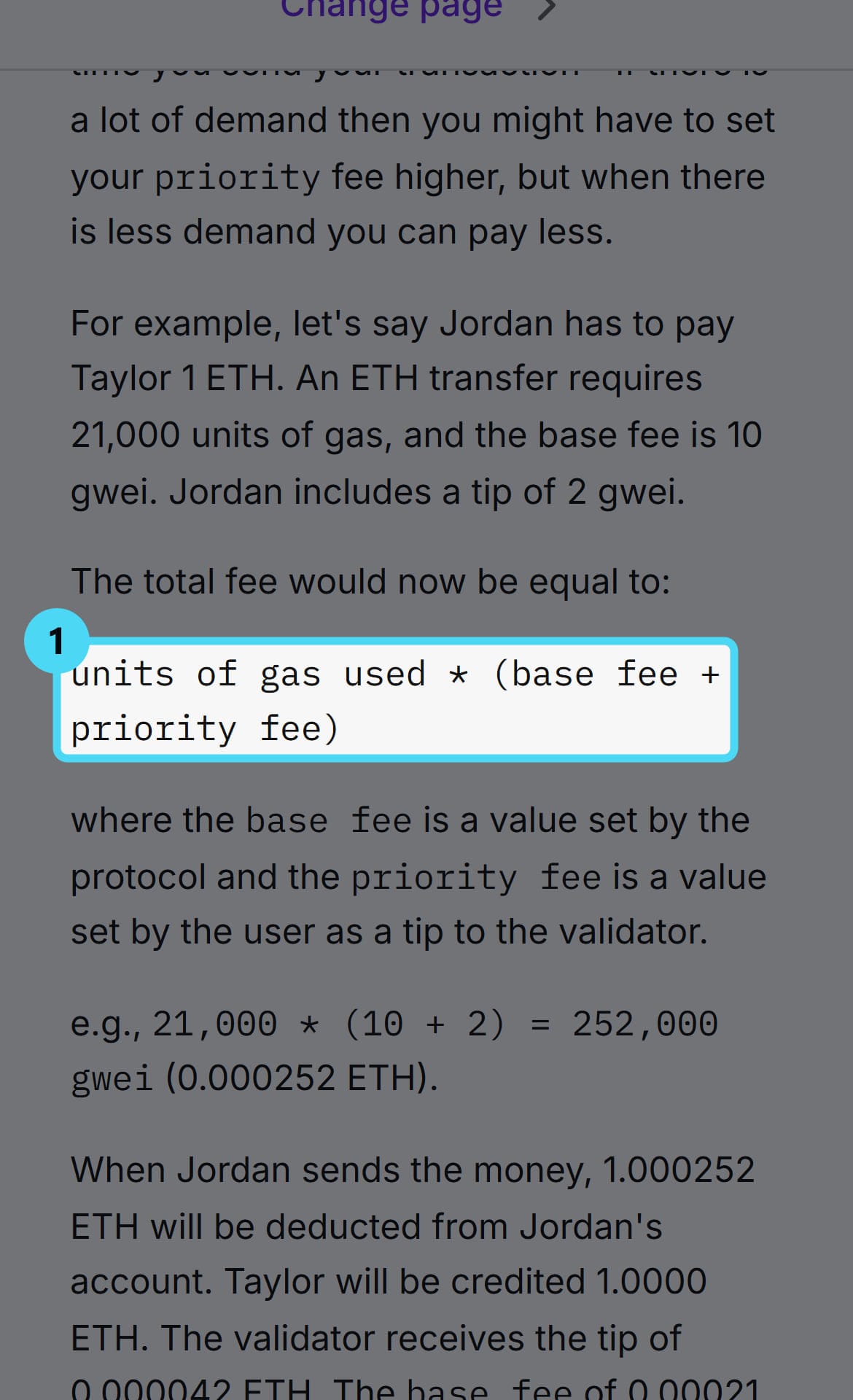
Gas is the unit Ethereum uses to measure the computation a transaction needs. You pay for it in ether (ETH). The fee is the gas used multiplied by the base fee plus a priority fee (the tip). The protocol sets the base fee and burns it. The tip goes to the validator. A plain ETH transfer needs 21,000 gas. The newest change to these rules is the Glamsterdam upgrade. It would make creating and accessing on-chain state cost more gas. Developers ran it on the Sepolia testnet on October 6, 2026. On October 22, 2026 they postponed its next testnet step, and Ethereum has not set a mainnet date.

The latest: Glamsterdam would reprice state, and it is on hold
- October 22, 2026: The Ethereum Foundation postponed Glamsterdam's activation on the Hoodi testnet. It had been planned for October 26. Core developers said they needed more time "to allow for further investigation of interactions of EIP-8037 with mainnet smart contracts." No new date has been set. The Foundation says mainnet users and ETH holders do not need to do anything. The delay also cancels a schedule that would have raised Hoodi's block gas limit to 200 million.
- October 6, 2026: Glamsterdam went live on the Sepolia testnet.
- Mainnet: ethereum.org lists the Glamsterdam date as "TBD."
Two proposals in Glamsterdam would change gas costs. Both are still in "Last Call" review, which ends on November 1, 2026, so their values can still change.
EIP-8037: state creation gas cost increase
EIP-8037 would price every new piece of on-chain state by its size in bytes. It sets one constant, CPSB (cost per state byte), at 1,530 gas. A new account counts as 120 bytes and a new storage slot as 64 bytes. At those values, a new account costs 183,600 gas and a new storage slot 97,920 gas. Today they cost 25,000 and 20,000. State gas would also be metered separately from execution gas. The proposal caps a transaction's total gas limit at 2^32 − 1.
EIP-8038: state-access gas cost update
EIP-8038 would raise the cost of reading and writing existing state. Among its changes:
| Parameter | Now | Proposed |
|---|---|---|
COLD_ACCOUNT_ACCESS | 2,600 | 3,000 |
STORAGE_WRITE (SSTORE) | 2,800 (derived) | 10,000 |
ACCOUNT_WRITE | 6,700 (derived) | 9,000 |
CREATE_ACCESS | 7,000 (derived) | 12,000 |
STORAGE_CLEAR_REFUND | 4,800 | 11,616 |
ACCESS_LIST_ADDRESS_COST | 2,400 | 2,900 |
ACCESS_LIST_STORAGE_KEY_COST | 1,900 | 2,000 |
COLD_STORAGE_ACCESS (2,100) and WARM_ACCESS (100) stay the same.
Who is affected
The Ethereum Foundation's August 24, 2026 note says regular users need to do nothing, because updated wallets and infrastructure will handle the change. It asks developers to check for:
- hardcoded gas values, such as fixed 2,300-gas stipends
- logic that branches on
gasleft() - presigned transactions with fixed gas limits
- gas estimators that cache old constants and can underestimate
How the fee is calculated
ethereum.org gives the formula as:
fee = units of gas used × (base fee + priority fee)
- Base fee: The protocol sets it. A transaction must pay at least this much to be valid. It is burned when the block is created, which removes it from circulation.
- Priority fee (tip): Paid on top of the base fee. It gives validators a reason to include your transaction.
- Max fee (
maxFeePerGas): The most you will pay per unit of gas, base fee and tip included. You get back the difference between the max fee and what was actually charged. Setting a higher max fee does not raise the price you pay. It only raises your ceiling.
Prices are usually quoted in gwei. One gwei is one-billionth of an ETH (0.000000001 ETH).
A worked example
The ethereum.org transactions page uses a 21,000-gas transfer with a 190 gwei base fee and a 10 gwei tip:
- (190 + 10) × 21,000 = 4,200,000 gwei = 0.0042 ETH
- 0.00399 ETH (the base fee part) is burned
- 0.00021 ETH (the tip) goes to the validator
The same transfer at a 20 gwei base fee and a 2 gwei tip costs 21,000 × 22 = 462,000 gwei, or 0.000462 ETH. These are example inputs, not current network prices.
Gas limit and failed transactions
The gas limit (gasLimit) is the most gas you will let a transaction use. Gas you do not use is refunded. If a transaction runs out of gas partway through, the EVM reverts its changes, but the gas already used is still charged. A failed transaction can therefore cost you a fee and do nothing. If you raise the limit, the transaction can run longer, but it is no more likely to succeed if the contract call would fail anyway.
Since Fusaka went live on mainnet on December 3, 2025, one transaction can use at most 16,777,216 gas (2^24). That cap comes from EIP-7825. A transaction above it is invalid, and so is any block that contains one. Under EIP-8037 as drafted, this cap would apply only to execution gas, not to state gas.
Fee for a plain ETH transfer
What does a plain ETH transfer cost at the base fee and tip you enter?
| Gas units for a plain ETH transfer | Base fee | Priority fee (tip) | Total fee |
|---|---|---|---|
| 21,000 gas | 20 gwei | 2 gwei | 0.000462 ETH |
| 21,000 gas | 20 gwei | 2 gwei | 0.000462 ETH |
| 21,000 gas | 50 gwei | 1 gwei | 0.001071 ETH |
- Gas units are the figure the documentation gives for a standard ETH transfer.
- Base fee and tip are your own gwei figures, not current network values.
- The total does not include any refund of unused max fee.
The result is an estimate from the figures you enter, not a live network price.
Why fees rise and fall
- Each block has a target size of half the current block gas limit, and it can hold up to twice the target.
- The base fee rises by up to 12.5% after a block that is above target. It falls by up to 12.5% after one that is below.
- When demand is high, users also offer higher tips to get in sooner.
- Validators can change the block gas limit by signalling, and network upgrades can change it too. EIP-7935, which shipped with Fusaka, set the default limit in client software to 60 million, up from 36 million. It changed the defaults, not the consensus rules.
The ethereum.org gas page says fees are often lower when North America is asleep. Because the base fee updates with every block, waiting a few minutes during a spike can also help. Layer-2 networks charge lower fees for activity that does not need to run on mainnet.
Blob gas is a separate fee
Since Dencun (March 13, 2024), Ethereum has had type-3 "blob" transactions under EIP-4844. Rollups mainly use them to post data cheaply. They have their own fee fields, maxFeePerBlobGas and blobGasPrice. Two config-only forks after Fusaka raised blob capacity. BPO1 (December 9, 2025) moved the target/max blobs per block from 6/9 to 10/15. BPO2 (January 7, 2026) moved them to 14/21.
Key dates
| Upgrade | Date (UTC) | Gas-related change |
|---|---|---|
| London | Aug 5, 2021 | EIP-1559: base fee plus tip, base fee burned |
| Paris (the Merge) | Sep 15, 2022 | Proof-of-stake: validators, not miners, include transactions |
| Dencun | Mar 13, 2024 | EIP-4844 blob transactions |
| Fusaka | Dec 3, 2025 | 16,777,216 gas cap per transaction; 60M default gas limit |
| Glamsterdam | TBD | Proposed repricing of state creation and access |
