On February 23, 2026, a single $61.5 million Bitcoin long position was liquidated on the HTX exchange, triggering a cascade that wiped out 137,422 traders in 24 hours. Total crypto liquidations hit $468 million that day - and a liquidation heatmap had flagged the danger zone days in advance. If you trade crypto futures or use any form of leverage, understanding this tool is not optional.
A liquidation heatmap visualizes price levels where large clusters of leveraged positions are likely to be forcibly closed. It transforms raw exchange data into a color-coded overlay on price charts, revealing exactly where the "hidden liquidity" sits - and where price is most likely to move next.
⚡ Quick Answer
A liquidation heatmap is a visual trading tool that uses color gradients (purple-to-yellow) to show where leveraged positions are likely to be forcibly closed. Yellow zones indicate high concentrations of potential liquidations, while purple/blue zones indicate low activity. Traders use these maps to predict where price is likely to move, identify dynamic support and resistance levels, and avoid placing stop-losses in obvious "hunt" zones. The most popular free tool is CoinGlass, which aggregates data from Binance, Bybit, OKX, and other major exchanges.
What Is a Crypto Liquidation Heatmap?
A crypto liquidation heatmap is a chart overlay that estimates the price levels where large-scale liquidation events are most likely to occur. In crypto futures markets, traders use leverage - borrowed funds that amplify both gains and losses. When the price moves against a leveraged position and the trader's margin falls below the maintenance requirement, the exchange forcibly closes (liquidates) that position.
The heatmap collects data from perpetual futures markets across major derivatives exchanges like Binance, Bybit, and OKX, then calculates where clusters of liquidation orders are stacking up. Those clusters are displayed as colored zones on the chart. The brighter and "hotter" the color, the more liquidation orders are concentrated at that price level.
This matters because derivatives account for roughly 75-80% of total crypto exchange trading volume. When a big cluster of liquidations gets triggered, the resulting forced buy or sell orders create massive, sudden volatility. Understanding where these clusters sit gives traders a forward-looking edge that traditional technical analysis simply cannot provide.
Consider what happened in early February 2026: Bitcoin crashed from approximately $90,000 to a low of $60,001 on February 6, marking its steepest correction since the FTX collapse. According to Reuters, $2.56 billion in Bitcoin positions were liquidated during that move. Traders who had been monitoring the liquidation heatmap could see the dense cluster of long liquidations sitting between $60,000 and $65,000 - exactly where the cascade unfolded.
To fully grasp how liquidation heatmaps work, it helps to first understand how funding rates in crypto shape leveraged positioning. Funding rates reveal whether the market is skewed long or short, and those imbalances are precisely what the heatmap visualizes.
How Leverage Trading Liquidation Works
Before diving deeper into heatmap reading, you need to understand the mechanics of leverage trading liquidation. When a trader opens a leveraged position - say, 10x long on Bitcoin - they are borrowing funds from the exchange to control a position ten times larger than their actual deposit. The catch is that if the price moves against them by just 10%, their entire margin is wiped out and the position is automatically closed.
Each leveraged position has a specific liquidation price calculated by the exchange based on the entry price, leverage ratio, and maintenance margin requirement. When Bitcoin's market price hits that liquidation price, the exchange fires a forced market order to close the position. That forced order adds immediate buying or selling pressure to the market.
The chain reaction is what makes this dangerous. When one group of traders gets liquidated at a certain price, their forced orders push the price further in the same direction, which then triggers liquidations for another group at the next level. This phenomenon is called a liquidation cascade. On February 5, 2026, the crypto market experienced its largest liquidation event in 90 days, with cascading liquidations amplifying a move that started with a relatively modest price decline.
The heatmap exists specifically to show you where these cascades are likely to begin. By revealing where the "fuel" is stacked, it lets you position yourself before the explosion rather than getting caught in it.
⚠ Risk Warning
Leverage trading is extremely risky. According to CoinGlass data, over $3-4 billion in crypto positions were liquidated in a single week during February 2026. Never trade with leverage you cannot afford to lose, and always use proper risk management. A liquidation heatmap is an analytical tool - it does not guarantee profitable outcomes.
Bitcoin Liquidation Heatmap: Anatomy of the Chart
Understanding a bitcoin liquidation heatmap requires knowing its core components. Every heatmap displays three dimensions of data simultaneously, making it one of the most information-dense tools available to crypto traders.
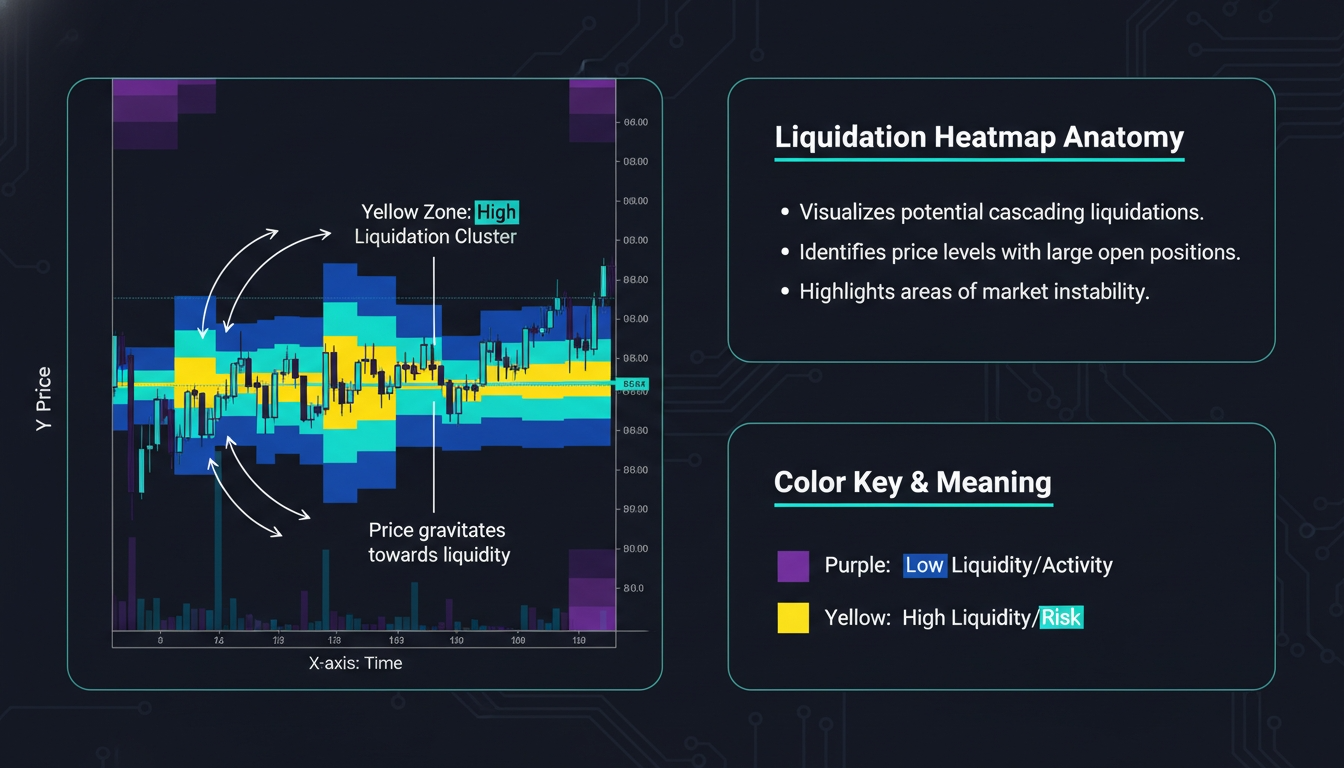
The X-axis (horizontal) represents time. Depending on your selected timeframe, this could span 12 hours, 24 hours, 7 days, 30 days, or even a full year. The Y-axis (vertical) represents price levels, arranged from low to high. The color gradient represents the intensity of potential liquidations at each price-time coordinate. On CoinGlass, the industry-standard platform, colors range from purple (low liquidation density) through green and orange to bright yellow (highest liquidation density).
Here is how the color coding works in practice:
Beyond the basic color map, the heatmap reveals two critical structural elements. Liquidation clusters form when multiple individual liquidation levels stack together at similar prices. The larger the cluster, the stronger the "magnetic pull" on price. Liquidity pools are broader areas where liquidation levels overlap with stop-loss orders, take-profit orders, and resting limit orders - these become the ultimate magnet zones that institutional traders and market makers target.
How to Read a Liquidation Heatmap: Step-by-Step
Learning how to read a liquidation heatmap is the single most important skill for using this tool effectively. The process is straightforward once you understand what to look for. Here is a practical step-by-step approach.
Identify the Brightest Zones
Open the heatmap and immediately scan for yellow or orange clusters. These are the highest-concentration liquidation zones and represent the primary price targets the market is likely to move toward. As CoinGlass explains, these bright areas form what they call "magnetic zones" - price ranges where market prices tend to gravitate due to the sheer volume of liquidation orders sitting there.
Determine Cluster Position Relative to Current Price
Clusters above the current price represent short liquidation levels - where traders betting on a decline would be forced to close. Clusters below represent long liquidation levels - where traders betting on a rise would get wiped out. If you see bright yellow zones predominantly above the current price, most traders are short and the market may squeeze upward. If the bright zones sit below, most traders are long and a downward sweep is more likely.
Assess the "Gap" Between Price and the Cluster
Look at the dark (purple) areas between the current price and the nearest yellow cluster. These "liquidity gaps" are zones with very few orders, meaning price tends to move through them rapidly. A wide gap followed by a dense cluster often leads to a sharp, fast move when the breakout happens.
Compare Multiple Timeframes
CoinGlass offers timeframes from 12 hours to 1 year. Short-term heatmaps (12h-24h) show where intraday volatility is likely. Longer-term views (7d-30d) reveal structural liquidity levels that have more significance. According to Quadcode's analysis, larger timeframe clusters (4H, 12H, Daily) are far more significant than short-timeframe micro-clusters, which tend to be noisy.
Look for Confluence With Technical Levels
The heatmap becomes most powerful when a liquidation cluster aligns with a traditional support or resistance level, a Fibonacci retracement, or a psychological round number (like $60,000 or $70,000). When multiple signals point to the same price, the probability of a strong reaction increases dramatically.
Understanding how to read these maps is closely related to on-chain analytics, which provides another layer of data about where large holders are positioned and whether institutional money is flowing in or out.
CoinGlass Liquidation Heatmap Models Explained
CoinGlass is the industry-standard platform for coinglass liquidation heatmaps, and it offers multiple models that serve different trading styles. Understanding the differences is essential for getting the most out of the tool.
According to a CoinGlass official explanation on X, the platform offers three distinct heatmap models. Model 1 calculates only high-leverage positions (10x, 25x, 50x, and 100x). This model is designed for short-term traders who want to identify where the most aggressive, overleveraged positions are concentrated - these are the levels most likely to be hit during quick intraday moves.
Model 2 calculates all leverage levels, including lower leverage like 2x, 3x, and 5x. This model provides a broader view of the market and is typically used for medium- to long-term analysis. Because it includes more conservative positions, the clusters shown tend to be wider and more structurally significant.
Model 3 is the most comprehensive, incorporating aggregated liquidation data across all leverage tiers with additional weighting based on position sizes. It provides the most complete picture of market-wide liquidation risk.
For most traders, starting with Model 2 provides the best balance between detail and noise. Scalpers who need to identify intraday levels should use Model 1, while traders doing comprehensive multi-timeframe analysis benefit from Model 3.
The Magnet Effect: Why Price Moves Toward Liquidation Zones
The concept that ties the entire liquidation heatmap together is the "magnet effect." Understanding why price consistently gravitates toward high-liquidation zones separates effective heatmap users from traders who simply look at colors.
In crypto derivatives markets, large institutional players and market makers need "exit liquidity" to fill massive orders without causing excessive slippage. A dense cluster of liquidation levels represents a concentration of forced market orders waiting to be triggered. For a large buyer looking to accumulate a significant position, a cluster of short liquidations is the perfect opportunity - those liquidated shorts become forced "buy" orders, providing the liquidity needed to absorb a massive entry.
This is why price frequently "sweeps" through a bright zone and then reverses. The big players have used the liquidation cascade to fill their positions, and once the liquidity is consumed, the reason for the price movement disappears. This is the same dynamic that drives crypto liquidations today across every major exchange.
A real-world example illustrates this perfectly. During the bounce from Bitcoin's February 6 low of $60,001, BTC rallied to approximately $68,600 over the following days. During that bounce, leveraged long positions accumulated rapidly - BeInCrypto data showed Bitcoin futures open interest rising from $19.54 billion to $20.71 billion. Those longs created dense liquidation clusters below the price. When the February 23 sell-off hit, price was drawn straight into those clusters, triggering $468 million in liquidations including the headline-grabbing $61.5 million whale position on HTX.
🎯 Key Takeaways: The Magnet Effect
- Price is attracted to areas of high liquidation density because those zones contain the liquidity that large players need to fill orders.
- Once a liquidation cluster is "swept" (triggered), the magnet effect disappears and price often reverses sharply.
- The sweep-and-reverse pattern is one of the most reliable heatmap signals for identifying potential entry points.
- Cascading liquidations amplify moves - one group's liquidation triggers the next, creating volatility spikes.
Bitcoin Liquidation Levels: Real-World Examples From 2026
To make bitcoin liquidation levels concrete, let's examine how heatmap data corresponded with actual market events in early 2026 - a period of extreme volatility that provided textbook examples.
The correction that began in late January 2026 saw Bitcoin fall from approximately $90,000 to $60,001 by February 6. According to VanEck's research, this sell-off produced $3-4 billion in total liquidations over one week, with $2-2.5 billion concentrated in Bitcoin futures alone. BTC's 7-day price decline ranked in the 99th percentile of all historical outcomes.
The liquidation heatmap had displayed dense long-liquidation clusters between $60,000 and $70,000 for weeks before the crash materialized. As price descended through each cluster, the cascade effect amplified the decline. The $60,000 level served as the final major cluster, and when it was swept, selling pressure exhausted - BTC bounced and rallied back toward $68,600.
Then came the February 23 event. With 93% of liquidated positions being longs - according to CoinGlass data cited by Phemex - the heatmap clearly showed that the market had reloaded leveraged long positions during the bounce, creating fresh liquidation clusters below the price. The pattern repeated: price was drawn to the liquidity, the cascade triggered, and the cycle continued.
For those learning risk management strategies, these events demonstrate exactly why understanding liquidation levels is critical for survival in leveraged crypto markets.
📅 February 2026 Liquidation Timeline
Late January 2026
BTC begins declining from ~$90,000. Dense long-liquidation clusters visible between $60K-$70K on the heatmap.
February 2, 2026
$2.56 billion in BTC liquidations reported by Reuters. Price cascades through heatmap clusters.
February 5-6, 2026
Largest liquidation event in 90 days. BTC touches $60,001 - the final major heatmap cluster. Selling exhausts.
February 7-22, 2026
BTC bounces to ~$68,600. Traders reload leveraged longs. New heatmap clusters form below price.
February 23, 2026
$61.5M whale liquidated on HTX. $468M total liquidations. 93% were long positions. The cycle repeats.

Best Liquidation Heatmap Tools Compared
Choosing the right platform determines the quality of your heatmap analysis. Here are the leading tools available to crypto traders in 2026, each with distinct strengths.
CoinGlass is the most widely used and referenced platform. It offers free access to liquidation heatmaps covering BTC, ETH, and major altcoins across Binance, Bybit, OKX, and other exchanges. The three-model system (described above) provides flexibility for different trading styles. Timeframes range from 12 hours to one year. CoinGlass also offers complementary tools including real-time liquidation data, open interest tracking, funding rate charts, and a liquidation map (which shows cumulative liquidation levels at different prices rather than the time-based heatmap view).
Hyblock Capital caters to more advanced traders with detailed liquidity maps, whale positioning data, and institutional-grade analytics. Its heatmap interface offers higher resolution and additional filtering options. Hyblock is particularly popular with swing traders who want to overlay liquidation data with other positioning metrics.
TensorCharts integrates real-time heatmaps with order flow data, Delta analysis, and volume tools. This makes it especially powerful for scalpers and day traders who need to see not just where liquidations are clustered, but how active order flow is interacting with those clusters in real time.
TradingLite combines heatmaps with visual liquidity layers and an intuitive interface that's ideal for tracking market maker behavior. It has a strong reputation for visual clarity, though it requires a paid subscription for full access.
Laevitas offers institutional-grade derivatives analytics, including volatility dashboards, options flow tracking, and liquidation projections. It is the most sophisticated option and is primarily used by professional traders and funds.
Trading Strategies Using the Liquidation Heatmap
Knowing how to read the heatmap is only half the equation. Here are the specific strategies professional traders use to translate heatmap data into actionable trades.
The Liquidity Sweep Reversal
This is the most common heatmap-based strategy. Traders identify a high-density yellow cluster just above or below a consolidation range, then wait for the price to wick into the cluster. If the price sweeps through the level and quickly reclaims the previous range - often confirmed by RSI divergence - it signals a high-probability reversal entry. The logic is simple: once the liquidation liquidity has been consumed, the "fuel" for further movement in that direction is exhausted.
The Short Squeeze Accelerator
When Bitcoin is in a clear uptrend and a massive cluster of short liquidations sits just above a psychological resistance level, the heatmap signals a potential short squeeze. As price approaches and begins triggering short liquidations, those forced buy orders accelerate the breakout. Traders enter long on the breakout, knowing that the cascade of short liquidations will push price through resistance much faster than normal buying pressure would.
Confluence Trading
The highest-probability setups occur when a heatmap cluster aligns with other technical signals. If a dense liquidation zone sits at a key Fibonacci level, a historical support zone, and a round-number psychological level all at once, the likelihood of a strong price reaction increases substantially. Combining the heatmap with proper risk management and other indicators creates a robust trading framework.
Common Mistakes When Using Liquidation Heatmaps
Liquidation heatmaps are powerful, but they are frequently misused. According to Whaleportal's analysis, there are several critical mistakes that traders make repeatedly.
The most common error is treating liquidation zones as guaranteed price targets. A bright yellow zone shows where traders will get liquidated if price reaches that level - it does not guarantee the price will actually move there. The market can consolidate, reverse, or trend in the opposite direction for extended periods before a liquidation cluster is eventually reached.
Using the heatmap in isolation is another frequent mistake. The heatmap reveals potential liquidation zones, but without confirming signals from price action, volume analysis, funding rates, or other indicators, acting on heatmap data alone leads to inconsistent results. The tool works best as a confirmation layer within a broader strategy.
Ignoring timeframe differences creates confusion. A 12-hour heatmap might show short liquidation clusters above the price, suggesting bullish pressure. But a 7-day view might reveal much larger long liquidation clusters below, indicating that the bigger move is likely downward. Always check multiple timeframes to avoid trading against the dominant structural trend.
Focusing on a single exchange reduces accuracy. Liquidation levels are more reliable when they appear consistently across Binance, Bybit, OKX, and other major platforms. A cluster visible only on one exchange may not represent meaningful market-wide liquidity.
🎯 Key Takeaways: Avoiding Heatmap Mistakes
- Heatmap zones show probability, not certainty - never assume price must reach a liquidation cluster.
- Always combine heatmap data with at least one other confirming indicator (RSI, funding rates, volume, support/resistance).
- Check multiple timeframes - the structural (7d-30d) view often overrides short-term (12h-24h) signals.
- Cross-reference multiple exchanges for the most reliable liquidation zones.
- Adjust intensity settings - sometimes important clusters are hidden at default sensitivity levels.
Liquidation Heatmap vs. Liquidation Map: What Is the Difference?
Traders often confuse the liquidation heatmap with the liquidation map, and while both tools deal with liquidation data, they serve different purposes.
A liquidation heatmap is time-based. It shows the history and evolution of liquidation clusters over a selected period (12 hours to 1 year), plotted against price. This allows you to see how liquidation levels have built up over time and where the current "hot zones" sit. It is primarily a forward-looking tool for predicting where price is likely to move next.
A liquidation map (also called a "liq map") is a snapshot. It shows the current cumulative liquidation levels at different prices - essentially answering the question "if price moves to $X right now, how much would be liquidated?" According to CoinGlass, the liquidation map provides a visual chart of liquidation risk across the current order book, but without the time dimension that the heatmap includes.
Additionally, a liquidation chart focuses on historical data - showing what has already been liquidated rather than what might be liquidated in the future. It helps traders analyze past leverage dynamics to understand where market pressure points occurred.
For comprehensive analysis, professional traders use all three in combination: the heatmap for forward-looking predictions, the map for real-time positioning, and the chart for historical context.
Who Should Use Liquidation Heatmaps?
Liquidation heatmaps are not for everyone. They serve specific types of traders and add limited value for others.
The tool is most valuable for day traders who need to identify intraday reversal points and avoid getting caught in liquidation spikes, swing traders looking to enter or exit around key support and resistance zones, and leverage traders who want to understand where other leveraged positions are concentrated to manage their own risk exposure. Traders who are navigating crypto in 2026 with active strategies will find heatmaps particularly useful during periods of high volatility.
The tool is not designed for long-term investors or "HODLers" who are not concerned with short-term price movements, anyone focused purely on fundamental analysis, or passive portfolio builders who use dollar-cost averaging strategies. If your investment approach is based on diversifying a crypto portfolio for the long term, the granular short-term data provided by liquidation heatmaps will add more noise than value.
That said, even long-term investors can benefit during major market events. Using a heatmap to identify capitulation zones - where massive liquidation clusters have been fully swept - can help time larger DCA entries more effectively. The February 2026 crash to $60,001 was exactly this type of event, where the heatmap showed exhaustion of long liquidation clusters, signaling a potential bottom for accumulation.
Frequently Asked Questions
What is a liquidation heatmap in crypto?
A liquidation heatmap is a visual trading tool that uses color gradients to display where leveraged positions are likely to be forcibly closed across cryptocurrency exchanges. It aggregates data from exchanges like Binance, Bybit, and OKX, then maps potential liquidation levels against price and time. Bright yellow zones indicate high concentrations of liquidation orders, while purple or blue zones indicate low activity. Traders use heatmaps to anticipate where price is likely to move next, since markets tend to gravitate toward areas of high liquidation density.
How accurate are liquidation heatmaps?
Liquidation heatmaps show estimated liquidation levels based on open interest and leverage data - they represent probability, not certainty. The actual liquidation amounts may be lower than displayed because some traders close positions manually before reaching their liquidation price. According to CoinGlass, the levels represent relative intensity indicators rather than exact figures. The heatmap's accuracy improves significantly when used alongside other tools like funding rates, open interest trends, and traditional technical analysis.
Where can I access a free liquidation heatmap?
CoinGlass offers the most comprehensive free liquidation heatmap at coinglass.com/pro/futures/LiquidationHeatMap. It covers major trading pairs including BTC/USDT, ETH/USDT, and popular altcoins across multiple exchanges. The free tier includes all three heatmap models and timeframes from 12 hours to 1 year. Hyblock Capital and TensorCharts also offer limited free access, while TradingLite and Laevitas require paid subscriptions for full functionality.
Do liquidation heatmaps work for altcoins?
Yes, liquidation heatmaps are available for most major trading pairs beyond Bitcoin, including Ethereum, Solana, XRP, and many more. CoinGlass supports a wide range of altcoin pairs across Binance, OKX, and Bybit. However, altcoin heatmaps tend to be less reliable than Bitcoin's because altcoin futures markets have lower overall liquidity and open interest. The magnet effect is strongest in BTC, where derivatives volume is highest, and weakens proportionally with lower-volume assets.
What is the difference between a liquidation heatmap and a regular order book?
A key distinction is the type of data each displays. An order book shows limit orders - where traders want to buy or sell (intent). These orders can be canceled or "spoofed" at any time, making the data less reliable. A liquidation heatmap shows where traders will be forced to exit (vulnerability). Since liquidations are triggered automatically by the exchange, the data cannot be faked. This makes heatmap data fundamentally more reliable than order book data for predicting price movement.
Can liquidation heatmaps predict market crashes?
Not in the predictive sense, but they can reveal where crashes are likely to accelerate. Dense clusters of long liquidations below the current price act as "fuel" for downward cascades. When a sell-off reaches these clusters, the forced liquidation orders amplify the decline. The February 2026 Bitcoin correction from $90,000 to $60,000 demonstrated this perfectly - the heatmap showed dense long liquidation clusters throughout that range, and each cluster triggered the next as price descended.
How often should I check the liquidation heatmap?
For day traders and scalpers, checking the heatmap before each trading session and updating it hourly during active trades is standard practice. Swing traders typically review it daily or when approaching major price levels. The heatmap is dynamic - new positions are constantly being opened and closed, so the liquidation landscape shifts throughout the day. Setting up alerts on CoinGlass for when price approaches major liquidation clusters can reduce the need for constant monitoring.
Conclusion
The liquidation heatmap has become one of the most valuable tools in the crypto trader's arsenal - and for good reason. In a market where crypto liquidations routinely reach hundreds of millions of dollars, understanding where those liquidations are concentrated gives you an edge that pure technical analysis cannot match.
The core concept is straightforward: leveraged positions create invisible "magnets" on the price chart, and the heatmap makes those magnets visible. Bright yellow zones pull price toward them. Once the liquidity is consumed, price often reverses. By reading these patterns, you can position yourself ahead of major moves instead of reacting after the fact.
Start with the free CoinGlass heatmap. Use Model 2 for your initial analysis. Identify the brightest clusters above and below the current price. Combine that information with funding rates, open interest data, and traditional support and resistance analysis. Never use the heatmap alone, and never place your stop-losses inside visible liquidation clusters.
For traders ready to build a stronger foundation, understanding liquidation heatmaps marks the transition from reactive trading to proactive positioning. The data is free. The edge is real. How you use it is up to you.
Ready to Start Trading Smarter?
Combine liquidation heatmap analysis with real-time market data to take your crypto trading to the next level.
Explore Zipmex →⚠ Disclaimer: The information provided in this article is not intended to provide investment or financial advice. Investment decisions should be based on the individual's financial needs, objectives, and risk profile. We encourage readers to understand the assets and risks before making any investment entirely. Cryptocurrency investments are subject to high market risk. Leveraged trading carries additional risk of losses exceeding your initial deposit. Past performance does not guarantee future results.