With over 17,000 cryptocurrencies tracked globally and Bitcoin commanding roughly 58% of the total crypto market cap, understanding what separates Bitcoin from everything else is one of the most important first steps in crypto. If you have ever seen terms like "altcoin season," "BTC dominance," or "altcoin index" and wondered what they actually mean for your money, this guide breaks it all down.
⚡ Quick Answer
An altcoin is any cryptocurrency other than Bitcoin. The word combines "alternative" and "coin." As of February 2026, there are thousands of altcoins - from Ethereum and Solana to meme coins like Dogecoin. Whether the market favors Bitcoin or altcoins is tracked through BTC dominance (currently ~58%) and the Altcoin Season Index (currently at 43, meaning it is Bitcoin Season).
Understanding altcoins is not just about definitions. The relationship between Bitcoin and altcoins drives entire market cycles - and knowing where you are in that cycle can be the difference between buying at the right time and chasing peaks. This guide covers what altcoins are, the main types, how Bitcoin dominance works as a market compass, and how to read the altcoin season indicator to make smarter decisions.
What Is an Altcoin? Definition and Origin
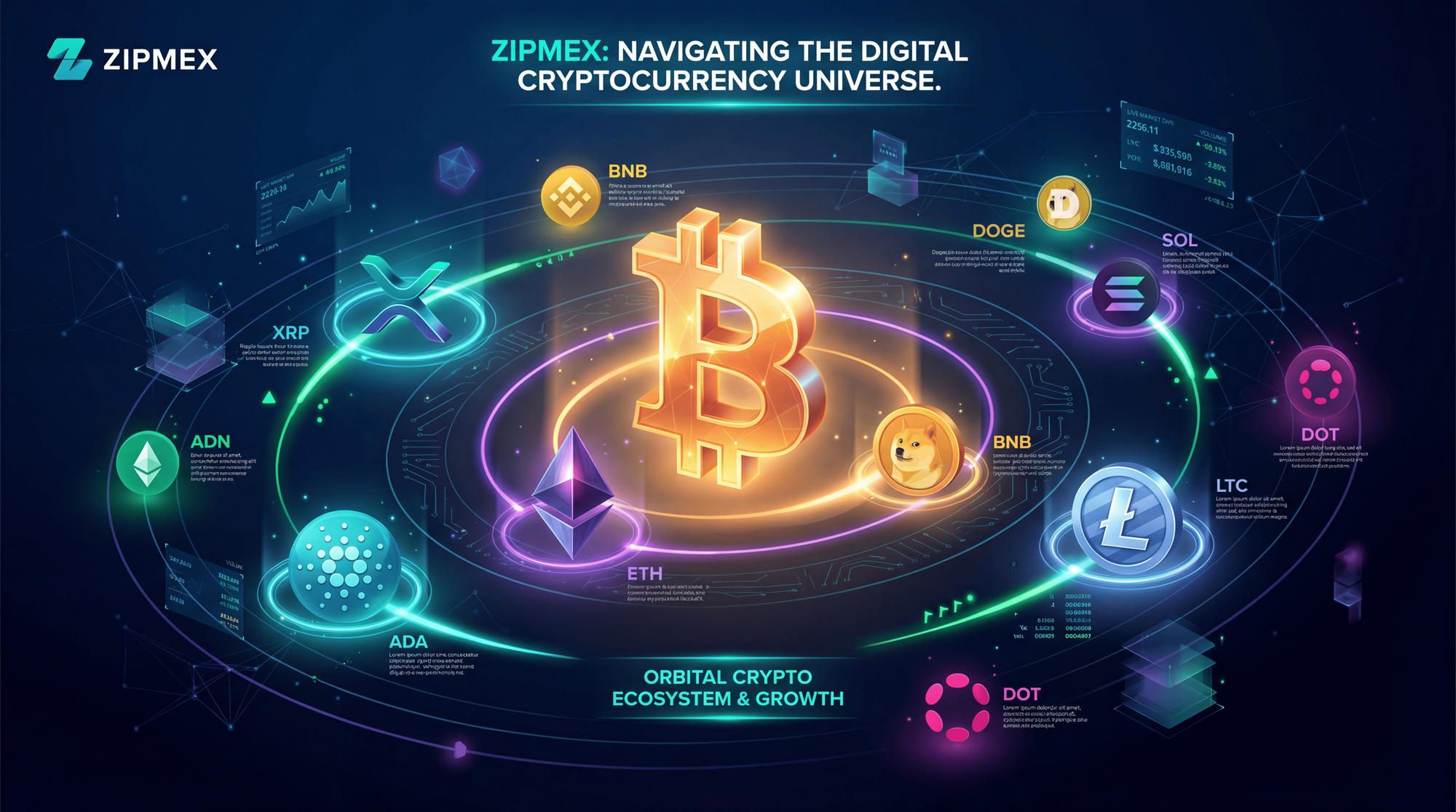
An altcoin - short for "alternative coin" - is any cryptocurrency that is not Bitcoin. The term emerged in the early days of crypto when developers began creating alternatives to Bitcoin, each attempting to improve on its limitations or serve entirely new purposes. According to Investopedia, altcoins include all cryptocurrencies and tokens other than Bitcoin, with some definitions also excluding Ethereum due to its unique foundational role.
The first altcoin was Namecoin, launched in April 2011 with the goal of decentralizing domain name registration. Litecoin followed in October 2011, created by former Google engineer Charlie Lee as a "lighter" version of Bitcoin with faster block times and a different mining algorithm called Scrypt. These early projects set the template for what would become a massive ecosystem of alternative digital assets.
Today, the altcoin landscape is unrecognizable from those early days. CoinGecko tracks over 17,750 cryptocurrencies across nearly 1,500 exchanges, with the vast majority being altcoins. Some sources estimate there are over 10,000 active cryptocurrencies in circulation as of 2026, though the total number ever created is far higher - many projects have been abandoned or have effectively zero trading volume.
The altcoin market spans everything from Ethereum (with a market cap around $225 billion) to micro-cap tokens with valuations under $1 million. This enormous range means that "altcoin" is less a specific category and more of an umbrella term covering very different types of assets with very different risk profiles.
Types of Altcoins: The 7 Major Categories
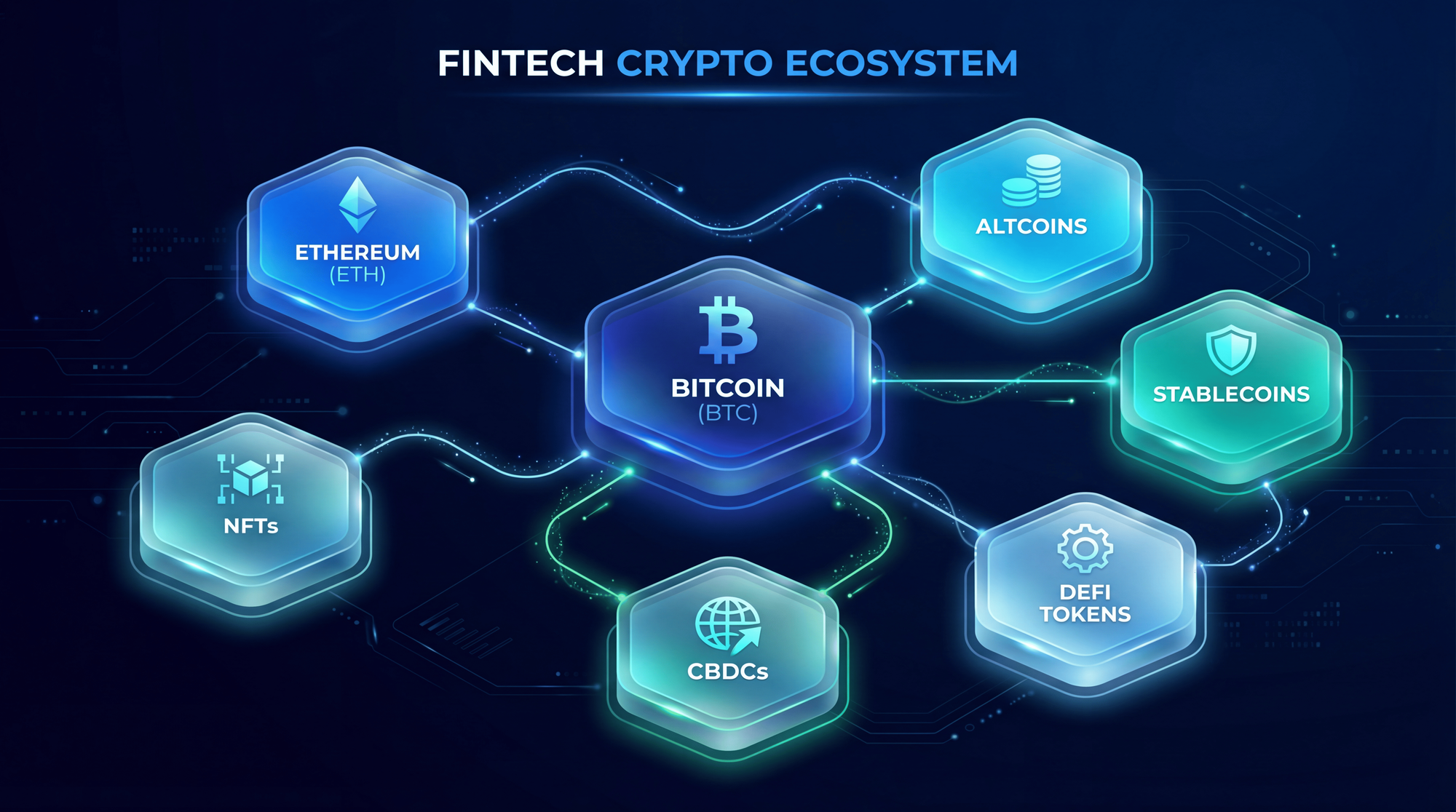
Not all altcoins are created equal. They serve fundamentally different purposes, and understanding these categories helps you evaluate each project on its own terms rather than lumping them all together. Here is a breakdown of the seven major altcoin types you will encounter.
Platform Coins (Layer 1s)
Platform coins power their own blockchains that support smart contracts and decentralized applications. Ethereum (ETH) is the original and largest, but competitors like Solana (SOL), Cardano (ADA), and Avalanche (AVAX) offer different trade-offs in speed, cost, and decentralization. These are often considered the "infrastructure" layer of crypto - the highways on which other applications are built.
Stablecoins
Stablecoins are designed to maintain a stable value, typically pegged 1:1 to the US dollar. Tether (USDT) and USD Coin (USDC) are the dominant examples, with USDT alone holding a market cap of approximately $183 billion. They serve as the primary on-ramp and off-ramp between volatile crypto assets and fiat-denominated value, and are excluded from most altcoin season calculations because their prices do not fluctuate meaningfully.
Utility Tokens
Utility tokens provide access to specific services within a blockchain ecosystem. Chainlink (LINK) pays node operators for providing oracle data, Filecoin (FIL) purchases decentralized storage, and ETH itself functions as a utility token by paying gas fees on Ethereum. The value of a utility token is theoretically tied to the demand for the service it enables.
Governance Tokens
Governance tokens give holders voting rights over protocol decisions - things like fee structures, treasury spending, and upgrade proposals. Uniswap (UNI), Aave (AAVE), and Maker (MKR) are well-known examples. Holding these tokens is roughly analogous to holding voting shares in a company, though the legal frameworks are very different.
Payment Tokens
Payment tokens are designed primarily as mediums of exchange. Litecoin (LTC), XRP, and Bitcoin Cash (BCH) fall into this category. XRP, built on the XRP Ledger, targets cross-border bank payments with settlement times of 3-5 seconds, while Litecoin positions itself as a faster, cheaper alternative to Bitcoin for everyday transactions.
Meme Coins
Meme coins originate from internet culture and jokes rather than technological innovation. Dogecoin (DOGE), created in 2013 as a parody of Bitcoin, is the original meme coin. Shiba Inu (SHIB), Pepe (PEPE), and the Trump-associated TRUMP token followed. Meme coins are heavily driven by social media sentiment and celebrity endorsement rather than fundamental utility, making them among the most speculative and volatile assets in crypto.
Security Tokens
Security tokens represent ownership in real-world assets - equity, real estate, bonds, or other financial instruments - recorded on a blockchain. They are regulated by securities authorities (like the SEC in the United States) and represent the intersection of traditional finance and crypto infrastructure. While still a smaller niche, security tokens are growing as tokenization of real-world assets gains institutional attention.
🎯 Key Takeaways
- An altcoin is any cryptocurrency other than Bitcoin - the term covers everything from Ethereum to meme coins.
- The first altcoin (Namecoin) launched in April 2011. Today there are over 17,000 tracked cryptocurrencies.
- The seven main altcoin categories - platform coins, stablecoins, utility tokens, governance tokens, payment tokens, meme coins, and security tokens - carry very different risk/reward profiles.
- Always evaluate an altcoin by its category, market cap, use case, and team - not just by its price movement.
BTC Dominance Meaning: Why Bitcoin's Market Share Matters
BTC dominance - also written as BTC.D - measures Bitcoin's market capitalization as a percentage of the total crypto market. The formula is straightforward:
BTC Dominance = (Bitcoin Market Cap ÷ Total Crypto Market Cap) . 100%
As of February 26, 2026, Bitcoin's market cap is approximately $1.35 trillion while the total crypto market cap stands at roughly $2.4 trillion, placing BTC dominance at around 58%. This means that more than half of all money in crypto is allocated to Bitcoin, with the remaining 42% spread across thousands of altcoins.
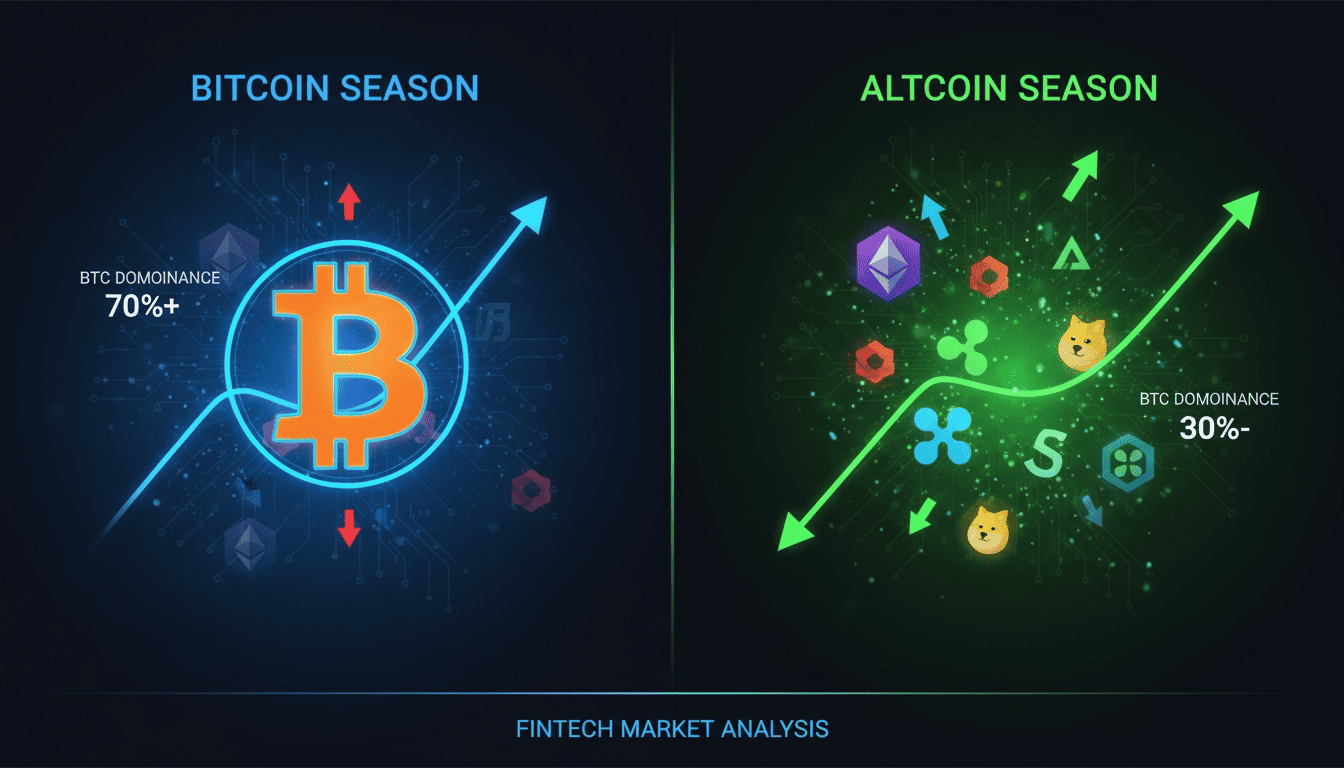
Why does this number matter? Because BTC dominance acts as a sentiment gauge for the entire market. When dominance rises, it typically means capital is flowing into Bitcoin and away from altcoins - investors are playing it safe. When dominance falls, money is rotating into altcoins - investors are taking on more risk in search of higher returns. Understanding this dynamic is essential for anyone who holds or trades altcoins, because as we explored in our complete guide to BTC dominance, the interplay between Bitcoin and altcoins defines the rhythm of crypto market cycles.
How to Read the Bitcoin Dominance Chart
The BTC dominance chart is available on platforms like TradingView (ticker: BTC.D), CoinMarketCap, and CoinGecko. Here is what different dominance ranges historically signal:
At the current level of approximately 58%, the market is firmly in Bitcoin-dominant territory. This is consistent with the broader trend since 2023, where BTC dominance has climbed from 40% at the end of 2022 to 59% by the end of 2025, driven by spot Bitcoin ETF approvals, the 2024 halving, and institutional adoption that has favored Bitcoin over altcoins.
Historical Bitcoin Dominance: A Timeline
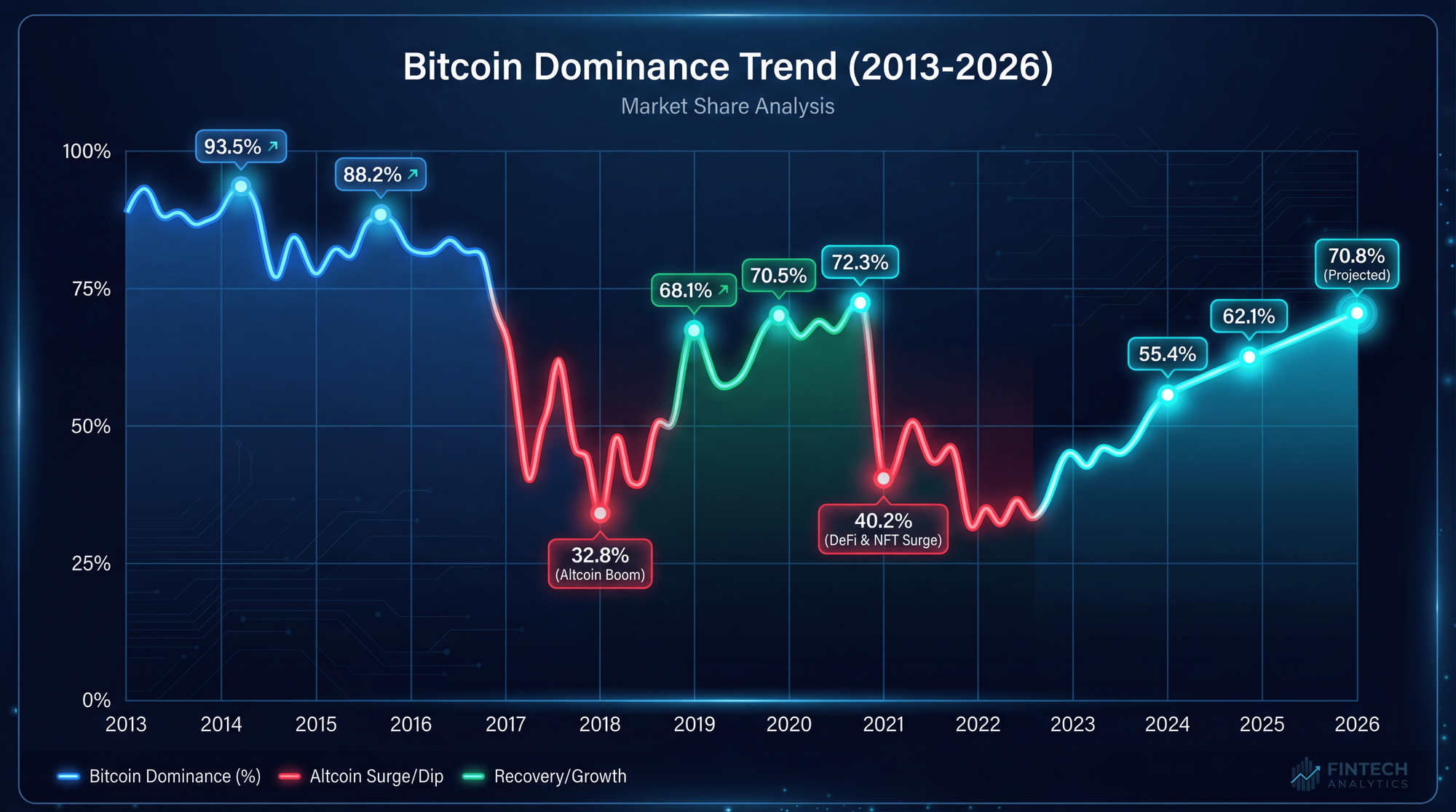
The history of BTC dominance tells the story of how the crypto market has evolved from a single-asset ecosystem into a diverse, multi-chain landscape. Here are the key milestones based on data from CoinGecko's dominance history and CoinCodex's historical data:
📅 Bitcoin Dominance Timeline
2013-2016: Bitcoin Era
BTC dominance ranged from 82% to 93%. Few altcoins existed and even fewer had meaningful market caps.
2017-2018: ICO Boom & Crash
The Ethereum-driven ICO craze caused BTC dominance to plunge. It hit an all-time low of approximately 31.1% on January 16, 2018. After the crash wiped out most altcoins, dominance rebounded to ~70% by August 2019.
2020-2021: DeFi Summer & NFT Mania
DeFi protocols, NFTs, and Play-to-Earn gaming drove capital into altcoins. BTC dominance fell from ~70% to around 40% by end of 2021. ETH alone captured ~16% dominance.
2022: Terra & FTX Collapses
Major failures destroyed trust in altcoins. Terra/LUNA wiped out ~$45 billion. FTX collapse shook the entire market. Capital fled to Bitcoin as a "safer" crypto asset.
2023-2026: Institutional Bitcoin Era
BTC spot ETF approvals (Jan 2024), the 2024 halving, and the U.S. Strategic Bitcoin Reserve pushed dominance from ~40% to the current ~58%. BTC leads; altcoins follow selectively.
A key pattern emerges from this history: BTC dominance tends to rise during bear markets and early bull markets (when investors seek safety) and decline during late bull markets (when speculative appetite for altcoins peaks). According to CoinGecko's research on BTC dominance history, Bitcoin dominance has been on the rise for three consecutive years - a historically unusual streak that reflects the strength of institutional capital flowing into Bitcoin through ETFs and corporate treasuries.
Altcoin Season Indicator: How to Know When Altcoins Are Winning
The altcoin season indicator (also called the Altcoin Season Index) is a metric that tells you whether the broader altcoin market is outperforming Bitcoin. It answers one of the most important timing questions in crypto: is this a Bitcoin market or an altcoin market?
The most widely referenced version is maintained by Blockchaincenter.net, while CoinMarketCap also publishes its own index. Both work on a similar principle.
The methodology is straightforward: the index looks at the top 50 or 100 cryptocurrencies (excluding stablecoins and wrapped tokens) and checks how many of them outperformed Bitcoin over the last 90 days. If 75% or more of those top coins beat Bitcoin's returns, it is declared "Altcoin Season." If 25% or fewer outperform Bitcoin, it is "Bitcoin Season." The result is expressed as a number from 1 to 100 - the higher the number, the stronger the altcoin performance.
As of late February 2026, the Blockchaincenter Altcoin Season Index sits at 43, firmly in "Bitcoin Season" territory. This confirms what the BTC dominance data already tells us - Bitcoin is outperforming the majority of altcoins. The Altcoin Month Index reads 73 (closer to altcoin territory for the shorter timeframe), while the Altcoin Year Index is at 39, with 1,487 days since the last confirmed altcoin year - the longest such streak on record.
🔢 Altcoin Season Index Snapshot (February 2026)
Season Index (90 days)
43 - Bitcoin Season
Month Index (30 days)
73 - Neutral/Altcoin Leaning
BTC Dominance
~58%
Days Since Last Alt Season
153 days
How Altcoin Seasons Typically Unfold
According to CoinMarketCap's altcoin season methodology, altcoin seasons tend to follow a recognizable pattern. Bitcoin's price rises first, introducing bullish sentiment into the market and driving up BTC dominance. Then Ethereum begins to outperform, drawing attention to the smart contract ecosystem. As confidence builds, capital rotates from BTC into mid-cap and small-cap altcoins, multiple narrative-driven sectors rally simultaneously, and the Altcoin Season Index climbs above 75.
The last major altcoin season ran from approximately February to May 2021, when large-cap altcoins achieved returns of around 174% versus Bitcoin's 2% over the same period, according to CoinMarketCap. During that period, the total altcoin market cap reached roughly 130% of Bitcoin's - a level that has not been repeated since.
Bitcoin vs Altcoins: The Rotation Cycle
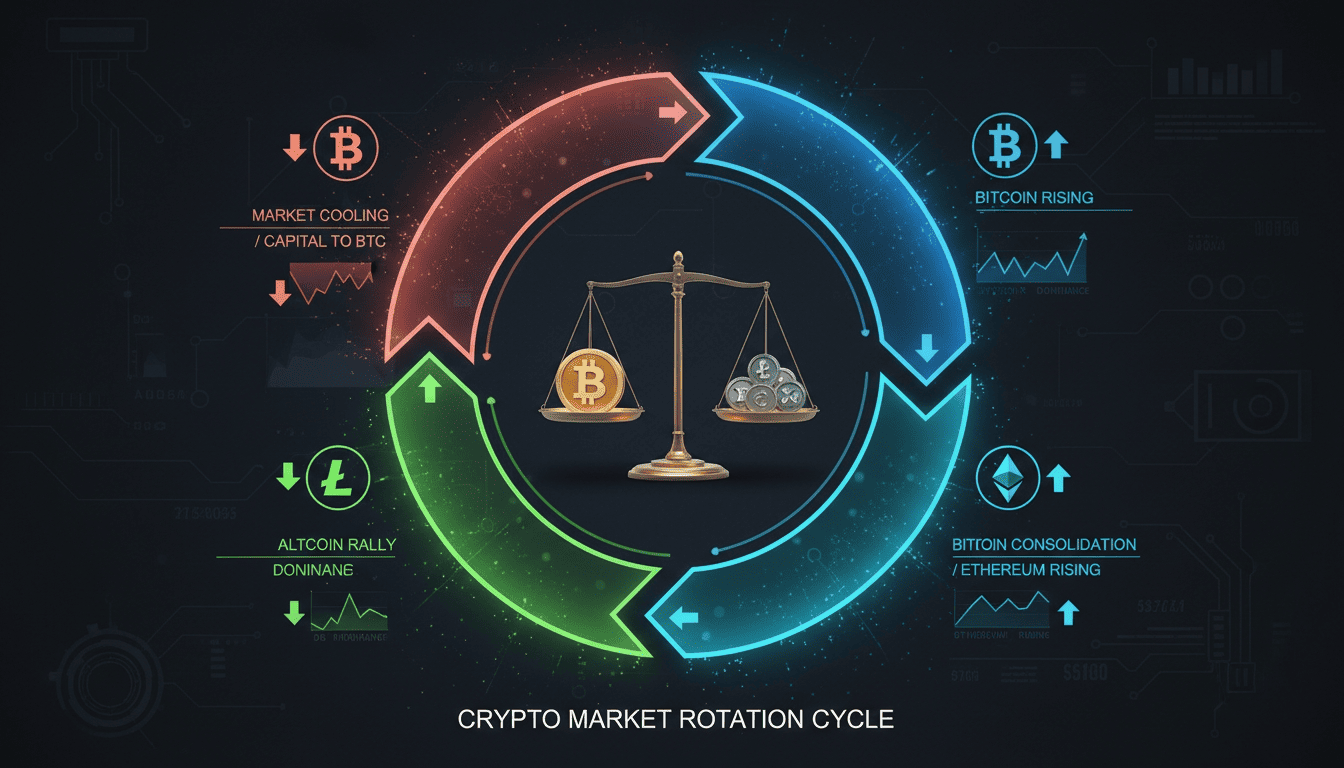
The relationship between Bitcoin and altcoins is not random - it follows a cyclical rotation pattern that experienced traders monitor closely. Understanding this rotation is key to timing entries and exits.
When Bitcoin dominance is rising and BTC price is also rising, the market is in "Bitcoin accumulation" mode. Most of the gains go to BTC, and altcoins often underperform or even decline against BTC. This is typically the early stage of a bull cycle, and it is the phase the market appears to be in as of early 2026, as you can observe on the crypto dominance chart.
When Bitcoin dominance starts falling while the total market cap continues to rise, capital is rotating from Bitcoin into altcoins. This is the sweet spot for altcoin investors - BTC has already done the heavy lifting of bringing new capital into the market, and now that capital is seeking higher returns in riskier assets.
When both Bitcoin dominance and total market cap start declining, it signals a broad market downturn. Everything sells off, but altcoins typically fall harder and faster than Bitcoin - often 70-90% or more from their highs, as seen in the 2022 bear market. Understanding how to spot overbought crypto markets can help you identify when a reversal is approaching.
⚠ Risk Warning
Altcoins are significantly more volatile than Bitcoin. While they can deliver outsized returns during altcoin seasons, they can also lose 80-99% of their value in bear markets. Many altcoins from previous cycles never recovered their all-time highs. Never invest more than you can afford to lose, and consider the altcoin season indicator as one signal among many - not a guarantee of future performance.
Top Altcoins by Market Cap in 2026
To put the altcoin landscape in perspective, here are the largest non-Bitcoin cryptocurrencies ranked by market capitalization as of late February 2026, based on data from CoinDesk and CoinGecko:
Notice how the top altcoins span multiple categories - platform coins (ETH, SOL, BNB), a stablecoin (USDT), and a payment token (XRP). This diversity reflects the fact that the altcoin market is not one monolithic category but a collection of distinct sectors, each with its own drivers and dynamics. For a deeper analysis of individual altcoin price potential, see our research on tokens like XRP and Dogecoin.
How to Use BTC Dominance and the Altcoin Season Index in Your Strategy
Understanding these metrics is only useful if you can translate them into decisions. Here is a practical framework for incorporating BTC dominance and the altcoin season indicator into your investment approach.
When BTC dominance is rising (as it is now), the market is telling you that Bitcoin is the safer bet relative to altcoins. This does not necessarily mean altcoins will lose value in absolute terms - just that they are likely to underperform Bitcoin. For most investors, this is a time to maintain heavier BTC allocation and be selective with altcoin positions, favoring established, large-cap projects over speculative small-caps.
When BTC dominance starts declining from elevated levels, it historically signals the beginning of capital rotation into altcoins. This is when experienced traders begin building altcoin positions - not at the peak of altcoin mania, but during the early stages of the rotation. Look for BTC.D to break below key support levels while the total crypto market cap continues rising.
When the Altcoin Season Index crosses above 75, the altcoin rally is already well underway. While it can continue further, this is historically when risk increases. Sharp reversals in BTC dominance can happen quickly, and altcoins that tripled in weeks can lose half their gains in days. This is the time to start taking profits rather than adding exposure.
Frequently Asked Questions
What is an altcoin in simple terms?
An altcoin is any cryptocurrency other than Bitcoin. The word is a combination of "alternative" and "coin." Altcoins range from major platforms like Ethereum and Solana to smaller tokens with very specific use cases. As of 2026, there are thousands of altcoins, each with different purposes, risk levels, and market capitalizations.
Is Ethereum considered an altcoin?
Technically, yes - Ethereum is an altcoin because it is not Bitcoin. However, some crypto participants treat Ethereum as its own category due to its size (approximately $225 billion market cap), its foundational role as the largest smart contract platform, and the fact that most altcoin season indices include ETH in their calculations alongside other altcoins.
What does BTC dominance mean for altcoin prices?
BTC dominance measures Bitcoin's share of the total crypto market cap. When it rises, capital is flowing toward Bitcoin and away from altcoins, which generally means altcoins underperform. When it falls, capital is rotating into altcoins, creating conditions for broader altcoin rallies. The current BTC dominance of approximately 58% indicates a Bitcoin-dominant market.
How do I know if it is altcoin season?
Check the Altcoin Season Index on platforms like Blockchaincenter.net or CoinMarketCap. If the index is above 75, it means 75% or more of the top cryptocurrencies are outperforming Bitcoin over the last 90 days - that is altcoin season. Below 25 is Bitcoin season. As of February 2026, the index reads 43, which is Bitcoin season.
What are the safest altcoins to invest in?
No cryptocurrency is truly "safe," but large-cap altcoins with strong fundamentals, active development, and real-world adoption carry lower relative risk. Ethereum, Solana, XRP, and BNB are among the most established. Stablecoins like USDT and USDC maintain dollar parity but carry counterparty risk. Always research the specific project and only invest what you can afford to lose.
Can altcoins outperform Bitcoin?
Yes - during altcoin seasons, many altcoins dramatically outperform Bitcoin on a percentage basis. In the February-May 2021 altcoin season, large-cap altcoins returned roughly 174% compared to Bitcoin's 2%. However, altcoins also tend to underperform Bitcoin during bear markets and early bull phases, and many altcoins from past cycles never recover their previous highs.
Where can I track BTC dominance live?
The most popular platforms for live BTC dominance data are TradingView (search for BTC.D), CoinMarketCap's Bitcoin Dominance Chart, and CoinGecko's dominance page. Glassnode provides more advanced historical dominance data for professional analysis.
Conclusion: Altcoins, Dominance, and What Comes Next
Understanding what altcoins are, how BTC dominance works, and what the altcoin season indicator signals gives you a framework for navigating one of the most important dynamics in crypto. The current market - with BTC dominance near 58% and the Altcoin Season Index at 43 - is firmly in Bitcoin territory. This is consistent with a post-ETF, post-halving environment where institutional capital continues to favor Bitcoin.
For investors, this means maintaining a thoughtful approach: heavier Bitcoin allocation during periods of rising dominance, selective altcoin positions in established projects, and patient monitoring of the dominance chart for signs of the next rotation. History suggests that altcoin seasons do come - they just follow their own timeline, often when the market least expects it.
Whether you are building your first crypto portfolio or refining your strategy, the concepts covered here - altcoin categories, BTC dominance ranges, and the rotation cycle between Bitcoin and altcoin dominance phases - are foundational knowledge that will serve you in any market condition. For more foundational learning, check out our beginner's guide on what is cryptocurrency and our detailed overview of how to learn crypto as a beginner.
Ready to Explore the Crypto Market?
Start with Bitcoin, diversify into altcoins, and build your portfolio with confidence on Zipmex.
Start Trading Now →⚠ Disclaimer: The information provided in this article is not intended to provide investment or financial advice. Investment decisions should be based on the individual's financial needs, objectives, and risk profile. We encourage readers to understand the assets and risks before making any investment entirely. Cryptocurrency investments are subject to high market risk. Past performance does not guarantee future results.