A bear trap is one of the most costly mistakes a short seller can make - and one of the most reliably recurring patterns in financial markets. In plain terms, a bear trap occurs when an asset appears to break below a key support level, signaling a trend reversal, only to reverse sharply upward and lock bearish traders in losing positions. Understanding what a bear trap is, why it forms, and how to avoid it is a core competency for anyone serious about trading crypto, stocks, or any volatile asset.
⚡ Key Takeaways
- A bear trap is a false downtrend signal where price briefly breaks below support before reversing upward, trapping short sellers.
- Low trading volume during a breakdown is the single most reliable early warning sign that a move may be deceptive.
- Waiting for confirmed candle closes below support - not just intraday wicks - and using stop-losses on every short position are the two non-negotiable defenses.
To understand why bear traps are so dangerous, let's start with exactly how they form.
What Is a Bear Trap? Definition and Core Concept
A bear trap in trading is a deceptive price pattern where an asset briefly breaks below a key support level or chart structure, triggering bearish traders to open short positions, before reversing direction and surging higher - trapping those sellers in mounting losses. The word "trap" is apt: the market baits bearish traders in, then slams the door.
Three actors make this pattern work. Retail traders see the breakdown and react instinctively - selling the asset or opening short positions. Institutional players, particularly in thinner markets like crypto, may deliberately engineer the move downward to flush out weak hands and collect cheap liquidity. Market mechanics then do the rest: as short sellers are forced to buy back their positions to cover losses, their buying pressure accelerates the very rally that's destroying them.
Bear traps aren't unique to any single asset class. They appear in stocks, cryptocurrency, forex, commodities, and indices - anywhere that short selling exists and where price action can mislead a crowd.
Why Bear Traps Happen - The Psychology and Mechanics
Two forces create bear traps: organic crowd psychology and deliberate institutional mechanics. Herd mentality is the foundation. When price drops below a well-known support level, traders with identical chart setups react identically - they see a breakdown and short. Confirmation bias amplifies this: once you're short, every tick lower feels like validation.
The institutional layer is what converts a simple dip into a full bear trap. Large market participants - hedge funds in equities, whales in crypto - can push price briefly below support to trigger stop-loss orders and short entry flows. Once that liquidity is collected, they reverse and buy aggressively. The sequence plays out like clockwork:
The 6-Stage Bear Trap Sequence:
- Uptrend in place - market sentiment is bullish; price is making higher highs and higher lows
- Price dips below support - a visible support level breaks, triggering bearish signals
- Bears pile in - short sellers enter; selling pressure briefly accelerates the decline
- Buying emerges - institutional buyers or positive catalysts absorb the supply
- Price reverses - asset reclaims support; the breakdown is revealed as false
- Short squeeze ignites - trapped short sellers buy to cover, adding fuel to the rally
GameStop in early 2021 demonstrated this at an extreme scale. Heavily shorted by institutions, the stock received a wave of coordinated retail buying from Reddit's WallStreetBets community. Bears expecting a continued decline were caught in one of the most violent short squeezes in modern market history. The initial weakness was, in hindsight, a textbook bear trap.
In crypto markets, whale-driven bear traps are particularly common. Bitcoin's order books are thinner than those of major equity indices, meaning relatively less capital is required to flash-crash the price below a key level. This plays out repeatedly at round-number psychological levels - $30K, $40K, $60K - where a sharp, low-volume wick below support gets followed within hours by a full recovery.
Types of Bear Trap Patterns on a Chart
Not all bear traps look identical. Three distinct chart formations generate the majority of false breakdowns:
1. Support Level False Breakdown
The most common form. Price pierces a well-defined horizontal support level - often a previous swing low or a round number - then closes back above it within the same session or the next candle. The key tell: the break is not followed by continuation, and volume during the breakdown is below average.
2. Moving Average False Breakdown
Price crosses below a key moving average (commonly the 50 EMA or 200 SMA) intraday but fails to close below it at day's or session's end. Trend-following algorithms fire short signals on the cross, but the candle close invalidates the breakout. When the 200 SMA acts as the trigger, these traps tend to be especially violent on recovery.
3. Pin Bar Squeeze
A candlestick with an unusually long lower wick that rejects lower prices at support. The pin bar often forms at the exact low of a bear trap - it represents the moment institutional buyers absorbed all available sell orders. A bullish pin bar forming immediately below a support level, followed by a close back above, is one of the clearest reversal signals a chart can produce.
One additional detail worth noting: bear traps frequently find support at Fibonacci retracement levels (38.2%, 50%, 61.8%) even when they superficially appear to break conventional horizontal support. If price "breaks" a horizontal level but simultaneously bounces off a major Fibonacci level, treat the breakdown with serious skepticism.

Real-World Bear Trap Examples
Theory makes sense on paper. These three cases show what bear traps look like when real money is on the line.
Knowing what a bear trap looks like in hindsight is the first step - but the real skill is spotting one before the trap springs. Understanding the fundamentals of a bear market helps provide the broader context you need to read price action correctly.
How to Spot a Bear Trap - 6 Warning Signals
Spotting a bear trap in real time is never easy - but these six signals give you an edge before committing to a short position. No single signal is definitive; the more that align, the stronger the case for a false breakdown.
⚡ 6 Bear Trap Warning Signs - Reference Checklist
- 📉 Low or declining volume during the breakdown - true reversals need conviction behind them
- 📊 RSI oversold + bullish divergence - price prints a new low but RSI makes a higher low
- 📈 MACD bullish divergence - MACD histogram rising while price falls
- ⚡ Quick recovery above support - price reclaims the broken level within 1-5 candles
- 📰 No fundamental catalyst - the breakdown has no news or on-chain event driving it
- 🎯 Fibonacci confluence - price lands precisely on a 38.2%, 50%, or 61.8% Fibonacci level
Volume is the most important signal on this list. A genuine trend reversal according to Investopedia almost always comes with above-average selling volume - traders with real conviction are hitting the bid hard. A low-volume breakdown of support tells you that sellers lack the firepower to sustain the move. When price slips below support on 40-50% of normal volume, that's an immediate flag to discount the breakdown until it proves itself with follow-through.
The absence of a fundamental catalyst is equally telling in crypto. A bear trap often forms in a vacuum - no negative protocol news, no macro risk event, no meaningful change in on-chain fundamentals. If the price of BTC drops 8% below a major support level and you can't point to any reason it should, that's not bearish sentiment - it's manufactured pressure.
Using Technical Indicators to Confirm or Reject a Breakdown
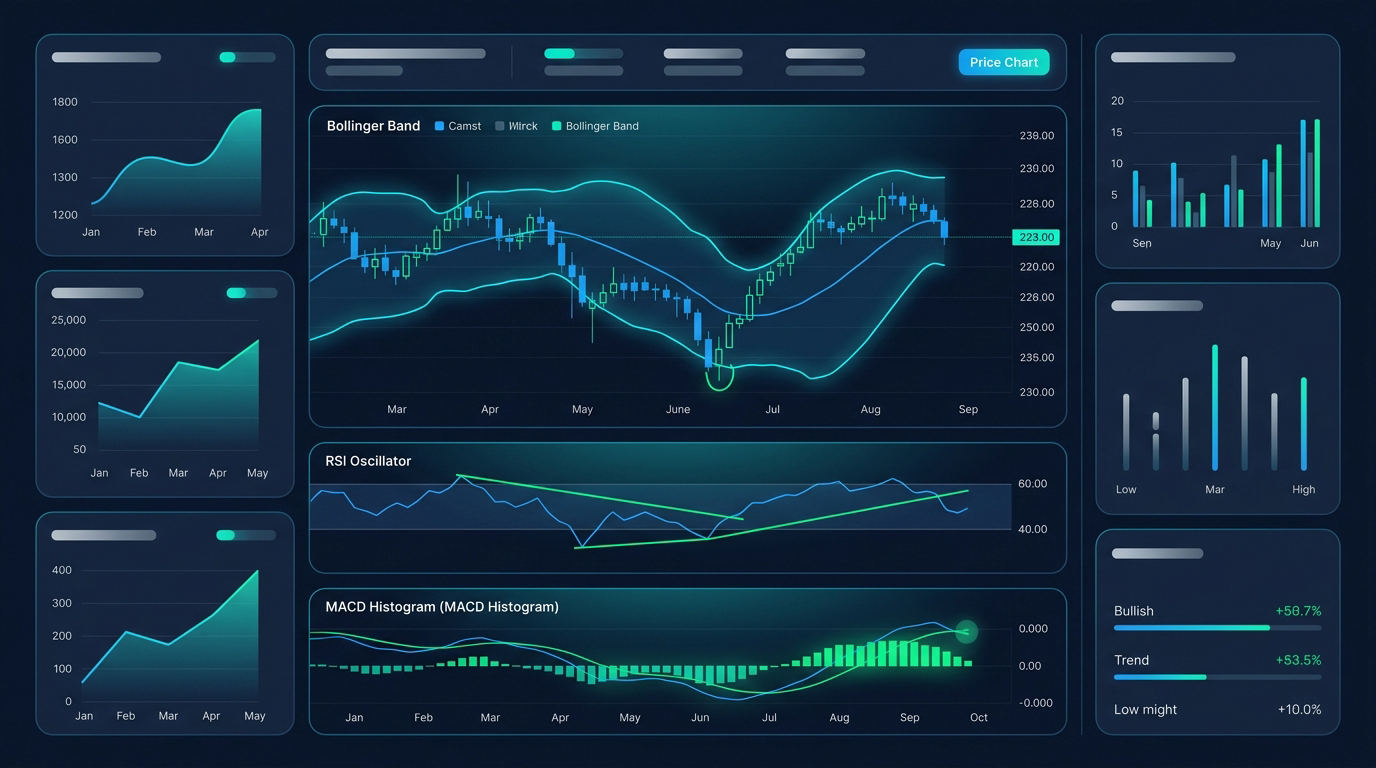
The four primary technical indicators that distinguish genuine breakdowns from bear traps each provide a different lens on the same question: does this sell-off have real momentum behind it?
RSI and MACD divergences are the indicators I weight most heavily. When price makes a new session low but RSI prints a higher low - particularly below the 30 oversold threshold - that divergence represents declining bearish momentum. The market is running out of sellers. Pair that with a MACD histogram that's rising (even while still negative), and the picture of a false breakdown becomes clear.
Bollinger Bands add a probability layer. When price briefly pokes below the lower band and snaps back inside within the same candle or the next, it signals that the market viewed those prices as overextended. The band itself acted as a rubber band pulling price back - a structural tell that the breakdown lacked follow-through. For a broader grounding in safe cryptocurrency trading practices, it's worth understanding how these indicators fit within an overall risk framework.
How to Avoid Bear Traps - Practical Risk Management
No strategy eliminates bear traps entirely - but disciplined risk management can make them survivable. Most traders caught in bear traps don't lose because they had a bad analysis; they lose because they abandoned their risk parameters under pressure. Research on market structure suggests approximately 40% of perceived trend reversals in established uptrends are actually bear traps, which means caution should be your default posture when shorting into an established bullish trend.
⚠ Bear Trap Defense Checklist - Before Shorting Any Asset
- Wait for candle close confirmation → never short on an intraday wick below support; require a daily or 4H candle to close below the level
- Verify volume → require breakdown volume to exceed the 20-period average before treating the move as genuine
- Check RSI and MACD → divergence present = reduce position size or wait for stronger confirmation
- Identify the fundamental catalyst → can you name a specific reason for the continued decline? If not, stay cautious
- Use multiple timeframes → confirm the breakdown on the daily before acting on an hourly signal
- Set your stop-loss before entry → every short position needs a defined max-loss threshold, placed just above the potential recovery level
The psychological dimension of bear traps is where traders consistently underperform. When a trade goes against you, the instinct to freeze - to hold and hope - is almost universal. But every minute you stay in a losing short is a conscious decision to maintain that position. If you weren't already short, would you enter here? If the honest answer is no, covering is the right call.
Bear Trap vs Bull Trap - Key Differences
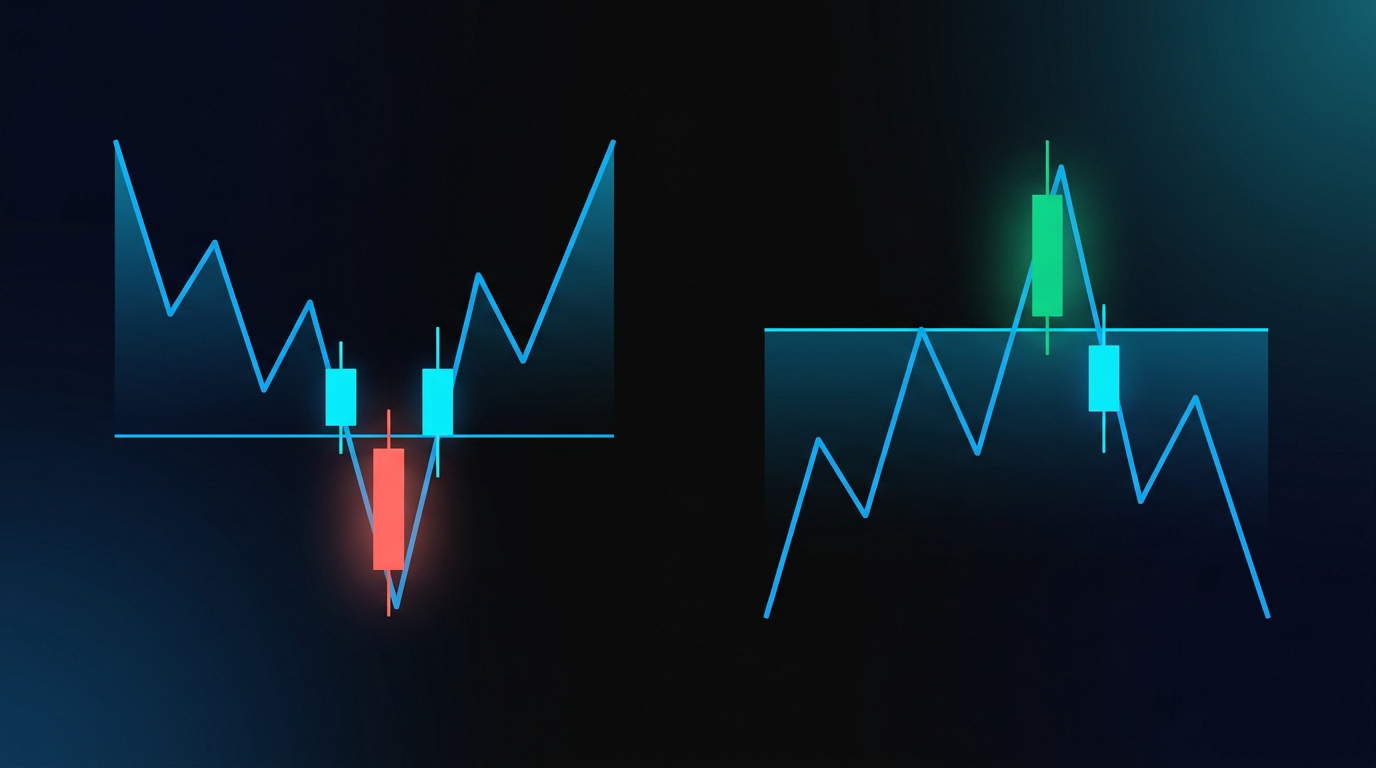
Understanding bear traps in isolation misses half the picture. Their mirror image - the bull trap - operates on identical psychology but in the opposite direction.
Both traps exploit confirmation bias and FOMO - the emotional impulse to act on a clear-looking signal without waiting for confirmation. When both a bear trap and a bull trap appear on the same asset in quick succession, it reliably signals choppy, directionless price action where neither bulls nor bears have genuine control. In those conditions, staying flat is often the highest-probability trade.
In both cases, the defense is identical: patience, volume confirmation, and disciplined stop-losses.
Bear Trap Trading Strategy - How to Profit From the Pattern
Most traders learn about bear traps as a risk to avoid. Experienced traders treat them as entry opportunities. When a bear trap forms and springs, the short squeeze that follows often produces explosive, asymmetric moves - precisely because trapped short sellers are forced to buy regardless of price.
The "trap reversal" entry works as follows:
- Identify the false breakdown - price breaks below a well-defined support level on low volume, then shows divergence signals from RSI or MACD
- Wait for reclaim confirmation - require a candle close back above the broken support level (not just an intraday wick)
- Enter long on the close - the reclaim candle's close is the entry trigger
- Set stop-loss below the false breakout low - this is the structural invalidation point
- Target the next resistance level - the first logical profit-taking point is the previous swing high above current price
Here's a worked example with realistic numbers:
The logic behind the trade is straightforward: trapped short sellers are now forced buyers, and their covering provides consistent upward fuel during the rally. The stop-loss is well-defined and sits at the structural invalidation point. The risk-reward skews favorably because you're entering a confirmed reversal, not guessing at a bottom.
This strategy demands discipline. It doesn't work on every suspected bear trap - only on those with genuine confirmation signals. Beginners should focus on avoidance first; the reversal trade is reserved for traders who can identify the pattern consistently and execute the stop-loss without hesitation.
Popular Trading Strategies and Bear Trap Compatibility
Bear traps interact differently depending on your trading style and timeframe. Here's how each major approach should treat them:
Swing traders face the highest practical exposure to bear traps because they trade on the timeframes where false breakdowns are most consequential and most common. For swing traders, the daily candle close rule is non-negotiable - no position should open based on an intraday penetration of support.

Bear Trap in Crypto - Special Considerations
Crypto markets don't just experience bear traps - they amplify them. Four structural features of crypto trading make false breakdowns more frequent, more violent, and faster-moving than in traditional markets.
📊 Why Crypto Bear Traps Are More Extreme
🐋 Whale Influence
A single wallet controlling 0.5-1% of an asset's supply can engineer a meaningful price dip on thinner exchanges to trigger stop-loss clusters, without the regulatory scrutiny that would prevent similar behavior in regulated equity markets.
⚡ Thin Order Books
Crypto order books, even on major pairs, are substantially thinner than equity index futures. Less capital required to move price means false breakdowns are cheaper to manufacture and easier to engineer.
🕐 24/7 Trading
Bear traps can spring at 3 AM on a Sunday, when institutional buying is less available to cushion the move and retail traders are less alert. Weekend and overnight hours are disproportionately common timing for crypto bear traps.
🔄 Leverage and Liquidation Cascades
When leveraged longs get liquidated during the initial dip, their forced selling amplifies the move downward, making the breakdown look more convincing. Once the liquidations are absorbed, the recovery is equally sharp and fast.
On-chain data provides an additional layer of defense unavailable in traditional markets. Unusually large exchange inflows before a dip - measured via tools like Glassnode or CryptoQuant - can signal that large holders are preparing to sell or execute a liquidity sweep. When on-chain flows contradict the bearish price narrative, that divergence is worth noting.
The Fear & Greed Index is another crypto-specific tool. Extreme fear readings (below 20) during a price dip that occurs within an established uptrend tend to correlate with bear trap conditions. When the crowd is maximally fearful about a move that has no fundamental justification, the contrarian read is often correct.
Whether in crypto or traditional markets, the ultimate defense against bear traps comes down to one thing: the discipline to wait for confirmation before acting on a signal that merely looks bearish. Before committing capital to any short position, it's also worth reviewing the basic principles of safe cryptocurrency trading as a foundational reference.
⚠ Risk Disclaimer
- Crypto trading involves substantial risk of loss → bear trap identification strategies do not eliminate risk and should not be relied upon as the sole basis for trading decisions
- Leveraged positions amplify losses → always manage position sizes according to your individual risk tolerance
- This content is for educational purposes only → it does not constitute financial advice

Conclusion - Navigating Bear Traps With Confidence
Bear traps are a permanent feature of every liquid market - not a glitch in the system, but a feature of how price discovery actually works. Markets have always moved in ways that punish the impatient and reward those who wait for evidence. Understanding bear traps means understanding that a price chart is not a story that reads in one direction; it's a dynamic battlefield where apparent clarity is sometimes manufactured.
⚡ Bear Trap in 5 Points
- A bear trap is a false downtrend signal - price breaks below support, reverses sharply, traps short sellers
- Institutional liquidity engineering is a primary cause in both equity and crypto markets
- Low volume + RSI/MACD divergence at the breakdown = suspect the trap
- Wait for candle close confirmation and use stop-losses - these two rules prevent most bear trap losses
- For experienced traders, the trap reversal pattern offers asymmetric long setups with clearly defined risk
For beginners: Focus entirely on avoidance. Don't short during established uptrends without volume confirmation and a pre-defined stop-loss. When you're unsure whether a breakdown is genuine, the default position is to do nothing - and that's a valid trade.
For intermediate traders: Build RSI and MACD divergence scanning into your pre-trade routine. Check volume relative to the 20-period average before committing to a short. Use the bear trap checklist from this guide as your pre-entry filter.
For advanced traders: The trap reversal strategy offers a consistent framework for profiting from other traders' mistakes. The key edge is patience - waiting for the reclaim candle close, not anticipating it.
The fastest way to develop genuine pattern recognition on bear traps is to review historical charts - on TradingView or equivalent platforms - and identify past examples in assets you trade. A few hours studying the GME 2021 squeeze or Bitcoin's repeated $30K defense will teach you more than theory alone can.
Platforms built on on-chain verifiability and transparent market mechanics reflect a broader direction the industry is heading - toward trustless systems where price action isn't obscured by hidden order flow or opaque intermediaries. Zipmex's self-custodial architecture reflects that trajectory: on-chain, verifiable, with no custodial layer between the trader and their position.
Last updated: April 2026.
Frequently Asked Questions
What is a bear trap in trading?
A bear trap is a false signal in financial markets where an asset appears to break below a key support level - suggesting a downward trend reversal - before reversing sharply upward and trapping short sellers in losing positions. The pattern catches bearish traders at precisely the worst time. When price reverses, those who opened shorts are forced to buy back at higher prices to limit losses, and that forced buying accelerates the rally further. Bear traps occur in all asset classes: stocks, crypto, forex, and commodities.
What is a bear trap in crypto?
In crypto, a bear trap is a false bearish breakdown typically more extreme than in traditional markets due to thinner order books, 24/7 trading, and the influence of large wallet holders (whales). A whale or coordinated group of large holders can push an asset's price briefly below a key support level to trigger stop-loss orders and liquidations, then buy back at the lower price before the market recovers. Bitcoin is particularly prone to bear traps at psychologically significant round-number levels where large clusters of stop-losses are predictably positioned.
How can I spot a bear trap before it springs?
Six warning signals help identify potential bear traps: low or declining volume during the breakdown; RSI oversold below 30 combined with a bullish divergence where price makes a new low while RSI makes a higher low; MACD bullish divergence with the histogram rising while price falls; quick price recovery above support within 1-5 candles; no identifiable fundamental catalyst justifying the decline; and price finding support at a Fibonacci retracement level (38.2%, 50%, or 61.8%) even while appearing to break conventional horizontal support. Multiple signals aligning simultaneously make a stronger case than any single indicator alone.
What is the difference between a bear trap and a bull trap?
A bear trap targets short sellers and occurs during uptrends: price falsely breaks below support, luring in shorts before reversing higher. A bull trap is the exact mirror image - price falsely breaks above resistance during a downtrend, luring in buyers before reversing lower, trapping long positions in a loss. Both traps exploit confirmation bias and FOMO. When both types appear on the same asset in quick succession, it signals choppy, directionless market conditions where staying flat is often the highest-probability trade.
Can I profit from a bear trap pattern?
Experienced traders actively trade bear traps as long entry setups. When a false breakdown is confirmed by volume divergence, RSI/MACD signals, and a reclaim candle close above support, the resulting short squeeze provides an asymmetric trading opportunity. Entry is near the bottom of the trap, the stop-loss sits below the false breakdown low, and the target is the next resistance level. Risk-reward on these setups often ranges from 2:1 to 4:1 because you're entering a confirmed reversal with a clearly defined invalidation point. This is an advanced strategy - consistency requires reliable pattern identification and disciplined stop-loss execution.
What should I do if I am already caught in a bear trap?
If you're already short and a bear trap is springing against you, the priority is decisive action, not paralysis. Check whether your pre-planned stop-loss level has been hit - if yes, exit immediately. Every moment of delay is a conscious decision to hold a losing position. If you entered without a stop-loss, set one now at a defined max-loss threshold rather than hoping for a reversal of the reversal. Avoid the common mistake of averaging into the short to "improve your entry" - adding to a losing short in a bear trap context typically compounds losses as the squeeze intensifies. Preserve capital first; analyze the trade afterward.
How does position sizing protect against bear traps?
Position sizing is the arithmetic layer beneath all bear trap risk management. The core principle: risk no more than 1-2% of total trading capital on any single short position. Calculate this as: (Account Size . Risk %) ÷ Distance to Stop-Loss = Maximum Position Size. On a $10,000 account risking 1%, that's $100 total risk divided by a $500 distance to stop-loss, giving a 0.2 BTC maximum position. Conservative position sizing means a bear trap that hits your stop-loss costs a manageable, planned loss rather than an account-threatening drawdown.