Every time you execute a trade and get filled in milliseconds - no waiting, no hunting for a counterparty - a market maker is behind it. They're one of the most misunderstood participants in financial markets, operating quietly in the background while every retail trade, ETF purchase, and options contract flows through their infrastructure. Understanding what a market maker does, how they profit, and why their presence matters directly affects how you trade and what it costs you.
⚡ Key Takeaways
- A market maker continuously quotes both a buy (bid) and a sell (ask) price for a security, committing to trade at those prices at any moment
- Their primary function is providing liquidity - ensuring there's always a counterparty for any trade
- Profit comes from the bid-ask spread captured across millions of transactions per day, not from directional price bets
- Market makers are heavily regulated entities registered with the SEC, FINRA, FCA, and other bodies depending on jurisdiction
- For traders, market makers determine execution quality, spread costs, and the speed at which orders get filled
What Is a Market Maker? Definition and Core Concept
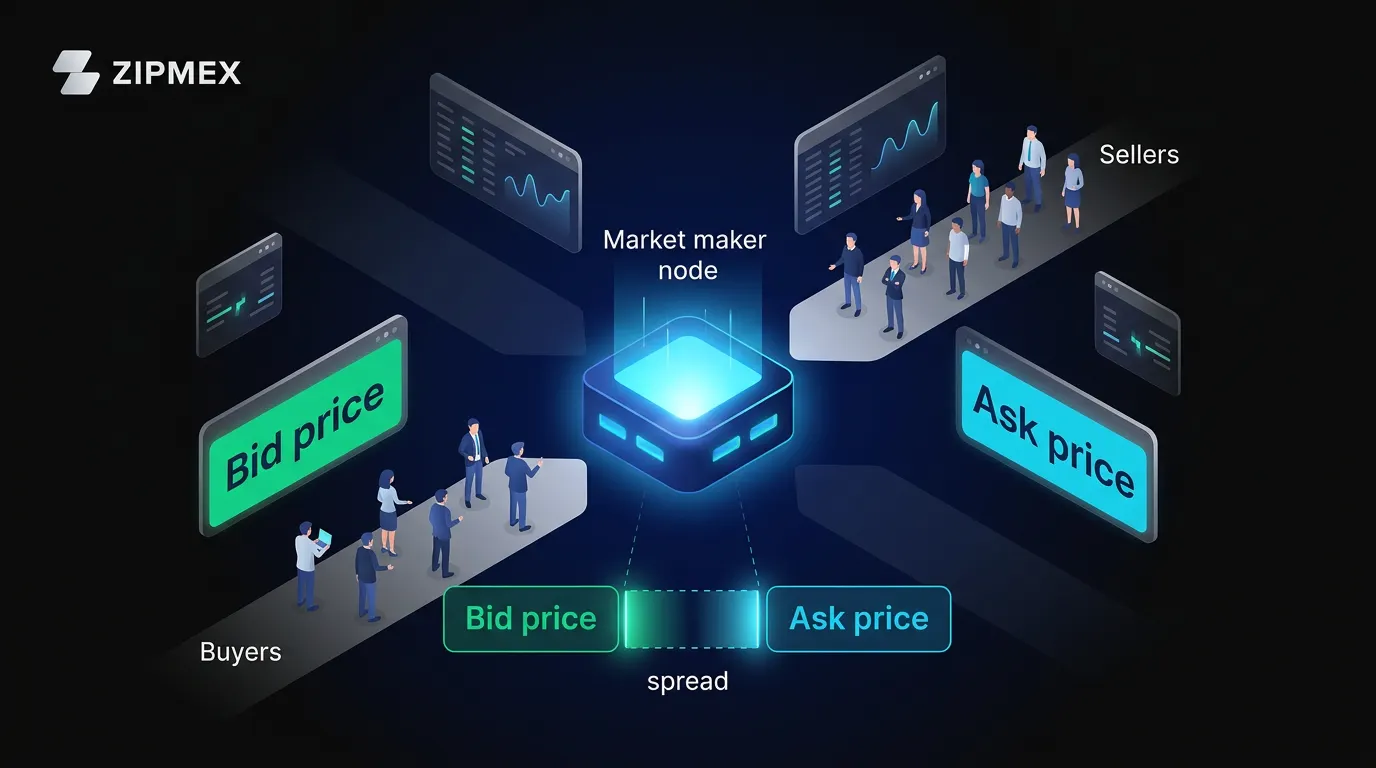
A market maker is a firm or individual that continuously quotes both a bid price and an ask price for a security - and commits to executing trades at those prices, regardless of direction. They'll buy from a seller at the bid and sell to a buyer at the ask, at any point during market hours, without waiting for a natural counterparty to appear.
That last part matters. A standard trader places a buy order and waits for someone willing to sell at the right price. A market maker doesn't wait - they're always there, on both sides, simultaneously. This is what it means to make a "two-sided market." Market makers hold inventory of securities specifically to fill this role: they need actual shares or contracts on hand to sell to buyers, and the capital to absorb inventory from sellers.
The SEC formally defines a market maker as a firm that stands ready to buy and sell stock on a regular and continuous basis at publicly quoted prices. That regulatory definition matters - it creates legal obligations, not just incentives. In practice, a market maker quoting $100.00 bid / $100.05 ask is saying: "I'll buy your shares for $100 right now, and I'll sell them to anyone who wants in at $100.05." The $0.05 difference is the spread - the market maker's gross margin before costs and risk.
In finance, market makers are often called liquidity providers, and the two terms are essentially synonymous in most contexts. Understanding how the maker vs taker dynamic works in crypto is especially useful if you're trading on centralized exchanges, where limit orders and market orders map directly onto this distinction.
How Does a Market Maker Work? Mechanics Explained
The operational cycle of a market maker runs continuously during trading hours and looks like this:
- Post the quote - The market maker publishes a bid and ask for a security (e.g., $100.00 / $100.05)
- Buyer takes the ask - A trader buys at $100.05; the market maker sells from inventory
- Seller takes the bid - A trader sells at $100.00; the market maker buys into inventory
- Spread captured - Across both sides, the market maker earns $0.05 per share on net turnover
- Repeat at scale - This cycle runs thousands of times per second across hundreds of securities
The margin on any individual trade is tiny - fractions of a penny in highly liquid markets. In large-cap equities, the bid-ask spread frequently sits below $0.01 per share. The business model isn't about per-trade margins; it's about volume. A market maker processing 10 million shares per day at a $0.01 spread captures $100,000 in gross spread revenue on that single name alone - before costs, hedging, and risk management.
Modern market makers rely on algorithmic systems and predictive analytics to price securities in real time. Accurate pricing across hundreds or thousands of instruments simultaneously requires infrastructure that would be impossible to run manually. The speed at which a market maker adjusts quotes in response to new order flow, volatility shifts, or cross-asset signals is a primary competitive edge.
The key risk: inventory moves against the market maker. If a market maker buys shares at $100.00 and the price immediately drops to $99.50, they're sitting on a loss before they can offset the position. Managing this - known as inventory risk - is the central operational challenge of market making.
📊 Market Maker Order Cycle - Step by Step
Step 1: Quote posted → $100.00 bid / $100.05 ask
Step 2: Buy order arrives → Market maker sells 500 shares at $100.05
Step 3: Sell order arrives → Market maker buys 500 shares at $100.00
Step 4: Net spread earned → $0.05 . 500 = $25 gross on the round trip
Step 5: Process repeats across thousands of instruments per session
Types of Market Makers: Designated vs. Competing
Not all market makers operate under the same structure. Two primary models govern how they function across different exchanges:
Designated Market Makers (DMMs) are firms officially assigned by an exchange to take responsibility for a specific security. The NYSE's DMM system is the most prominent example - each listed stock has a single firm responsible for maintaining a fair and orderly market in that security. DMMs set the opening price each day (which often differs from the prior close due to overnight order flow), absorb buy/sell imbalances, and are held to explicit regulatory obligations. The NYSE formerly called these participants "specialists" - if you see that term in older financial literature, it refers to the same role.
Competing Market Makers operate differently. NASDAQ's model deploys multiple firms simultaneously quoting prices for the same security. None of them has exclusive obligations, but all are competing to win order flow. That competition drives tighter spreads - firms must continuously outbid each other for business. For investors, a competitive multi-market-maker environment typically means better pricing than a single designated firm with monopoly order flow.
A third category - unofficial or voluntary market makers - operates in order-driven markets without a formal designation. They don't have the obligation to maintain continuous quotes, but they also don't get the competitive advantages that come with a DMM role.
The Role of Market Makers in Financial Markets
Without market makers, you'd need to find your own buyer or seller every time you wanted to trade. Think about what that means in practice: you decide to sell 200 shares of a mid-cap stock at 2:47 PM on a Tuesday. Who's on the other side? Maybe nobody. Maybe someone, but at a price 3% below where you want to sell. The market maker eliminates that problem - they're always there, quoting a price, ready to transact.
Market makers serve four critical functions in the broader market ecosystem:
1. Providing Liquidity - The most fundamental function. By committing to buy and sell at all times, market makers ensure traders can enter or exit positions without waiting for a natural counterparty. U.S. equity markets average over 11 billion shares traded daily - that volume only flows smoothly because market makers continuously absorb and distribute order flow.
2. Maintaining Orderly Markets - Market makers reduce sudden price gaps. When a large sell order hits without a corresponding buyer, the price could collapse. A market maker absorbs part of that order at their bid price, dampening the move. They identify supply/demand imbalances in real time and adjust quotes to signal where equilibrium is forming.
3. Supporting Price Discovery - Prices reflect information efficiently only when there are active participants continuously incorporating new data. Market makers adjust their bids and asks in real time based on order flow, volatility signals, news, and cross-asset movements. Every quote adjustment is a micro-vote on where the security's fair value sits - cumulatively, this is how price discovery works.
4. Supporting ETFs and Less Liquid Assets - Market makers are particularly critical in exchange-traded funds and thinly traded securities, where natural buyer-seller matching would break down without their presence.
⚡ The Four Functions of Market Makers
- 🔵 Liquidity - Always on both sides; trades execute without waiting
- 🟢 Orderly Markets - Dampens volatility; absorbs imbalances
- 🟡 Price Discovery - Continuous quote adjustment reflects new information
- 🟠 ETF Support - Keeps ETF prices aligned with underlying assets
Market Makers and ETF Liquidity
ETFs add a layer of complexity that makes market maker involvement especially important. An ETF's market price must stay aligned with the net asset value (NAV) of its underlying basket of securities. When that alignment drifts, a market maker exploits the discrepancy through arbitrage - and in doing so, corrects it.
The mechanism works through an ETF's creation/redemption process:
- ETF trading at a premium to NAV: The market maker buys the underlying basket of securities and creates new ETF shares, then sells those shares on the exchange. The increased ETF supply drives the price back toward NAV.
- ETF trading at a discount to NAV: The market maker buys the discounted ETF shares and redeems them for the underlying basket, then sells the underlying. Reduced ETF supply pushes the price back up.
This continuous arbitrage keeps premiums and discounts small for most liquid ETFs - typically under 0.1% in normal market conditions. For niche ETFs - international equity ETFs, small-cap sector funds, high-yield bond ETFs - the same mechanism applies, but market makers demand wider spreads to compensate for the higher risk of holding the underlying basket. In DeFi, a structurally similar arbitrage loop governs how locked liquidity works in token pools - the same principle of keeping pool prices aligned with underlying value, enforced by economic incentives rather than a central firm.
📊 ETF Arbitrage Loop
ETF Price > NAV → Market Maker Creates New Shares → ETF Supply Increases → Price Falls to NAV
ETF Price < NAV → Market Maker Redeems Shares → ETF Supply Decreases → Price Rises to NAV
How Market Makers Make Money: The Profit Model
Market makers don't bet on whether prices go up or down. That's a critical distinction. A hedge fund speculates on direction. A market maker profits from the spread - the difference between what they buy at and what they sell at - regardless of where prices move. They're running a high-volume, thin-margin, infrastructure business, not a directional trading operation.
The profit model has three layers:
Layer 1: Bid-Ask Spread - The primary income source. Every time a market maker buys at $100.00 and sells at $100.05, they capture $0.05 gross. The math at scale is compelling:
This explains why market makers obsess over spread width, execution speed, and order flow volume - each component multiplies directly into revenue.
Layer 2: High-Volume Consistency Model - Market makers don't need to win big on individual trades. They need consistency and scale. Bernoulli's law of large numbers is their business model: the theoretical spread captured on every single trade adds up to real, actualized revenue across billions of shares. A market maker losing on 40% of trades can still be highly profitable if they're capturing the spread on the other 60% at enormous volume.
Layer 3: Risk Management and Hedging - This is the cost side that offsets the spread revenue. Market makers actively hedge their inventory positions using derivatives, related securities, and options contracts to neutralize directional exposure. If a market maker is long 50,000 shares of a volatile tech stock, they may short a correlated ETF to offset the directional risk while keeping the position on the books.
One additional nuance worth understanding: price improvement. When market makers compete aggressively for order flow, they sometimes quote prices tighter than the National Best Bid and Offer (NBBO) - the regulatory benchmark for the best publicly available prices. A market maker quoting $50.01 ask when the NBBO ask is $50.03 is providing price improvement to the buyer, giving up part of their own spread.
Inventory Risk and How Market Makers Manage It
Inventory risk is the operational fault line of market making. To provide liquidity, a market maker must hold securities. To hold securities, they're exposed to price movement. If a market maker absorbs a large sell order at $100.00 bid and the stock then gaps down to $97 on breaking news, they've taken a $3-per-share loss across their entire inventory before they can hedge.
Adverse selection deserves specific attention because it's the subtlest risk. When a market maker is on the other side of a trade, their counterparty sometimes knows more than they do - an institutional investor liquidating ahead of a negative earnings release, for example. Market makers use order flow analysis and pattern recognition to identify when incoming order flow might be "informed" versus uninformed retail flow, and they adjust spreads accordingly.
During the COVID crash of March 2020 and the August 2015 flash crash, even major market makers temporarily withdrew from some markets or dramatically widened spreads - acknowledging that inventory risk exceeded the compensation available in the spread.

Market Makers vs. Other Market Participants
The vocabulary around market participants creates genuine confusion, especially for traders who haven't worked inside a trading infrastructure. Market makers, brokers, traders, and institutional investors all interact constantly, but they have fundamentally different roles, incentive structures, and relationships to price risk.
The most important distinction for retail investors is market maker vs. broker. Brokers act as agents - they route your order on your behalf and earn a commission (or receive other compensation, discussed below). Market makers are principals - they take the other side of your trade for their own account. When you click "buy" on a brokerage app, your broker routes that order to a market maker, who then sells you the shares from their inventory. You never interacted with another retail investor. You traded with an institution running a spread business.
Payment for Order Flow (PFOF) - What Retail Traders Should Know
PFOF is one of the more controversial mechanics in retail trading, and it connects brokers and market makers directly. Here's how it works: a brokerage receives compensation from a market maker in exchange for routing retail customer orders to them, rather than to open exchanges.
⚡ PFOF at a Glance
- What it is: A payment from market makers to brokers for routing retail orders to them
- Who benefits: Brokers receive revenue; market makers get predictable, consistent retail order flow
- The controversy: Critics argue it creates conflicts of interest - brokers may prioritize the highest-paying market maker over the one offering the best execution
- Current status (2026): Legal in the US; banned or restricted in the UK, EU, and Canada; under ongoing SEC scrutiny
The defense of PFOF rests on a real data point: retail investors executing through market makers often receive price improvement - execution inside the quoted NBBO spread. The market maker's ability to offset retail flow against institutional order flow internally allows them to sometimes beat the public exchange price. Proponents argue retail investors come out ahead on net, even accounting for the broker-market maker relationship.
The critique is equally valid: the retail investor has no visibility into whether their broker is selecting the market maker offering best execution or simply the one paying the highest rebate. Any retail trader using commission-free brokerage apps should understand this mechanic, because "free" commissions are never actually free.
How Market Makers Impact Retail and Institutional Traders
Every time you trade, market makers influence three things: how fast your order fills, at what price, and what the invisible transaction cost actually is.
Execution Speed is the most visible benefit. Without market makers, a market order to buy 100 shares of a stock would sit in an order book waiting for a matching seller. Market makers eliminate that wait - they're the perpetual counterparty. For liquid securities, fills happen in microseconds.
Spread Cost as Transaction Cost is less visible but more financially significant over time. Every retail trade "crosses the spread," meaning you buy at the ask price and sell at the bid. The midpoint between bid and ask is the theoretical fair value. The spread is what you pay to transact immediately rather than waiting. For large-cap, highly liquid stocks, this cost might be $0.01 per share - essentially negligible. For small-cap or thinly traded securities, spreads can reach 1-2% of the share price, which is a meaningful drag on returns. The same logic applies in perpetual futures markets - understanding how funding rates interact with spread costs is critical for any derivatives trader managing their total cost of position.
Slippage during volatility compounds spread costs. When markets dislocate - during earnings surprises, central bank announcements, or major macro events - market makers widen spreads dramatically to compensate for elevated inventory risk. A stock that normally trades with a $0.02 spread might suddenly show a $0.50 spread during an earnings release. Retail traders executing market orders in these windows absorb significantly worse prices than they'd see during normal conditions.
Price Improvement is the upside. Competitive market making frequently results in fills inside the quoted spread. If the posted ask is $100.05 and your order fills at $100.03, you've received $0.02 per share in price improvement - directly out of the market maker's margin.
⚠ How to Trade Smarter Around Market Makers
- Use limit orders for illiquid or volatile securities - never submit market orders into thin markets
- Trade during peak hours (mid-session, 10 AM - 3 PM ET for US equities) when spreads are tightest
- Check the bid-ask spread before entering any position - a spread above 0.5% of price is a real cost worth factoring
- Be cautious with market orders during major economic announcements, earnings releases, or market open/close - spreads widen significantly at these moments
Institutional investors face a different version of this problem: market impact. When a pension fund needs to buy 2 million shares of a mid-cap stock, their own buying activity will move the price against them. Market makers absorb part of that flow, but large institutional orders are still managed carefully - typically broken into smaller tranches - precisely to avoid signal-broadcasting their position to market makers who might adjust quotes accordingly.

Market Makers Across Different Asset Classes
Market making doesn't just happen in stocks. The same core principle - continuously quoting bid and ask, profiting from the spread, managing inventory risk - applies across virtually every tradable instrument. The specifics vary significantly by asset class.
Forex deserves special attention: almost every forex trading firm is itself a market maker. There's no central forex exchange. The entire interbank FX market is a dealer network where participants continuously quote bid and ask prices for currency pairs. When a retail trader buys EUR/USD through a broker, they're typically trading against the broker's own market making desk, not against another retail participant.
Options market makers have a particularly complex job. They're quoting prices for thousands of contracts (different strikes and expiries) on the same underlying simultaneously. Each options contract has directional exposure (delta), volatility exposure (vega), time decay (theta), and second-order effects. Options market makers continuously run delta hedges - buying or selling the underlying stock to offset the directional exposure created by their options book. It's arguably the most technically demanding form of market making.
Crypto and DeFi introduce a conceptually related but technically distinct model: the Automated Market Maker (AMM). Instead of a firm or individual quoting prices, AMMs use algorithmic liquidity pools governed by mathematical formulas (typically constant product: x . y = k). Liquidity providers deposit assets into these pools and earn fees from traders. The "market maker" here is the algorithm and the pool, not a human operator. If you're deploying capital into DeFi protocols, the complete AMM guide covers how these systems price assets, how impermanent loss works, and how liquidity depth affects your execution. This decentralized model powers the majority of on-chain trading activity in DeFi - and it operates without custodians, central authorities, or the regulatory framework that governs traditional market makers.
Regulation and Oversight of Market Makers
Market making is one of the most regulated activities in finance. That's by design - the market infrastructure that market makers provide is too critical to leave unmonitored.
In the US, market makers are registered with both the SEC and FINRA. Obligations include maintaining continuous two-sided quotes during market hours, adherence to position limits, reporting requirements, and compliance with best execution standards. NYSE DMMs carry additional explicit obligations: they must facilitate price discovery at the open, absorb order imbalances, and maintain fair and orderly markets even during stress.
Naked short selling - selling shares without first borrowing them - is generally prohibited for most market participants. Official market makers are granted a limited exemption because their role sometimes requires selling securities they don't yet own to maintain continuous liquidity. This exemption is tightly controlled and has been progressively restricted by regulatory reforms since the mid-2000s. It's not a loophole; it's a specifically authorized operational tool for maintaining market function.
One risk worth knowing: regulatory arbitrage. Market makers operating in less-regulated jurisdictions can sometimes undercut firms that bear higher compliance costs. For investors, this is a reminder that the market maker on the other side of your trade may not be subject to the same oversight standards as a US-registered firm.

Conclusion - Why Market Makers Matter for Every Investor
The near-instant execution you take for granted in modern investing - the sub-second fills, the penny-wide spreads on major stocks, the ETFs that track their benchmarks precisely - exists because of a competitive market-making ecosystem operating continuously behind every trade. Remove market makers and you'd quickly discover what markets look like without them: wider spreads, longer waits, more volatility, and significant gaps between where you want to trade and where you can.
For retail investors, three practical takeaways stand out: First, the bid-ask spread is a real transaction cost - for liquid large-cap stocks it's negligible, but for thinly traded securities it's a drag worth calculating before entering a position. Second, "commission-free" brokerage accounts route your orders through PFOF arrangements with market makers - understanding this doesn't mean you should avoid them, but it means you should use limit orders in volatile conditions to maintain price control. Third, checking the spread before placing a market order takes about two seconds and can save meaningful money on anything outside the most liquid instruments.
For institutional investors, market maker infrastructure is foundational to large-block execution. Breaking orders into tranches, timing execution to avoid signal broadcasting, and selecting execution venues carefully - these practices exist precisely because market makers are always watching order flow for information they can use.
For everyone, the evolution of market making is worth following. Algorithmic and AI-driven market making is accelerating, with machine learning models now pricing risk and adjusting quotes faster than any human could. In decentralized finance, AMMs are rewriting the market making model entirely - replacing firms with algorithmic pools, replacing regulation with on-chain smart contract code, and replacing trust in institutions with cryptographic verifiability. Platforms built on transparent, on-chain mechanics are demonstrating that markets don't require a central firm absorbing inventory risk - they can be governed by code, auditable by anyone, with outcomes verifiable in real time. For a deeper look at how this evolution plays out in practice - including how wrapped tokens expand cross-chain liquidity without requiring a centralized market maker - the DeFi infrastructure layer is where the next chapter of market making is being written.
The bid-ask spread, liquidity provision, and price discovery are concepts that apply whether you're trading large-cap stocks on the NYSE or perpetual futures on a self-custodial DeFi platform. Understanding how market makers operate makes you a more informed trader in every environment where they exist - and a more discerning participant in the environments where they're being replaced.
Last updated: April 2026.
Crypto and derivatives trading involves substantial risk of loss. Leveraged instruments can result in losses exceeding your initial deposit. This content is for educational purposes only and does not constitute financial advice. Assess your risk tolerance before engaging with any financial market.
Frequently Asked Questions
What is a market maker in simple terms?
A market maker is a firm or individual that continuously quotes both a buy price (bid) and a sell price (ask) for a security, committing to trade at those prices at any time. Their core function is providing liquidity - ensuring there's always a counterparty available when you want to buy or sell. Without market makers, you'd need to wait for a natural buyer or seller to appear at your price, which in many markets could take minutes, hours, or never. Market makers eliminate that friction in exchange for capturing the small difference between their bid and ask prices across a massive volume of trades.
How do market makers make money?
Market makers profit primarily from the bid-ask spread - the difference between what they pay for a security and what they sell it for. With spreads that can be fractions of a penny on highly liquid securities, profitability depends entirely on volume: executing millions of trades per day converts those tiny per-trade margins into substantial revenue. They also actively hedge their inventory positions using derivatives to manage directional risk, and in some markets receive payment from brokers (known as PFOF) for routing retail order flow to them. Market makers don't bet on price direction - their model is spread capture, not speculation.
What is the bid-ask spread and why does it matter?
The bid-ask spread is the gap between the highest price a buyer will pay (bid) and the lowest price a seller will accept (ask). For a stock quoted at $100.00 bid / $100.05 ask, the spread is $0.05. Every time you execute a market order, you pay the ask price to buy or receive the bid price to sell - meaning you immediately lose the spread on entry. For liquid large-cap stocks, spreads are typically $0.01-$0.03 per share and functionally negligible. For small-cap or thinly traded securities, spreads can reach 1-4% of share price, representing a significant real transaction cost that reduces net returns. Understanding maker vs taker fee structures on crypto exchanges maps directly onto this same dynamic.
What is Payment for Order Flow (PFOF)?
PFOF is a compensation arrangement where brokerage firms receive payments from market makers in exchange for routing retail customer orders to them rather than to open exchanges. The market maker benefits from receiving consistent, predictable retail order flow. The broker earns revenue that supports commission-free trading. The retail investor gets faster execution and often price improvement - but has limited visibility into whether their broker prioritized best execution or highest rebate. PFOF remains legal in the United States as of 2026, while the UK, EU, and Canada have restricted or banned the practice. The SEC has proposed reforms targeting order routing transparency, but the regulatory landscape continues to evolve.
What is a market maker in crypto and DeFi?
In centralized crypto exchanges (CeFi), market makers operate similarly to traditional finance - firms or individuals post continuous bid/ask quotes and earn the spread. Many exchanges run formal market maker programs, offering incentives like reduced fees or rebates. In decentralized finance (DeFi), the concept shifts fundamentally: automated market makers (AMMs) replace firm participants with algorithmic liquidity pools. There's no designated firm - anyone can deposit assets and become a liquidity provider, earning trading fees proportional to their pool share. The AMM model eliminates the need for a central counterparty and operates transparently, with all pricing logic governed by on-chain smart contracts.
How do market makers affect ETF prices?
Market makers keep ETF prices aligned with the net asset value (NAV) of their underlying assets through a continuous arbitrage process. When an ETF trades at a premium to NAV, market makers buy the underlying securities, create new ETF shares, and sell them - pushing the ETF price back toward NAV. When the ETF trades at a discount, they buy the ETF and redeem shares for the underlying basket. This mechanism keeps premiums and discounts tight for liquid ETFs - typically under 0.1% in normal conditions. For niche or less liquid ETFs, wider premiums and discounts signal that market makers are demanding higher compensation for the complexity of the arbitrage.
Are market makers regulated?
Yes. Market making is one of the most heavily regulated activities in finance. In the US, market makers must register with the SEC and FINRA, comply with continuous quoting obligations, maintain capital requirements, and adhere to best execution standards. Exchange-designated market makers (NYSE DMMs) carry additional explicit obligations. Globally, market makers operating across jurisdictions must register with relevant local bodies - the FCA (UK), CFTC (US derivatives), HK SFC (Hong Kong), IIROC (Canada), and others. Operating as an unregistered market maker in regulated markets carries significant legal exposure.
ZIPMEX promotes trading on trade.zipmex.com. Promotions are labelled and kept separate from news coverage, which is selected and checked without regard to them. Perpetual futures are leveraged derivatives. Prices can move fast and you can lose all of your margin. Not available in every jurisdiction. Not investment advice.