Two lines. One pressing higher with each bounce. One holding the ceiling, unmoved.
That tension is the ascending triangle pattern - one of the most recognizable and reliably bullish setups in technical analysis. When a flat horizontal resistance meets an upward-sloping support line, it doesn't signal indecision. It signals accumulation. Buyers are getting more aggressive with every pullback while sellers defend the same level. Eventually the ceiling breaks - and when it does, the trade setup is clean, measurable, and repeatable.
This guide covers everything: how to identify the ascending triangle on any chart, how to confirm a genuine breakout, how to set entries, stops, and targets, and how to avoid the false breakouts that trap impatient traders. Before diving in, it helps to be comfortable reading cryptocurrency charts - the pattern recognition skills in that foundation apply directly here.
⚡ Key Takeaways
- The ascending triangle is a bullish continuation pattern formed by a flat resistance line and a rising support trendline
- It carries a clear bullish bias - ascending triangles break upward more often than downward according to historical pattern studies
- Breakout confirmation requires a candle close above resistance, ideally with expanding volume
- The measured-move target equals the height of the triangle base projected upward from the breakout point
What Is an Ascending Triangle Pattern? Definition and Structure
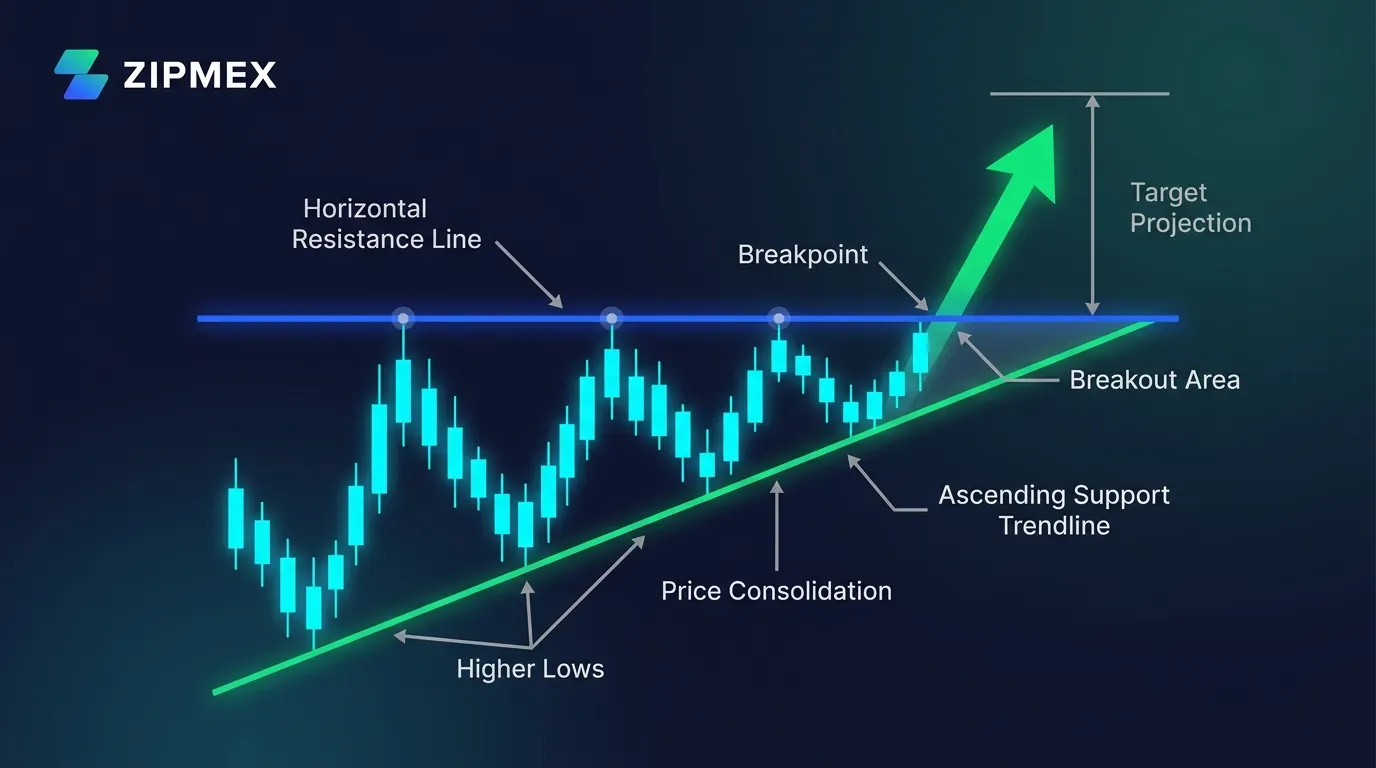
The ascending triangle pattern is a bullish chart formation defined by two converging trendlines: a horizontal resistance line connecting a series of roughly equal highs, and an upward-sloping support line connecting a series of successively higher lows. The shape creates a right angle at the left side of the pattern - which is why it's also called a right-angle triangle - with the two lines converging toward a point (the apex) on the right.
The pattern signals accumulation. As price oscillates between the flat ceiling and the rising floor, each new low forms higher than the last. That's buyers stepping in sooner and at better prices with each pullback - a measurable shift in market sentiment. Sellers, meanwhile, keep defending the same overhead level, as if a large supply zone sits there. The result is a price structure that compresses tighter over time until buying pressure overwhelms supply and a breakout occurs.
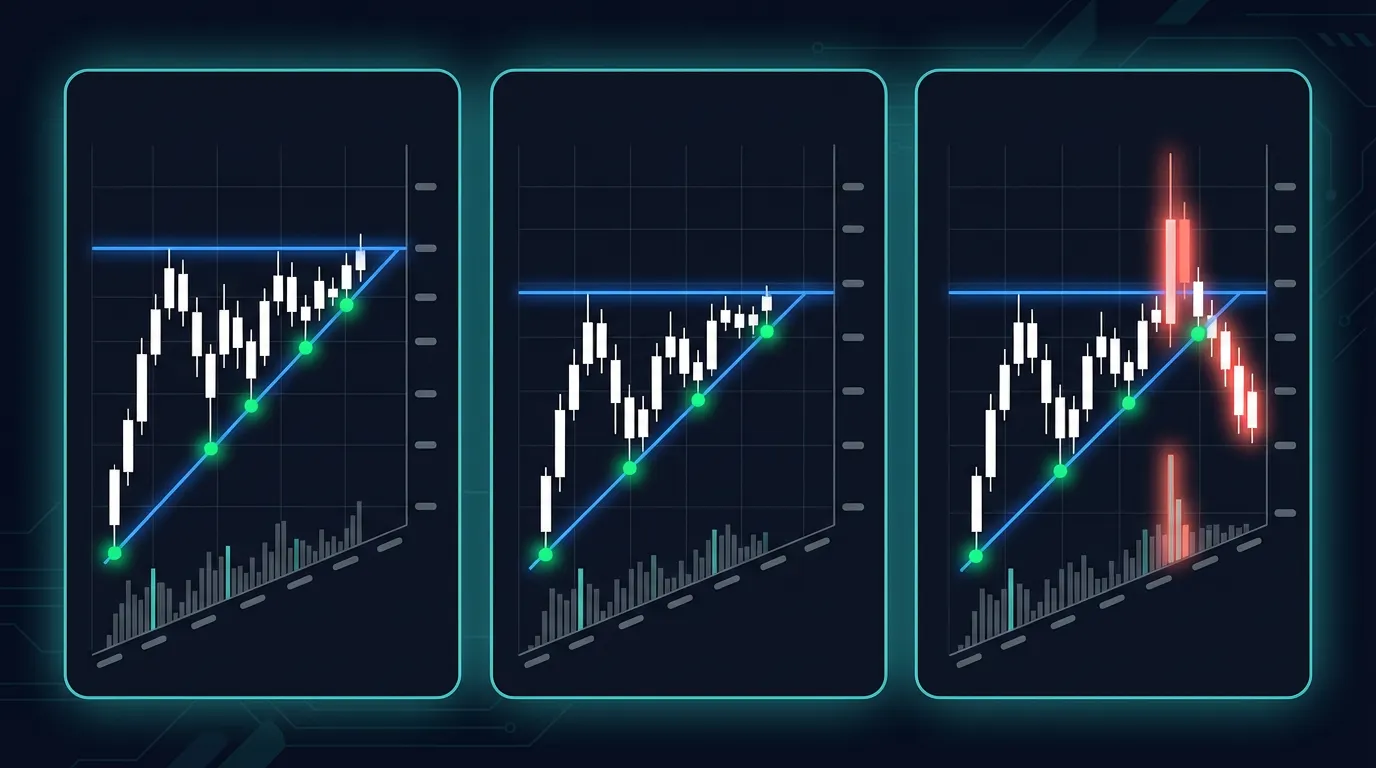
Volume typically contracts during formation - a healthy sign of coiling energy - then expands sharply at the breakout. Confirming the breakout with RSI or MACD alongside volume isn't mandatory, but it dramatically filters out the false moves that cost traders money.
While the ascending triangle most often forms mid-uptrend as a continuation pattern, it can also appear at the end of a downtrend as a reversal. The bullish bias holds either way.
To understand why this setup is so reliable, let's look at each component in detail.
Key Components: Resistance Line, Rising Lows, and Volume
Five structural requirements define a valid ascending triangle. Miss any one of them and the pattern's reliability drops considerably.
- At least two equal reaction highs - price needs to test the same resistance level at least twice, forming a flat horizontal line. Three or more tests make the level more significant.
- At least two successively higher reaction lows - each pullback must bottom out higher than the previous one. This is non-negotiable.
- Each trendline tested at least twice - ideally 2-3 touches per line for validity.
- Volume contracting during formation - decreasing volume through the consolidation phase signals that the market is coiling for a move, not breaking apart.
- Formation duration of weeks to months - most valid ascending triangles develop over one to three months. Intraday "triangles" carry significantly more noise.
⚠ Critical Validation Rule
- Equal or lower low → ascending triangle is invalidated immediately
- Rising lows are the entire basis → for the bullish bias - if they stop rising, the setup no longer exists
- Low-volume breakout → treat as unconfirmed; wait for the next candle
📊 Is Your Ascending Triangle Valid? Checklist
- Two or more equal highs forming a flat resistance level
- Two or more successively higher lows forming a rising support line
- Each trendline tested at least twice
- Volume is contracting during pattern formation
- Pattern has been developing for at least 2-3 weeks
Market Psychology Behind the Pattern
Every ascending triangle tells a specific story about who's winning and losing in the market.
Sellers are positioned at a fixed price level - a resistance zone they've defended repeatedly. Each time price approaches that level, sell orders flood the market and push price back down. But here's what's shifting: buyers are stepping in sooner after each rejection. Where they previously waited until price dropped to $45 before buying, they're now entering at $47, then $49. Those higher lows are buyers becoming more aggressive, more convinced that the level will eventually break.
The flat resistance says sellers are holding the ceiling. The rising support says buyers are losing patience and tightening the vice. When the ceiling finally cracks, it's not a surprise - it's the logical end point of that accumulation process.
Higher lows = buyers getting bolder. Flat resistance = sellers holding the ceiling. Eventually, something has to give.
Ascending Triangle as Continuation vs. Reversal Pattern
Most technical analysis textbooks present the ascending triangle solely as a continuation pattern - and they're right that this is the most common context. Price is in an established uptrend, consolidates within the triangle, then continues higher on the breakout.
What gets less coverage is its reversal role. When an ascending triangle forms at the end of a downtrend, it can signal the exhaustion of selling pressure. The same mechanics apply: flat resistance, rising lows, accumulation. The bullish bias holds regardless of what preceded the pattern. Whether it's continuation or reversal, what matters most is the quality of the formation itself - valid higher lows, tested resistance, and contracting volume.
Regardless of context, the identification process is the same - and it's where traders most often go wrong.
How to Identify an Ascending Triangle on Any Chart
Spotting the pattern correctly takes a systematic approach. Traders who eyeball triangles without checking the structural rules end up trading setups that don't qualify - and wonder why their win rate underperforms.
Here's the five-step identification process:
- Find an existing uptrend or consolidation phase - look for a stock, pair, or asset that has made a significant move up and is now trading sideways or pulling back
- Identify two or more equal highs - draw a horizontal line connecting those highs; this is your resistance level
- Connect two or more successively higher lows - draw a line from the first significant low through each subsequent higher low; this is your ascending support
- Check apex positioning - the pattern should be resolving in the first 75% of the way to the apex. If price is already at 90% of the way to convergence with no breakout, the setup is stale and unreliable
- Verify volume behavior - volume should be visibly declining from the left side of the pattern toward the apex. Expanding volume during formation weakens the setup
The most reliable ascending triangle setups appear on 4-hour, daily, and weekly charts. On shorter timeframes, market noise creates false structural features that don't hold up.
Practical Note: If price is coiling very close to the apex without breaking out, don't enter. The pattern should resolve cleanly. When price grinds to the very tip of the triangle with no breakout, the formation often collapses into choppy sideways movement rather than a clean directional move.
Once identified, the next step is trading it profitably.
Ascending Triangle Across Markets - Stocks, Forex, and Crypto
The structural rules for identifying an ascending triangle are identical across all liquid markets. What differs is how you confirm the breakout.
In stocks, volume data from exchanges is clean and highly reliable for breakout confirmation. In forex, true volume isn't available centrally - tick volume or the On-Balance Volume (OBV) indicator serve as reasonable proxies. In crypto markets, ascending triangles form frequently and visibly, but false breakouts are a real hazard. Bitcoin and ETH ascending triangles on the daily or weekly chart are more reliable than the same pattern on smaller-cap altcoins, where lower liquidity and thinner order books mean resistance levels get spiked and quickly reclaimed more often than in equities. Requiring a full daily candle close above resistance - not just an intraday wick - is a minimum standard for confirmation in crypto.
How to Trade the Ascending Triangle Pattern - Entry, Stop-Loss, and Target
Identifying the pattern is half the work. Executing the trade with defined risk and a logical target is where most traders either lock in consistent profits or give back everything they gained on identification.
The ascending triangle trading strategy involves three precise decision points: where to enter, where to place the stop-loss, and where to take profit.
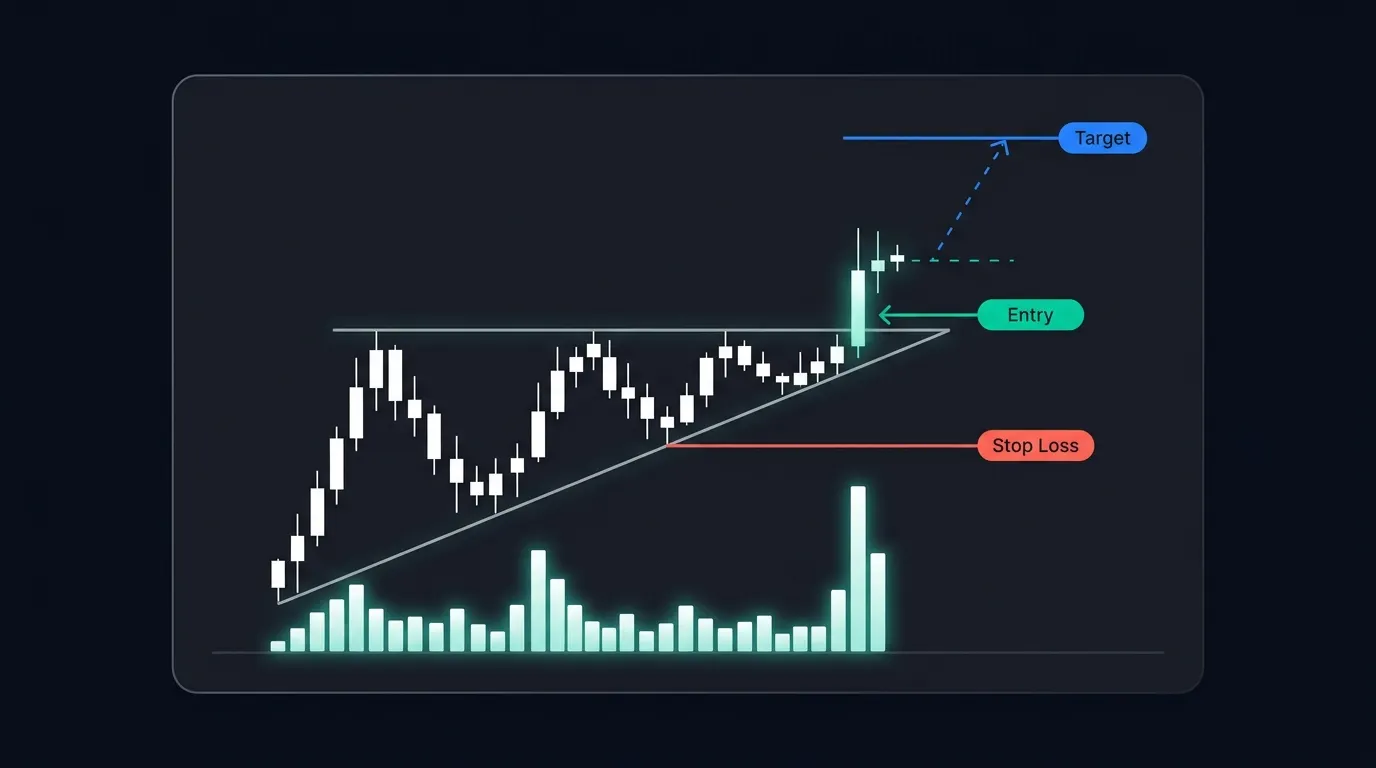
Entry: The breakout candle close above horizontal resistance is your trigger. Don't enter on an intraday wick above resistance - wait for the candle to close. A close above resistance with volume expanding above the 20-period average is the ideal confirmation.
Stop-Loss: Place the stop just below the most recent higher low within the triangle. This is the last piece of evidence for the bullish case - if price reverses below it, the setup is invalidated. Some traders use a tighter stop 1-2% below the breakout level itself, particularly after the resistance-turned-support is retested.
Target: The measured move. Measure the vertical height of the triangle at its widest point (from the horizontal resistance down to the lowest low at the start of the pattern). Project that distance upward from the breakout point.
A minimum 1:2 risk-reward ratio is worth enforcing on ascending triangle trades. The pattern's historical upward breakout rate and the measured-move methodology make it a mathematically favorable setup - provided every trade carries a defined stop-loss.
But how do you avoid false breakouts? Confirmation indicators are the answer.
Confirming the Breakout - Volume, RSI, and MACD
No single confirmation method is foolproof, but combining two or three indicators creates a meaningful filter against weak breakouts.
Volume is the non-negotiable. If volume doesn't expand on the breakout, treat the move as unconfirmed regardless of what price does. RSI above 50 adds momentum confirmation. A MACD bullish crossover - especially if it happens as price nears the apex - is a strong precursor that often telegraphs the breakout before it happens.
Entry Strategies - Aggressive vs. Conservative Approach
Two entry methods dominate ascending triangle trading, and which you use should depend on your risk tolerance and experience level.
Aggressive Entry: Enter at the close of the first candle that closes above horizontal resistance. You get the best price and the largest share of the measured move. The downside is exposure to false breakouts.
Conservative (Retest) Entry: Wait for price to pull back and retest the broken resistance level, which should now act as support. Enter when price bounces off that level. Throwbacks to the breakout zone are common on ascending triangles - meaning this opportunity is available more often than most traders realize.
⚡ AGGRESSIVE ENTRY
Entry: $50.25 (breakout candle close)
Stop: $47.50 (last higher low)
Target: $58.00
Risk: $2.75 . R:R = 1:2.8
✓ CONSERVATIVE (RETEST) ENTRY
Entry: $50.35 (bounce off former resistance)
Stop: $49.50 (below retest low)
Target: $58.00
Risk: $0.85 . R:R = 1:8.9
The conservative retest entry offers dramatically better risk-reward because the stop can sit much closer to the entry. For traders new to ascending triangles, the retest approach is worth the patience. Even with proper entries, false breakouts can and do occur - here's how to recognize and manage them.
Ascending Triangle vs. Similar Chart Patterns - Key Differences
Pattern misidentification is one of the most expensive mistakes in technical analysis. Three patterns get confused with the ascending triangle often enough to warrant a direct comparison.
Ascending Triangle vs. Rising Wedge - The Critical Distinction
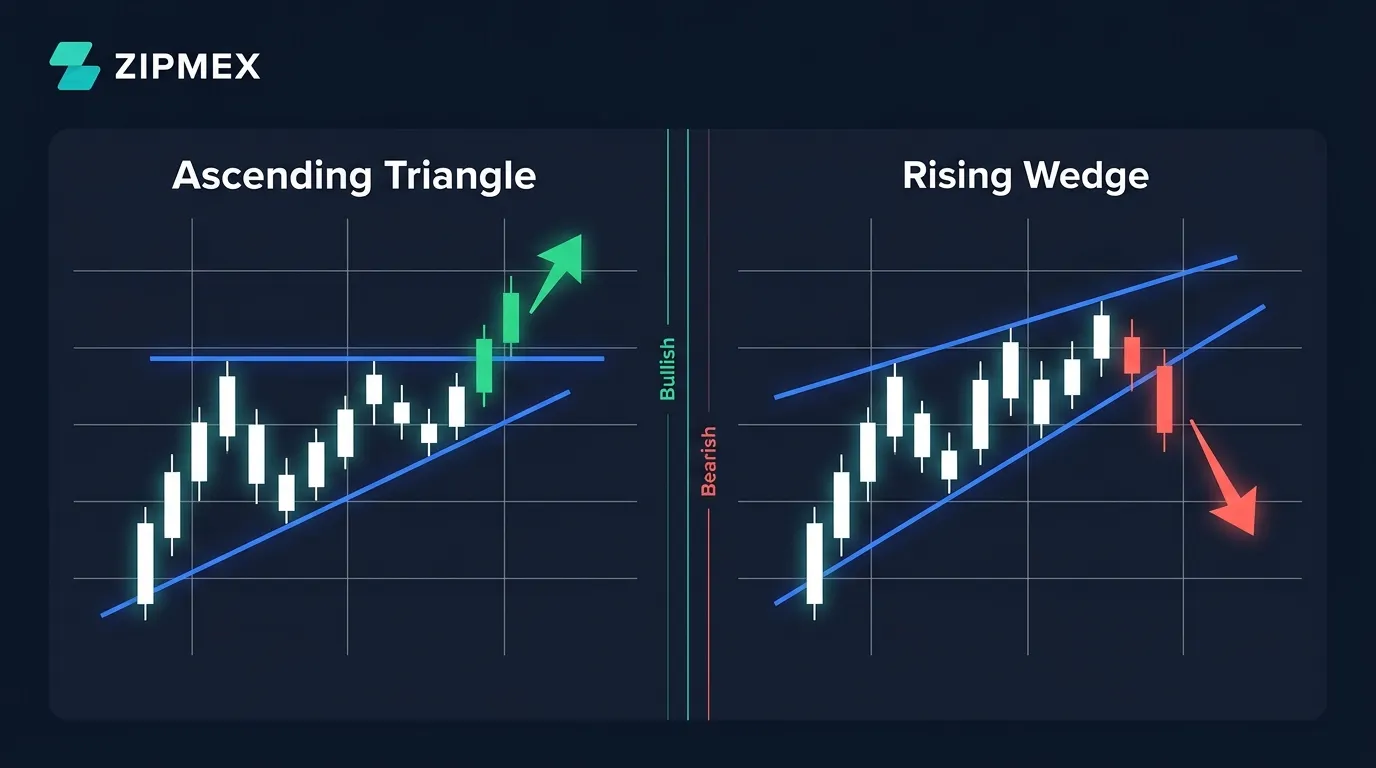
This is the comparison that trips up most traders. Both patterns have an upward-sloping lower support line. The difference is the upper line: in an ascending triangle, the upper line is flat. In a rising wedge, both lines slope upward with the lower line rising faster - creating a narrowing, wedge-shaped formation. The ascending triangle signals bullish continuation. The rising wedge signals bearish reversal. Trading one as the other produces the exact opposite result from what you expected.
The quick test: look at the upper trendline. Flat = ascending triangle (bullish). Sloping upward = rising wedge (bearish). That single check prevents the most common misidentification. Our falling wedge pattern guide covers the wedge family in full detail if you want to go deeper on those structures.
Ascending Triangle vs. Symmetrical Triangle
The symmetrical triangle has no inherent directional bias - lower highs and higher lows converge toward the apex, and the breakout direction determines where price heads. The ascending triangle has a built-in bullish bias because buyers are demonstrably stepping up (higher lows) while sellers hold a fixed level. Different patterns, different probabilities.
Ascending Triangle vs. Descending Triangle
The descending triangle is the mirror image: flat support floor with declining resistance. Where the ascending triangle signals that buyers are gradually winning, the descending triangle shows sellers winning - each bounce reaches a lower high, and the flat support eventually gives way downward.
Common Mistakes, False Breakouts, and Pattern Limitations
Even the best chart patterns fail. Here's what goes wrong with ascending triangle trades and how to protect yourself.
⚠ 5 Ascending Triangle Mistakes to Avoid
- Entering on an intraday wick → wait for a full candle close above resistance; wicks above resistance happen frequently and mean nothing without a close
- Ignoring volume at breakout → a low-volume breakout is a suspect breakout, regardless of how clean the pattern looked
- Entering near the apex → patterns that reach 90%+ of the way to convergence without breaking have lower reliability
- Skipping the rising-lows validation → confirm every pullback made a higher low than the previous one; an equal or lower low invalidates the setup
- Confusing with a rising wedge → check whether the upper trendline is flat (ascending triangle) or sloping upward (rising wedge); these carry opposite implications
The throwback rate on ascending triangles also deserves attention here. Even after a valid upside breakout, price frequently returns to test the breakout level before continuing higher. Traders who set stops too tightly just below the entry price - rather than below the last higher low - frequently get shaken out of legitimate trades.
How to Handle a False Breakout - Practical Management
When a false breakout happens, your stop-loss does its job. Here's how to make sure it does:
Rule 1 - Never enter on a wick. Only a candle close counts. An intraday spike above resistance that reverses before close is market noise.
Rule 2 - Require volume. If the breakout candle doesn't show volume meaningfully above the recent average, stay out or reduce position size to a probe entry.
Rule 3 - Reassess, don't revenge-trade. Getting stopped out on a false breakout doesn't invalidate the underlying setup. Price often consolidates further and makes another, stronger breakout attempt. Watch for the next higher low to form and treat it as a new entry opportunity.
Rule 4 - Size down in noisy environments. In crypto markets or low-cap stocks, consider cutting your standard position size by 50% to account for higher false-breakout frequency.
Trading Strategies Using the Ascending Triangle Pattern
Now that you know how to manage risk, here's how professional traders embed the ascending triangle into a complete trading system.
The ascending triangle trading strategy isn't one-size-fits-all. Different traders operate on different timeframes, with different risk profiles and holding period tolerances. The pattern adapts well to all of them - what changes is how you set entries, stops, and the confirmation threshold you require.
Combining the ascending triangle with trend-confirmation tools like Moving Averages and momentum indicators like RSI creates a layered approach that filters weak setups and identifies the highest-probability breakouts. A pattern forming above the 200-day moving average in a stock with rising RSI on the daily chart is fundamentally a stronger setup than an isolated ascending triangle with mixed indicator context.
📊 Multi-Timeframe Ascending Triangle Trading Process
Step 1 - Weekly Chart
Price above 50-week MA? Broader trend is bullish. Identify sector/market momentum context.
Step 2 - Daily Chart
Locate the ascending triangle formation. Verify higher lows, flat resistance, volume contraction. Mark breakout level and measured-move target.
Step 3 - 4-Hour Chart
Monitor for breakout candle close. Check RSI (above 50, trending up) and MACD (bullish crossover). Confirm volume expansion.
Step 4 - Execute
Enter on confirmed 4H or daily candle close above resistance. Set stop below last higher low. Set target at measured move. Partial profit at 50% of target.
When all three timeframes align - bullish weekly trend, valid daily pattern, confirmed 4H breakout - the probability of a successful ascending triangle trade increases substantially compared to acting on the daily pattern alone.
Popular Trading Strategies That Use Ascending Triangles
Swing Trading is the natural fit for the ascending triangle given its multi-week formation period. Enter on the daily breakout candle close, target the measured move over the following one to three weeks, and stop below the last higher low. RSI on the daily providing bullish divergence as price compresses is a strong secondary confirmation signal.
Breakout Day Trading on 1-hour or 4-hour charts works for active traders who find multiple setups per week. The key requirement is high volume confirmation - a breakout on a 4H chart with volume measurably above the 20-period average is significantly more reliable than a low-volume drift above resistance.
Trend Following places the ascending triangle as a continuation entry within a larger weekly uptrend. Price is in a strong trend, pulls back into the triangle formation, and the breakout signals the next leg higher. In genuine trending markets, the measured move target is often just the beginning.
Position Trading on weekly chart ascending triangles - on major assets like Bitcoin or large-cap equities - represents months of genuine accumulation. These trades move slowly but the measured move targets are proportionally larger.
Risk Management and Position Sizing for Ascending Triangle Trades
The cleanest setup produces losses if position sizing is wrong. Here's the framework.
Stop-Loss Placement: The preferred stop sits just below the most recent higher low within the triangle. A secondary option is placing the stop 1-2% below the breakout resistance level, particularly when using a conservative retest entry.
Position Sizing: Never risk more than 1-2% of total trading capital on a single ascending triangle trade.
Profit-Taking: Primary target is the measured move. Consider taking 50% of the position off at approximately halfway to that target - locking in profit while letting the remainder run. If volume fades significantly after the breakout, don't hold through it hoping for the full target.
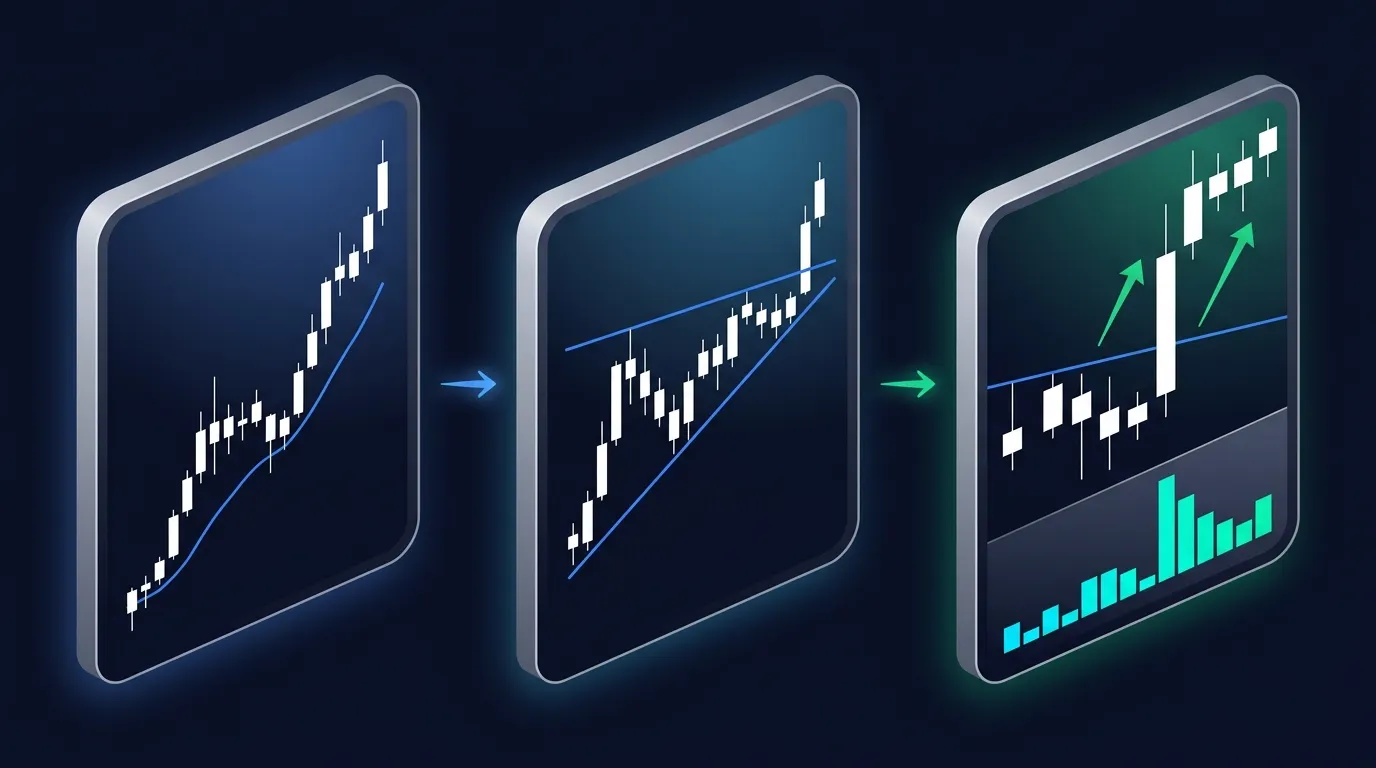
Multi-Timeframe Analysis with the Ascending Triangle
The top-down approach is standard practice among professional technical traders, and the ascending triangle integrates naturally into it.
Start on the weekly chart. Is price above the 50-week or 200-week moving average? Is the weekly trend pointing higher? If yes, you have the macro tailwind needed for ascending triangle setups to perform at their best. A daily ascending triangle that forms where the weekly trend is bearish carries significantly lower probability than the same pattern within a confirmed weekly uptrend.
Move to the daily chart to identify and validate the ascending triangle. Confirm the five criteria - equal highs, higher lows, trendline tests, volume contraction, appropriate duration - then mark the breakout level and calculate the measured-move target.
Drop to the 4-hour chart for entry timing. The 4H chart shows you when the breakout candle is closing, allowing more precise execution. It also shows MACD and RSI more granularly, helping you assess momentum alignment at the precise moment of breakout.
When all three timeframes align, the ascending triangle setup moves from "solid" to "high conviction."
Ascending Triangle Alternatives and Complementary Patterns
The ascending triangle is specific in what it requires: flat resistance, rising lows. Not every clean consolidation produces those exact conditions. Knowing the alternative bullish continuation patterns - and when to reach for one instead - rounds out a trader's technical toolkit.
One of the most underused techniques for improving ascending triangle entries is checking where the higher lows form relative to Fibonacci retracement levels of the prior trend. When the last higher low forms at or near the 38.2%, 50%, or 61.8% retracement of the prior up-move, it signals that buyers are defending a technically meaningful level - not just a random low. This adds conviction to the setup and provides a more structured stop-loss reference point just below that Fibonacci level.
Each pattern has its role. The ascending triangle remains one of the most reliable for confirming sustained buying pressure in a clear, measurable structure.
Conclusion - How to Apply the Ascending Triangle Pattern in Your Trading
The ascending triangle is one of technical analysis's most cleanly structured setups. Flat resistance. Rising lows. Contracting volume. Explosive breakout. The trade is defined before you enter - you know your entry, your stop, and your target the moment the breakout triggers.
How to apply it based on where you are:
Beginners: Work exclusively on daily charts. Use the conservative retest entry rather than chasing breakout candles. Risk no more than 1% per trade until you have at least 10 documented ascending triangle setups in your trading journal. Pattern recognition improves substantially with deliberate practice on historical charts.
Intermediate traders: Add RSI and MACD confirmation to your breakout checklist. Start experimenting with multi-timeframe alignment - check the weekly trend before trading daily setups. Begin differentiating the ascending triangle from the rising wedge on live charts until the distinction becomes automatic.
Advanced traders: Layer in Fibonacci retracement analysis to identify the highest-quality higher lows. Combine volume profile data to assess demand zones within the triangle. Use sector relative strength as a macro filter - ascending triangles in leading sectors within confirmed uptrends carry materially higher probability than isolated setups.
Platforms built on transparent, on-chain mechanics reflect the same principle that makes the ascending triangle compelling: the rules are verifiable, the logic is sound, and the outcome is a function of execution quality. When buyers keep stepping in at higher prices and sellers finally exhaust their supply at resistance, the ascending triangle delivers one of technical analysis's clearest, most actionable signals.
Last updated: April 2026.
Crypto trading involves substantial risk of loss. The ascending triangle pattern and all technical analysis methods described in this guide are educational tools, not financial advice. Past pattern performance does not guarantee future results. Leveraged trading amplifies both gains and losses and may not be suitable for all traders. Always trade with capital you can afford to lose.
Frequently Asked Questions
What is an ascending triangle pattern?
An ascending triangle pattern is a bullish chart formation in technical analysis defined by two converging trendlines: a flat horizontal resistance line connecting equal highs, and an upward-sloping support trendline connecting successively higher lows. The pattern reflects accumulation - buyers entering at progressively higher prices while sellers defend a fixed resistance level. It most commonly appears as a continuation pattern within an uptrend but can also form as a reversal at the end of a downtrend. The pattern resolves with a breakout, typically upward, confirmed by a candle close above resistance and ideally supported by expanding volume.
Is the ascending triangle bullish or bearish?
The ascending triangle is definitively bullish. Unlike the symmetrical triangle, which carries no inherent directional bias, the ascending triangle signals building buying pressure through its rising lower trendline. Historical pattern studies support this - ascending triangles break upward more often than downward. The rising lows show that buyers are increasingly aggressive with each pullback, while the flat resistance reflects sellers defending a ceiling that eventually runs out of supply. Even when the pattern forms after a downtrend in a reversal context, it retains its bullish bias.
What is the difference between an ascending triangle and a rising wedge?
This is the most critical pattern distinction for ascending triangle traders. Both patterns have an upward-sloping lower support line. The difference is the upper line: ascending triangle has a flat horizontal upper line, while the rising wedge has an upward-sloping upper line - both lines slope upward but the lower one rises faster. Despite visual similarity, these patterns carry opposite implications: the ascending triangle signals bullish continuation while the rising wedge signals a bearish reversal. Check the upper trendline - flat means ascending triangle, upward-sloping means rising wedge. Getting this wrong produces the opposite trade result from what you intended.
How do you calculate the price target after an ascending triangle breakout?
The price target is calculated using the measured move method. Measure the vertical height of the triangle at its widest point - the distance from the horizontal resistance line down to the lowest low within the pattern. Then add that distance to the breakout point (the resistance level). For example: if resistance is at $50 and the lowest low within the triangle is $42, the triangle height is $8 and the measured-move target is $58. This target is a guideline, not a ceiling - in strong trending markets, price often exceeds it. Consider taking partial profit at roughly the midpoint of the measured move.
How do you avoid false breakouts in an ascending triangle?
Four rules dramatically reduce false breakout exposure. First, require a full candle close above resistance - not just an intraday wick - before entering. Second, require volume expansion above the 20-period average at the breakout candle. Third, check RSI (above 50 and rising) and MACD (bullish crossover or rising histogram) for momentum confirmation. Fourth, size down positions in high-noise environments like crypto or small-cap stocks where false breakouts are structurally more common. None of these rules eliminate false breakouts entirely, but they filter out the low-quality fakeouts that don't survive the first trading session.
What timeframe is best for trading ascending triangles?
The daily chart is the most reliable timeframe for trading ascending triangles. Daily patterns reflect genuine multi-week accumulation and filter out intraday noise that creates false structural readings. Weekly charts produce higher-conviction signals but fewer setups and require patience. The 4-hour chart works well for active traders but increases noise and false-breakout frequency. Intraday charts below 1-hour can show ascending triangles, but the structures are fragile and heavily influenced by short-term order flow. For new traders, starting exclusively on daily charts builds cleaner pattern recognition before moving to shorter timeframes.
How does multi-timeframe analysis improve ascending triangle trades?
Multi-timeframe analysis improves ascending triangle trades by confirming the setup aligns with the broader market trend. The top-down approach: check the weekly chart to confirm the macro trend is bullish (price above the 50-week or 200-week MA); identify the ascending triangle on the daily chart and validate the formation; use the 4-hour chart to time the entry on the breakout candle with precise momentum confirmation via RSI and MACD. When all three timeframes point in the same direction, the trade has macro trend, pattern structure, and momentum all aligned - materially increasing the probability of success compared to trading the daily pattern in isolation.
ZIPMEX promotes trading on trade.zipmex.com. Promotions are labelled and kept separate from news coverage, which is selected and checked without regard to them. Perpetual futures are leveraged derivatives. Prices can move fast and you can lose all of your margin. Not available in every jurisdiction. Not investment advice.