Knowing how to buy NFTs in theory and actually executing your first purchase are two very different things. The wallet setup, the gas fees, the marketplace mechanics, the scam traps - it's a lot to absorb at once, and most guides gloss over the parts that actually trip people up.
This guide covers everything: what NFTs actually are under the hood, which blockchains to consider, how to set up and secure a wallet, how to navigate marketplaces from browse to checkout, what to look for before you commit funds, and how to protect yourself after the purchase. No hype, no shortcuts.
⚡ Key Takeaways
- NFTs are unique blockchain tokens that can represent ownership of digital art, music, gaming items, memberships, and real-world assets - not the underlying file itself.
- Buying NFTs requires three things: a compatible self-custody wallet, the correct blockchain cryptocurrency to fund it, and a trusted marketplace to transact on.
- Scams targeting NFT buyers are widespread and technically sophisticated. Understanding red flags is as important as understanding the buying process.
Before clicking "Buy," it helps to understand what you're actually purchasing.
What Are NFTs? Understanding the Basics Before You Buy
An NFT - non-fungible token - is a unique, non-interchangeable asset recorded on a blockchain. "Non-fungible" means no two are identical and one cannot simply be swapped for another of equal value. A dollar bill is fungible: trade it for another dollar bill and you have the exact same thing. An original concert ticket is non-fungible: it has a specific seat, specific date, and specific face value that can't be replicated.
That distinction matters because it's what allows NFTs to represent ownership of anything truly unique. Digital art, music albums, in-game items, community memberships, real estate deeds, trading cards, domain names - the range of NFT use cases is broader than most beginners expect. The underlying smart contract defines the token's properties, enforces its rules, and records every ownership transfer permanently on-chain.
NFTs first scaled on Ethereum, which was the first blockchain with smart contract infrastructure robust enough to support them - using the ERC-721 and ERC-1155 token standards that remain the foundation for most Ethereum NFTs today. Thriving ecosystems have since developed across multiple chains, each with its own trade-offs in cost, speed, and community depth.
How NFTs Actually Work: Blockchain, Wallets, and Ownership
Here's where many beginner guides mislead by omission: when you buy an NFT, you're not buying the file. You're buying a record on the blockchain - a token - that points to a file stored somewhere else.
Every NFT has three distinct components:
This distinction matters enormously for long-term value. If the metadata points to a centralised server and that server goes offline, the file disappears - leaving you holding a token that points to a broken link. Projects that store metadata on IPFS (InterPlanetary File System) or directly on-chain are significantly more durable. Before buying any high-value NFT, verify where the metadata and file are stored.
Gas fees are another reality to factor in upfront. Every time you transact on a blockchain - buying, selling, minting, or even approving a contract - you pay a network fee to compensate validators. These fees vary by chain, network congestion, and transaction complexity. On Ethereum mainnet, a single transaction during peak hours can realistically cost $20-80+. On Solana, the same operation averages around $0.00025 per transaction.
NFT Blockchains Compared: Ethereum, Solana, Polygon, and More
Your blockchain choice determines your wallet, your currency, your fee structure, and which marketplaces you can access. Here's how the major NFT chains stack up:
Ethereum has the deepest liquidity and the most established collections - Bored Ape Yacht Club, CryptoPunks, and Azuki all live here. Solana delivers a noticeably smoother, cheaper experience for gaming-focused buyers or high-frequency traders. Your blockchain choice determines which wallet you'll need next.
How to Buy NFTs: Step-by-Step for Beginners
When people ask how to buy NFTs, they usually want a clear sequence - not a theoretical overview. Here it is. The specific steps vary slightly by marketplace and chain, but the underlying process is consistent: set up a wallet, fund it, choose a marketplace, find the right NFT, and execute the purchase.
The 5-step NFT buying process:
- Set up a self-custody crypto wallet
- Fund the wallet with the correct cryptocurrency
- Choose a marketplace
- Research and select your NFT
- Execute the purchase and confirm on-chain
Step 1 - Set Up a Crypto Wallet
Your wallet is your gateway to every on-chain transaction. Unlike exchange accounts, self-custody wallets mean no third party holds your assets - your private key is your access, full stop.
For Ethereum and Polygon NFTs, MetaMask is the standard starting point. It's a browser extension and mobile app that integrates with virtually every Ethereum-compatible marketplace. For Solana NFTs, Phantom Wallet is the equivalent - clean, fast, and natively supported across Solana's marketplace ecosystem. The setup process for both takes under five minutes: download, create a new wallet, and immediately record your seed phrase.
⚠ Seed Phrase Safety - Non-Negotiable Rules
- Write it down by hand on paper. → Multiple copies in separate secure locations.
- Never store it digitally → No cloud drives, no notes apps, no emails.
- Never enter it into any website → Even one that looks completely legitimate.
- Marketplace support will never ask for your seed phrase → Anyone who does is attempting theft.
For storing high-value NFTs long-term, a hardware wallet - Ledger or Trezor - is the right move. Hardware wallets keep your private key offline and require physical confirmation for every transaction, making remote compromise essentially impossible. Think of a software (hot) wallet as your spending account and a hardware (cold) wallet as your vault. You can learn more about the differences in this comparison of crypto wallet types.
Step 2 - Fund Your Wallet with Cryptocurrency
Most NFT marketplaces require the native cryptocurrency of the NFT's host blockchain. Buying a Solana NFT? You need SOL. Buying on Ethereum? You need ETH. Buying on Polygon? You'll need MATIC/POL for gas, though some marketplaces accept ETH directly via bridging.
Two practical ways to fund your wallet:
- Option A - Centralised Exchange Transfer: Buy ETH or SOL on an exchange like Kraken, Coinbase, or Binance using fiat currency, then send it to your wallet address. Standard transfer times are 5-30 minutes depending on the blockchain.
- Option B - In-Wallet On-Ramp: MetaMask and Phantom both offer built-in fiat-to-crypto on-ramps via partners. Convenient, but fees are typically higher than using a dedicated exchange.
One practical tip: always fund slightly more than the NFT's listed price. Gas fees are charged on top of the purchase amount, and they can fluctuate between the time you check and the time you execute. If an NFT costs 0.1 ETH, having 0.12-0.15 ETH in your wallet prevents failed transactions.
Step 3 - Choose a Marketplace and Make Your Purchase
Not all NFT marketplaces are created equal. The top NFT marketplaces in 2026 each cater to different buyer profiles, blockchains, and trading styles:
For a first-time buyer on Ethereum, OpenSea is the practical starting point - it has the deepest catalogue, comprehensive collection statistics, and a checkout flow refined over years of user feedback.
The actual buying mechanics work in three modes: Fixed price ("Buy Now") - you pay the listed price immediately. Collection bid - you offer a price you're willing to pay for any NFT in that collection. Auction - the NFT goes to the highest bidder by a set deadline.
The checkout itself: connect your wallet → navigate to the NFT → review its traits, price history, and floor price relative to the asking price → click "Buy Now" or place a bid → confirm the transaction in your wallet popup. That last step is critical: once you confirm a transaction on-chain, it cannot be reversed. There is no dispute system, no chargeback, no undo. Verify the contract address and the NFT's collection page before hitting confirm.
What to Look for Before Buying an NFT
The buying mechanic is simple. The judgment required to buy well is not. DYOR - do your own research - isn't a cliché in the NFT space; it's the difference between a sound purchase and an expensive lesson.
Before committing funds to any NFT, here's the due diligence framework I use:
📊 NFT Due Diligence Checklist
- ✓ Verified creator/collection - confirmed via official links, not Discord or DMs
- ✓ Trading volume trend reviewed - volume growing, flat, or collapsing?
- ✓ Roadmap reviewed - specific, milestones-based, or vague?
- ✓ Community activity checked - Discord/X engagement genuine or bot-inflated?
- ✓ Rarity rank reviewed for the specific token you're buying
- ✓ On-chain metadata verified - stored on IPFS or on-chain, not a centralised server
- ✓ Team credibility assessed - doxxed, previous work verifiable?
- ✓ Smart contract checked for audit history (essential for high-value purchases)
Floor price is the cheapest currently listed NFT in a collection - it's the market's real-time opinion on minimum value. Rarity ranking reflects where your specific token sits within the collection's trait distribution: common traits appear in thousands of tokens, rare traits in dozens or fewer. Generally, rarer traits command premium prices, but demand is also driven by aesthetics and community sentiment.
Trading volume is the most honest signal available. A collection with declining volume across 30 days is losing momentum. Consistent or rising volume points to an active, engaged market with genuine two-way interest.
Evaluating a Project: Team, Roadmap, and Community
This is where most beginner guides go quiet, and where most beginner mistakes happen. The art draws you in. The fundamentals determine long-term value.
A credible project looks like this: a publicly known (doxxed) team with verifiable professional history, a roadmap with specific deliverables and realistic timelines, an active and substantive community discussion (not just price speculation), an audited smart contract for high-value collections, and a utility proposition that doesn't depend entirely on price appreciation.
To verify a team, cross-reference their social media presence across platforms and check whether any past projects delivered on their promises. For smart contracts, platforms like CertiK and Hacken publish audit results publicly. Knowing these green flags also means you'll recognise the red ones - which brings us directly to the threat landscape.
NFT Scams and Red Flags: How to Protect Yourself
The NFT space attracts a disproportionate amount of fraud relative to its size, and beginners are the primary target. Understanding the mechanics of the most common scams is the most practical defensive tool available.
The wallet drainer deserves special attention because it's technically subtle and financially devastating. When you connect your wallet to a dApp and sign a transaction, you may be approving that contract to move assets on your behalf - sometimes with no spending limit. Malicious contracts exploit this by requesting unlimited approval, then draining the wallet at a later time. You can review and revoke existing approvals at any time using Revoke.cash - a free, on-chain tool that shows every contract that has approval over your assets.
Wallet Security: Approvals, Hardware Wallets, and Safe Practices
Beyond knowing the scam taxonomy, active security habits are what actually prevent losses.
Four practices that materially reduce your risk:
- Use a dedicated "burner" wallet for minting and testing. Create a separate wallet, fund it with only what you need for the specific transaction, and connect only that wallet to new or unverified projects.
- Regularly audit and revoke smart contract approvals. Go to Revoke.cash, connect your wallet, and review what contracts have spending permissions. Revoke anything you don't recognise or no longer use.
- Move high-value NFTs to cold storage. A Ledger or Trezor stores your private key offline and requires physical confirmation for every outbound transaction - remote exploits simply can't reach it.
- Never enter your seed phrase anywhere. No exceptions. Legitimate wallets, marketplaces, or platforms will never ask for it.
⚡ Pro Tip: The Burner Wallet Strategy
Use a separate "burner" wallet funded with only what you need for minting. Never connect your main wallet to new or unverified projects. Treat every first interaction with an unknown contract as potentially hostile until proven otherwise. Your main wallet - where your valuable assets live - should never touch unverified contracts.
How to Store and Manage Your NFTs After Purchase
Most guides end at the purchase. That's where the real ownership decisions begin.
After buying an NFT, you face three storage questions: where is the on-chain token (always on the blockchain - that's permanent), where is the metadata and file pointer (IPFS vs. centralised server), and where do you physically hold the token (hot wallet vs. cold storage).
The metadata risk is underappreciated. If a collection stores its metadata on a centralised server rather than IPFS or on-chain, and that server goes offline - provider goes bankrupt, team abandons the project, storage subscription lapses - the file becomes inaccessible. The token still exists on-chain, but it points to a broken link. For high-value purchases, verify this before buying, not after. You can cross-check NFT contract details and metadata storage directly on-chain using block explorers - for Polygon NFTs, PolygonScan makes this straightforward.
What Can You Do With NFTs After Buying Them?
Buying and holding isn't the only strategy. Depending on the collection, your NFT may open more doors than just appreciation potential. There's a whole side of the NFT ecosystem that NFT games and play-to-earn mechanics have helped build, where NFTs function as genuine in-game assets with real transferable value.
5 things you can do with your NFT:
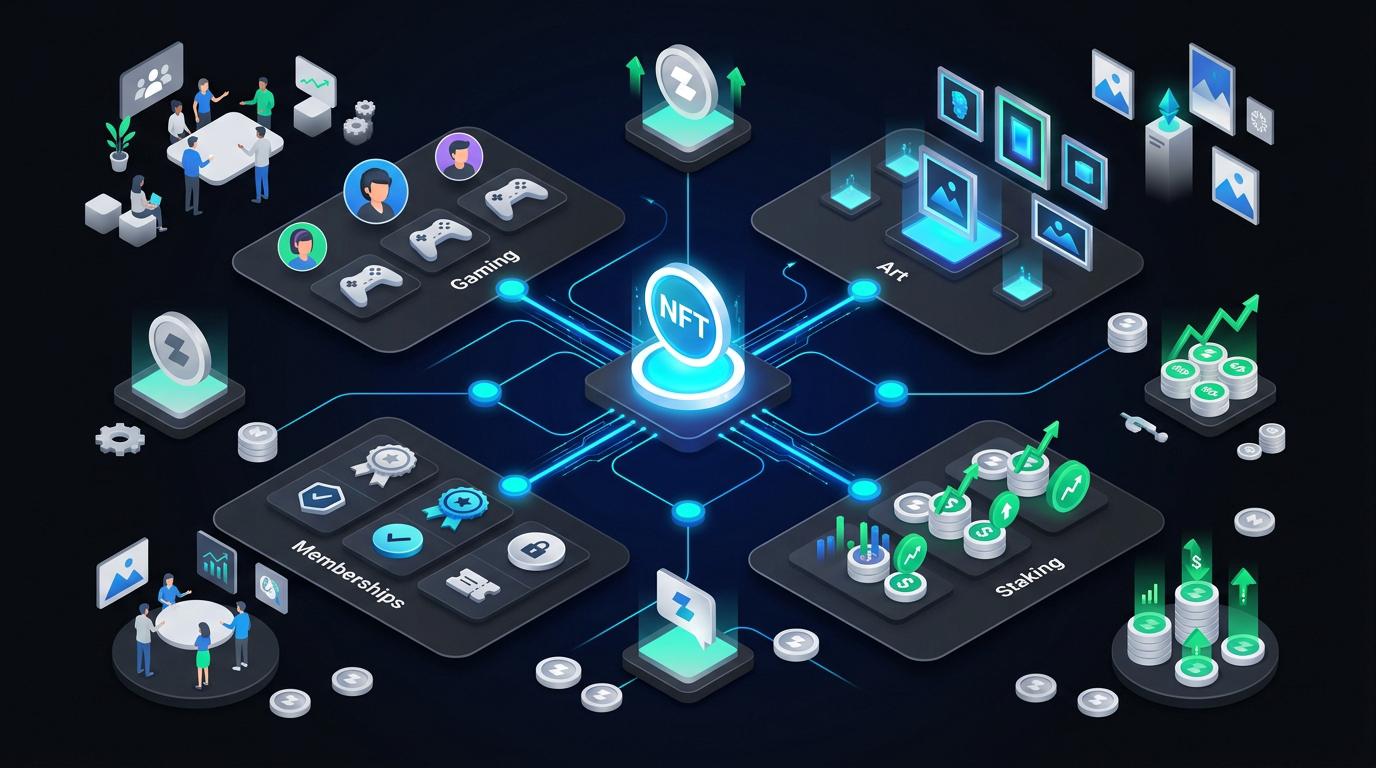
- Hold for collection value and community access. Many collections - Bored Ape Yacht Club being the most visible example - grant holders access to exclusive events, networking, merchandise, and collaboration opportunities. The NFT functions as a transferable membership pass with real-world perks attached.
- Resell on secondary marketplaces. List your NFT on OpenSea, Magic Eden, or Blur at any time. You set the price; buyers can accept immediately or make offers. Creator royalties - typically 2.5-10% - are paid to the original project on each secondary sale, either enforced by contract or voluntary depending on the marketplace.
- License commercial IP rights. Some collections - Nouns DAO and BAYC among them - explicitly grant holders commercial usage rights to their specific token's image. This means you can legally use the artwork in merchandise, branding, or media production. IP terms vary significantly by collection; always read the specific project's license before assuming any rights.
- Stake NFTs for yield. Select DeFi protocols allow NFT holders to stake their tokens in exchange for rewards. The mechanics differ by project - some pay in native tokens, others offer fee-sharing from platform revenue. Staking typically locks the NFT for the staking period.
- Use NFTs as in-game assets. Blockchain games like Axie Infinity, Gods Unchained, and Parallel are built around NFT ownership. Assets earned or purchased in-game can be traded on secondary markets, creating genuine economic activity around in-game performance.
Buying NFTs vs. Alternatives: Other Ways to Enter the NFT Ecosystem
Direct NFT ownership isn't the only path. For buyers not yet ready to manage wallets, navigate marketplaces, and handle on-chain transactions, there are lower-friction alternatives worth knowing.
Five ways to participate in the NFT ecosystem without direct ownership:
- NFT-related stocks and ETFs. Several publicly traded companies have significant NFT or Web3 exposure. This is indirect exposure with traditional brokerage access, no wallet required, but disconnected from specific NFT price movements.
- Fractional NFT platforms. Services like Tessera allow groups of buyers to collectively own high-value NFTs by splitting them into fungible shares. Lower capital requirement, but smart contract risk applies and liquidity depends entirely on platform activity.
- Free NFT airdrops and community giveaways. Many projects distribute free NFTs to early community members, Discord participants, or existing holders of related collections. Following projects on X/Twitter before their launch is a genuine low-cost entry point.
- Creator-direct platforms (Zora, Foundation). Buying directly from artists reduces speculative markup and supports creators more directly. Floor prices tend to be lower; the speculative secondary market is less active - better for genuine art collecting than short-term trading.
- Blockchain gaming with play-to-earn mechanics. Some NFT games allow players to earn assets through gameplay, which can then be sold or held. Game economics can be volatile; due diligence on tokenomics is essential.
The broader shift in this ecosystem is toward verifiable, self-custodial ownership models - where no platform can freeze your assets or alter the rules mid-game. Platforms that embed genuine on-chain transparency into their mechanics, from gaming outcomes to fee distribution, are building the durable foundation the space needs. That principle applies equally whether you're buying NFTs, trading perpetuals, or participating in prediction markets: on-chain verifiability is what separates trustless systems from ones that require faith in an intermediary. Zipmex is built on exactly that premise.
Conclusion: Is Buying NFTs Right for You?
After walking through the full picture - mechanics, marketplaces, due diligence, scam vectors, storage, and alternatives - the honest answer is: it depends entirely on why you're buying.
🎨 THE COLLECTOR
Drawn to art, community, or culture. Start small, apply the due diligence checklist, use a secured wallet, and engage with the community. Personal resonance is a legitimate and sustainable filter.
📈 THE TRADER
Interested in price appreciation. Understand the liquidity profile - NFTs are illiquid assets with wide bid-ask spreads. Crypto trading involves substantial risk of loss. Only allocate capital you can afford to lose entirely.
🛠 THE CREATOR
NFTs can function as a distribution channel - artists, musicians, and developers can monetize directly with programmable royalties. Platforms like Zora and Foundation offer accessible minting infrastructure. Start by creating, not just buying.
The non-negotiables, regardless of which category you fall into: control your own keys with a self-custody wallet, verify on-chain what you can't trust on paper, and never commit more capital than you can absorb losing entirely.
Crypto trading and NFT activity involve substantial risk of loss and are not suitable for all users. Nothing in this article constitutes financial, investment, or legal advice. Always conduct your own research before making any financial decisions.
Last updated: April 2026.
Frequently Asked Questions
What does NFT stand for?
NFT stands for non-fungible token. "Non-fungible" means the token is unique and cannot be exchanged on a one-for-one basis with another token - unlike ETH or BTC, where every unit is identical and interchangeable. NFTs are minted on a blockchain using smart contracts that enforce ownership, define the token's properties, and record every transfer permanently. Each NFT has a unique identifier that distinguishes it from every other token, even within the same collection.
Do I need a crypto wallet to buy an NFT?
Yes, in most cases. To buy NFTs directly on decentralized marketplaces like OpenSea or Magic Eden, you need a self-custody crypto wallet - MetaMask for Ethereum and Polygon NFTs, Phantom for Solana. The wallet stores your private key, and you connect it to the marketplace to sign and authorize transactions. Some centralized platforms allow credit card purchases with custodial accounts, but this removes the self-custody advantage and leaves you dependent on the platform's security and solvency.
What is a gas fee and how much does it cost?
A gas fee is a transaction fee paid to the blockchain's validator network to process and record your transaction. On Ethereum mainnet, fees fluctuate with network demand - from under $5 during quiet periods to $50-150+ during high-demand events. On Solana, the base fee averages around $0.00025 per transaction regardless of network activity. Gas is charged for every on-chain action: buying, selling, minting, transferring, and even approving contracts. Always hold slightly more than the NFT's listed price to cover these costs.
What is a rug pull in NFTs?
A rug pull is a scam where a project team collects mint revenue - sometimes millions of dollars - then abandons the project, deletes social media presence, and disappears with the funds. The NFTs become effectively worthless with no legal recourse in most jurisdictions. Warning signs include anonymous teams with no verifiable history, vague roadmaps, artificially inflated hype, Discord activity that disappears after mint day, and aggressively compressed timelines that allow no time for due diligence.
What is a wallet drainer and how does it work?
A wallet drainer is a malicious smart contract that exploits the approval mechanism built into blockchain token standards. When you interact with a dApp, you often sign a transaction granting that contract permission to move tokens from your wallet. A drainer requests unlimited approval, then transfers everything at a later time. The damage is immediate and irreversible. Defence: read every approval request carefully before signing, use Revoke.cash to review and remove existing approvals you don't recognise, and never connect your main wallet to unverified projects.
How do I safely store my NFTs?
The safest storage for valuable NFTs is cold storage - a hardware wallet like a Ledger or Trezor device. Hardware wallets store your private key offline and require physical button confirmation for every outbound transaction, making remote exploits essentially impossible. For assets you actively trade, a reputable software wallet (MetaMask, Phantom) provides marketplace compatibility with reasonable security if you follow sound practices: regular approval audits, a separate burner wallet for minting, and seed phrase stored offline only.
Are NFTs a good investment in 2026?
NFT market conditions in 2026 are substantially different from the 2021-2022 peak - volumes are lower, speculative fervor has cooled, and the projects that have retained value are those with genuine utility, strong communities, or cultural significance. Whether NFTs are a worthwhile allocation depends entirely on your risk tolerance, time horizon, and ability to conduct thorough due diligence. The market has matured in some respects, but the fundamental risk profile remains: illiquid, volatile assets with no guaranteed market. Nothing in this article constitutes investment advice.