Bitcoin promised to be peer-to-peer digital cash - but with 7 transactions per second and fees that once hit $60, everyday payments felt impossible. The lightning network bitcoin solution changes everything by moving transactions off-chain, settling them instantly for less than a penny.
⚡ Quick Answer
The Lightning Network is a Layer 2 protocol built on top of Bitcoin that enables near-instant payments (under 1 second) with fees typically under $0.01. It works by creating off-chain payment channels between users, only recording the opening and closing balances on the main Bitcoin blockchain. As of March 2026, the network has 17,000+ public nodes and approximately 4,900 BTC in total capacity.
What Is the Bitcoin Lightning Network?
The Lightning Network is a bitcoin layer 2 protocol - a second layer that sits on top of the main Bitcoin blockchain and handles transactions separately. Think of Bitcoin as the main highway: secure, reliable, but slow and expensive during rush hour. Lightning is the express lane that takes most of the traffic, moving it instantly at near-zero cost, while the main road handles only the opening and closing of the lane.
This scalability bottleneck is a central theme in the ongoing evolution of decentralized networks. While Bitcoin focuses on a Layer 2 payment protocol to handle high-frequency transactions, other ecosystems, such as Ethereum, have integrated smart contract flexibility directly into their base layer, albeit with different trade-offs in security and complexity. To better understand these competing philosophies, you can read our deep dive into Bitcoin vs Ethereum: key differences, pros & cons in 2026 for a full technical comparison.
Proposed in a 2015 whitepaper by Joseph Poon and Thaddeus Dryja, the Lightning Network launched on Bitcoin's mainnet in 2018 via Lightning Labs. The core insight was elegant: instead of recording every single transaction on the blockchain (which is expensive and slow), two parties could open a private payment channel, transact as many times as they wanted off-chain, and only publish the final balance on-chain when they were done.
This is a bitcoin scalability solution in its purest form. The main Bitcoin blockchain can process approximately 7 transactions per second. The Lightning Network can theoretically handle millions of transactions per second - enabling Bitcoin to compete with global payment networks like Visa.
How Does the Lightning Network Work?
Understanding how the Lightning Network operates comes down to three core concepts: payment channels, multi-hop routing, and Hash Time-Locked Contracts (HTLCs). Together they form a system where you can send BTC to anyone in the world in under a second, securely, without trusting the other party.
Payment Channels: The Foundation
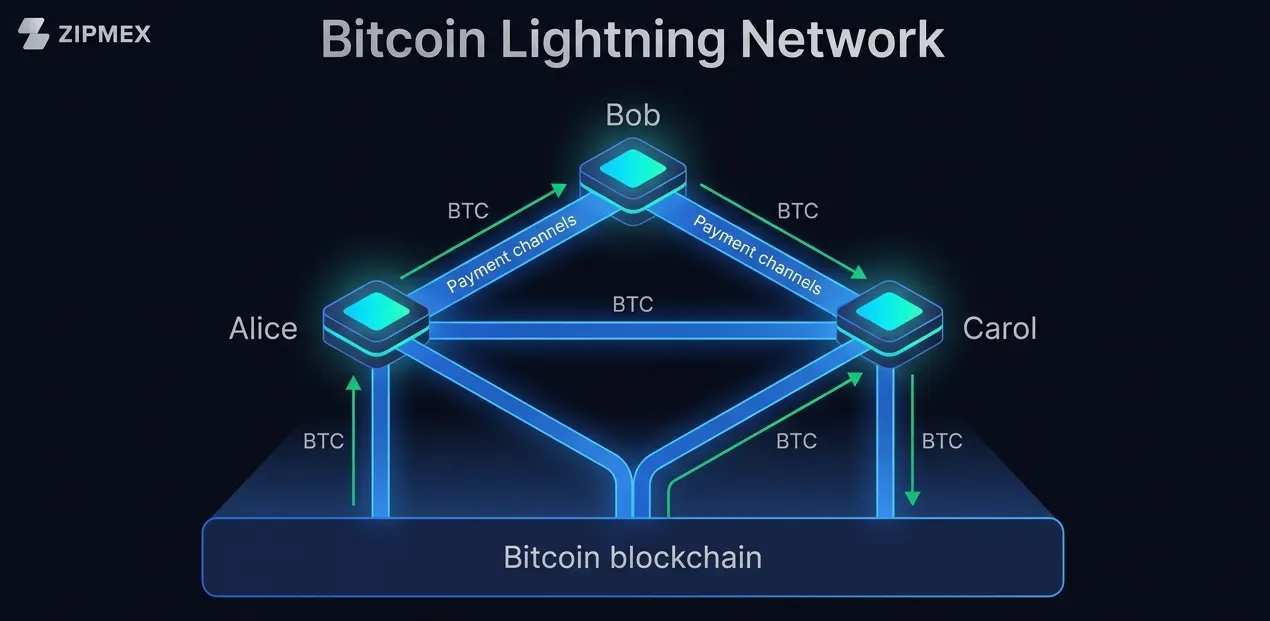
A payment channel is essentially a 2-of-2 multi-signature Bitcoin wallet - a shared account that both parties fund and control. Here's how it works step by step:
- Open the channel - Alice and Bob create an on-chain transaction that locks Bitcoin into a shared multi-sig address. This requires one blockchain confirmation (around 10 minutes). This is the only on-chain transaction during the channel's life.
- Transact off-chain - Alice and Bob can now send unlimited payments back and forth instantly. Each transaction updates a private "balance sheet" showing who owns what - without touching the Bitcoin blockchain at all. These are the off-chain transactions that make Lightning fast.
- Close the channel - When they're finished, either party can close the channel. The final balance is broadcast to the Bitcoin blockchain, and each party receives their BTC. Only this second transaction hits the main chain.
Think of it like a bar tab. You open a tab (payment channel), order multiple drinks (Lightning transactions), and settle the entire bill at the end (closing the channel). Only two events touch the main ledger: opening and closing the tab.
While opening a channel requires an initial on-chain transaction that is subject to current network demand, the subsequent off-chain payments are virtually free. Understanding the difference between these protocol-level costs and the logic behind mainnet congestion is vital for managing your long-term transaction overhead. We recommend exploring our detailed guide on what gas fees are and how blockchain transaction costs are calculated to optimize your timing when interacting with the base layer.
Multi-Hop Routing: Pay Anyone Without a Direct Channel
The real power of Lightning comes from network routing. You don't need a direct channel with everyone you want to pay. If Alice has a channel with Bob, and Bob has a channel with Carol, Alice can pay Carol by routing through Bob - automatically, in milliseconds.
The network uses an onion routing protocol - similar to how Tor works - where each node only knows the previous and next hop. This preserves privacy: Bob knows Alice sent a payment through him, but he doesn't know Carol is the final recipient.
HTLCs: The Security Mechanism
Hash Time-Locked Contracts are the cryptographic glue that makes payment channels bitcoin routing trustless. HTLCs ensure that if a multi-hop payment fails at any step, all locked funds are automatically returned. No one in the chain can steal your money mid-route. It's trustless by design - you don't need to know or trust the nodes routing your payment.
Lightning Network vs Bitcoin On-Chain: Full Comparison
Understanding when to use Lightning versus regular on-chain Bitcoin is essential for any crypto user. Here's a comprehensive breakdown:
The rule of thumb: use on-chain Bitcoin for large, infrequent transfers where finality and security are paramount. Use Lightning for everyday spending, tips, micropayments, and anywhere speed and low fees matter more than absolute finality.
🎯 Key Takeaways
- Lightning Network processes payments in under 1 second with fees typically below $0.01
- Only two transactions ever touch the main Bitcoin blockchain: opening and closing the payment channel
- As of March 2026, the network has 17,000+ public nodes and ~4,900 BTC in total capacity
- You don't need a direct channel with every recipient - routing handles it automatically
- Lightning unlocks true Bitcoin micropayments (satoshi-level) that are economically impossible on-chain
Lightning Network Wallets: Best Options in 2026
To use the Lightning Network, you need a Lightning-compatible wallet. There are two main types: custodial (simpler, a third party holds your keys) and non-custodial (you control your keys, more responsibility).
Custodial Lightning Wallets (Recommended for Beginners)
Wallet of Satoshi - The simplest Lightning wallet available. Download, receive sats, send instantly. No channel management required. Best for newcomers who just want to try Lightning payments without technical complexity.
Strike - A US-focused app built on Lightning. You can buy Bitcoin, send payments, and even receive direct deposits. Strike powers Twitter/X's Bitcoin tipping feature and is used extensively in El Salvador for remittances.
Non-Custodial Lightning Wallets (Recommended for Experienced Users)
Phoenix Wallet - Arguably the best non-custodial Lightning wallet in 2026. Handles channel management automatically while keeping you in full control of your keys. Available on iOS and Android.
Breez - A non-custodial wallet with a built-in podcast streaming feature (pay-per-minute audio), demonstrating Lightning's micropayment capabilities.
Zeus - For advanced users who run their own Lightning node. Full control, maximum privacy.

From wallet to 100× in 30 seconds. No signup. No deposit queue. Connect, trade, withdraw. Your signal won't wait for KYC.
The fastest way into leveraged trading. Connect your wallet — your position opens in seconds.
Is the Lightning Network Safe?
Security is a common concern - and a legitimate one. Here's a balanced breakdown of bitcoin lightning network safety:
📈 Security Strengths
- Bitcoin-backed: All Lightning funds originate from and settle on the Bitcoin blockchain - the most secure blockchain in existence.
- HTLCs prevent theft: Hash Time-Locked Contracts ensure that if a payment fails at any hop, all funds are automatically returned. Routing nodes cannot steal in-flight payments.
- Penalty mechanism: If a channel partner tries to cheat by broadcasting an old state, the honest party can claim all channel funds as a penalty - a strong deterrent.
- Onion routing privacy: Routing nodes see only the previous and next hop, not the full payment path - significantly better privacy than on-chain Bitcoin.
📉 Risks to Understand
- Hot wallet exposure: Lightning nodes must be online to receive payments, meaning funds in channels are in a "hot wallet" - more exposed than cold storage.
- Channel liquidity limits: You can only send up to the amount committed in your channel. Large payments may fail to route if the network lacks sufficient liquidity.
- Custodial wallet risk: If using a custodial Lightning wallet (like Wallet of Satoshi), you trust the provider with your funds. Use non-custodial options for larger amounts.
- Griefing attacks: A malicious node can lock your channel funds temporarily without stealing them - an ongoing area of research and improvement in the protocol.
Bottom line: Lightning is safe for everyday small payments. For significant sums, use on-chain Bitcoin or a non-custodial Lightning wallet with good inbound liquidity. Never store your entire Bitcoin stack on Lightning.
⚠ Risk Warning
Lightning Network is best suited for small, frequent payments - not for storing significant sums long-term. If using a custodial wallet, the provider could theoretically freeze or lose your funds. Always use Lightning for an amount you're comfortable spending, not saving.
The Lightning Network in 2026: Real-World Adoption
Lightning has moved well beyond an experimental protocol. Here's where it stands in 2026:
📊 Lightning Network Stats - March 2026
Public Nodes
17,000+
Public Channels
~40,000
Network Capacity
~4,900 BTC
Avg Transaction Fee
<$0.01
Key adoption milestones:
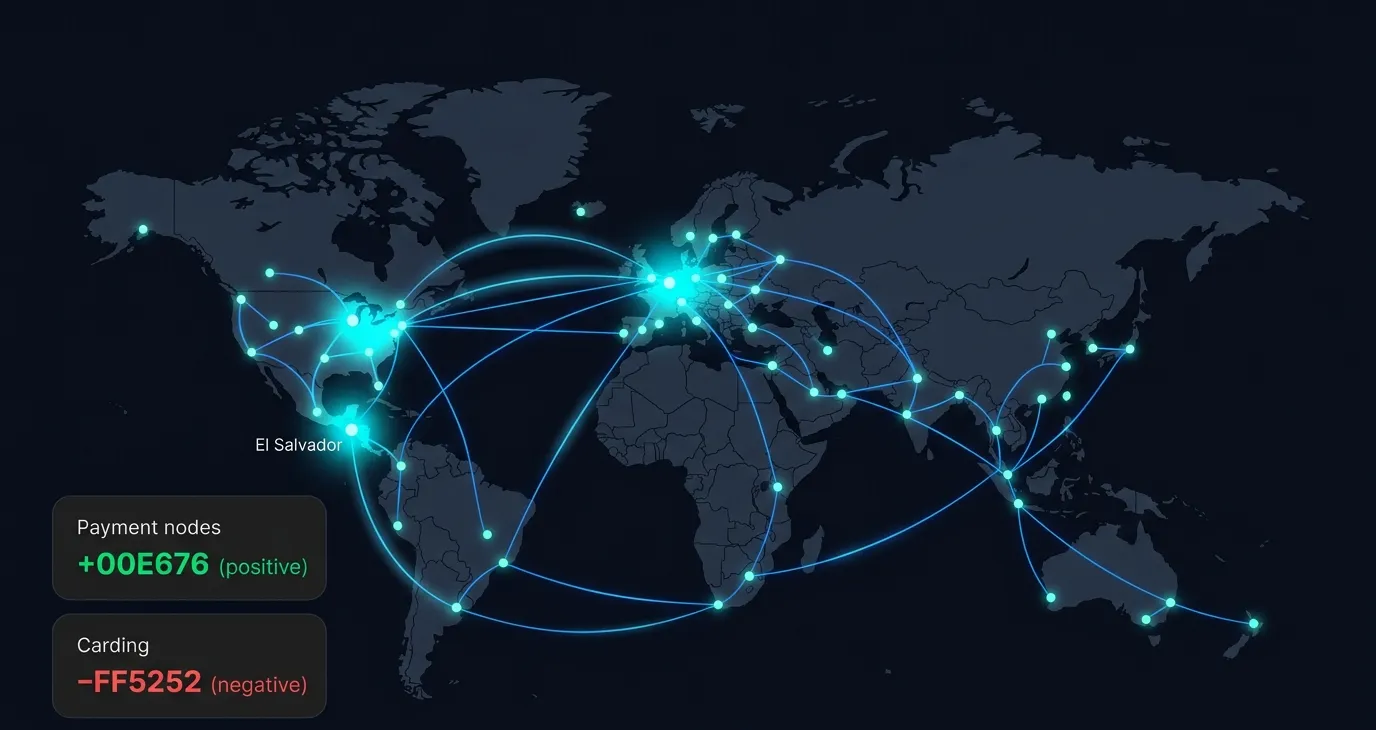
- El Salvador became the first country to make Bitcoin legal tender in 2021, with the government-issued Chivo wallet Lightning-compatible - enabling instant, low-cost remittances for millions of Salvadorans.
- Binance and OKX significantly increased their Lightning liquidity in late 2025, allowing users to deposit and withdraw BTC via Lightning for near-instant, low-fee transfers.
- Twitter/X integrated Lightning via Strike, enabling users to send Bitcoin tips instantly to content creators.
- Strike uses Lightning to offer near-zero-fee international remittances, directly competing with legacy money transfer services.
The network reached an all-time high in capacity in late 2025, driven by major exchange adoption, according to the Wikipedia Lightning Network page (March 2026 data).
How to Get Started with Lightning Network in 2026
Getting your first Lightning payment set up takes under 10 minutes. Here's the simplest path:
Download a Lightning Wallet
Download Phoenix (non-custodial, recommended) or Wallet of Satoshi (custodial, simplest) from the App Store or Google Play. Both are free.
Fund Your Lightning Wallet
Send a small amount of BTC from an exchange (Binance, OKX, and Kraken all support Lightning withdrawals) directly to your Lightning wallet address. Start with $10-$20 to experiment.
Send Your First Lightning Payment
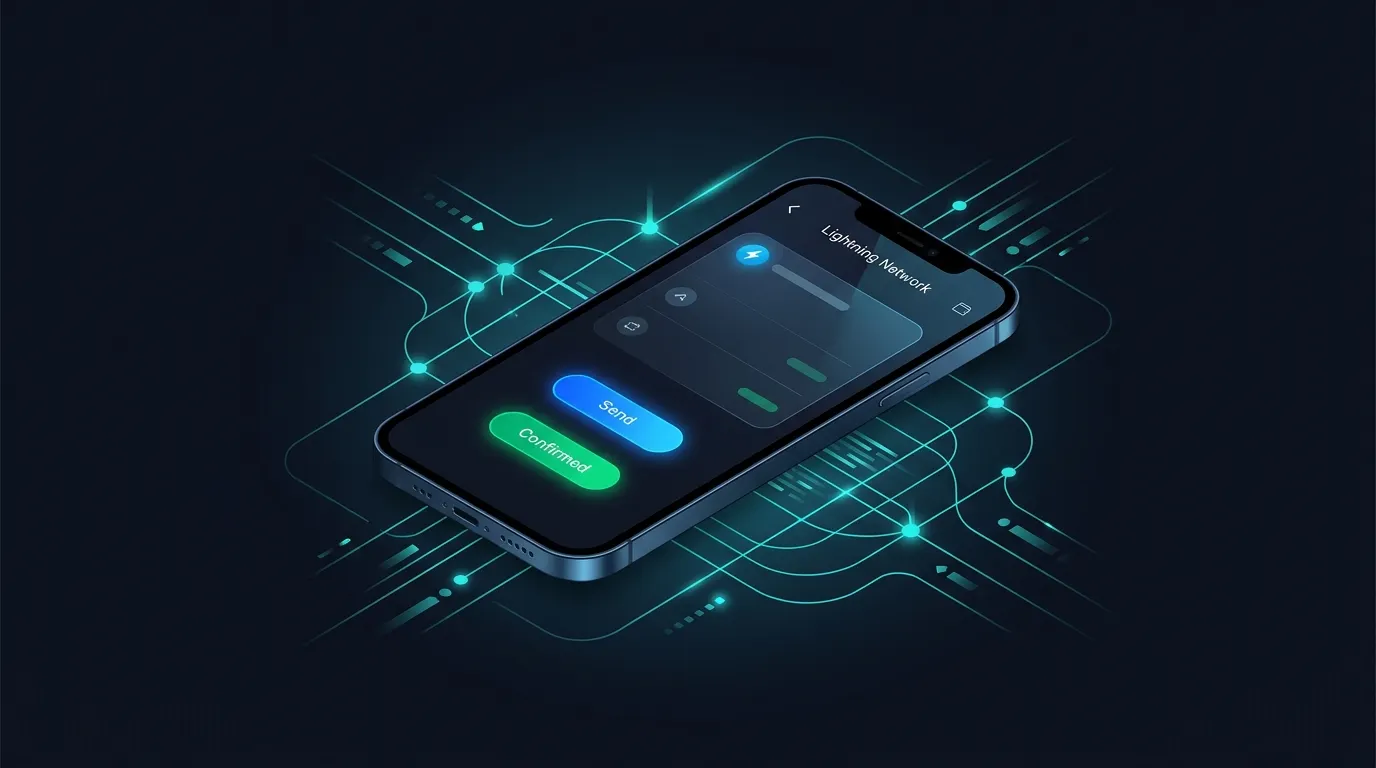
Scan a Lightning invoice QR code or paste a Lightning address (they look like email addresses: [email protected]). Confirm the amount and hit send. Your payment settles in under a second.
Explore Real Use Cases
Try tipping content creators on Nostr, paying for a VPN subscription via Lightning, or sending a satoshi micropayment to a friend in another country - all for fractions of a cent.
Lightning invoices are the standard way to request a payment. When you generate an invoice in your wallet, it creates a BOLT11 format string or QR code containing the payment amount, destination, expiration, and a cryptographic hash. The sender's wallet automatically finds the best route and executes the payment - typically in under a second.
Conclusion: Is the Lightning Network the Future of Bitcoin Payments?
The lightning network bitcoin case is compelling. For the first time, Bitcoin can realistically compete with legacy payment networks on speed and cost - without sacrificing the security or decentralization of the base layer. The numbers speak for themselves: 17,000+ nodes, 40,000 channels, and sub-cent fees as of March 2026.
The technology still has limitations - liquidity constraints, the need to be online to receive payments, and complexity for node operators. But for everyday users, modern wallets have abstracted most of that away. Phoenix and Wallet of Satoshi make Lightning as easy as any payment app.
For anyone serious about Bitcoin as a medium of exchange - not just "digital gold" - Lightning is the missing piece. It's not the future. It's already here.
Exchanges collapse. Your wallet doesn't. No deposits to lose. Settles straight to self-custody. Trade like the next FTX matters.
ZIPMEX perps settle directly to self-custody. No deposits to lose when the next FTX happens.
Frequently Asked Questions
What is the Lightning Network in simple terms?
The Lightning Network is a payment system built on top of Bitcoin that enables instant, near-free transactions. Instead of recording every payment on the blockchain, it creates private "tabs" (payment channels) between users - only recording the opening and closing balances on-chain. It's like Bitcoin's fast lane.
How much does a Lightning Network transaction cost?
Lightning transaction fees are typically less than $0.01 - often fractions of a cent (a few satoshis). This is because payments are routed through existing channels with minimal computational overhead, unlike on-chain Bitcoin transactions that compete for limited block space.
Understanding the difference between these protocol-level costs and the logic behind mainnet congestion is vital for managing your long-term transaction overhead. While opening a channel is a strategic one-time cost, high network demand can still impact your total spend. We recommend exploring our detailed guide on what gas fees are and how blockchain transaction costs are calculated to optimize your timing when interacting with the base layer.
Is the Lightning Network safe to use?
Yes, for small everyday payments. Lightning is secured by Bitcoin's cryptography and HTLC smart contracts that prevent theft during routing. The main risks are: hot wallet exposure (funds must be accessible online), custodial wallet risk, and potential channel liquidity issues. Never store large amounts long-term on Lightning.
Do I need to run a node to use Lightning?
No. Most users can use Lightning via mobile wallets like Phoenix or Wallet of Satoshi without running a node. Running your own node gives you maximum privacy and control, but it's optional and technical.
What is a Lightning invoice?
A Lightning invoice is a payment request in BOLT11 format - a string of characters or QR code containing the payment amount, recipient, expiration time, and a cryptographic hash. You generate one when you want to receive a payment, and the sender's wallet automatically finds a route to fulfill it.
Can I use Lightning Network with any Bitcoin?
Yes - Lightning uses real BTC. You fund a Lightning wallet or channel with on-chain Bitcoin, and your sats become instantly spendable via Lightning. When you close your channel, the final balance settles back on the Bitcoin blockchain.
⚠ Disclaimer: The information provided in this article is not intended to provide investment or financial advice. Investment decisions should be based on the individual's financial needs, objectives, and risk profile. We encourage readers to understand the assets and risks before making any investment entirely. Cryptocurrency investments are subject to high market risk. Past performance does not guarantee future results.