You open Binance and see Bitcoin at $97,450. You check Coinbase - it says $97,512. You look at Kraken - $97,389. Same coin. Three prices. What's going on?
Quick Answer: Crypto prices differ between exchanges because each platform is an independent marketplace. Prices are set by local supply and demand, so different user bases, liquidity levels, trading volumes, and fee structures create natural price gaps - usually 0.1-2%, occasionally more during volatile markets.
This isn't a bug. It's how decentralized, fragmented markets work - and once you understand it, you can use it to your advantage.
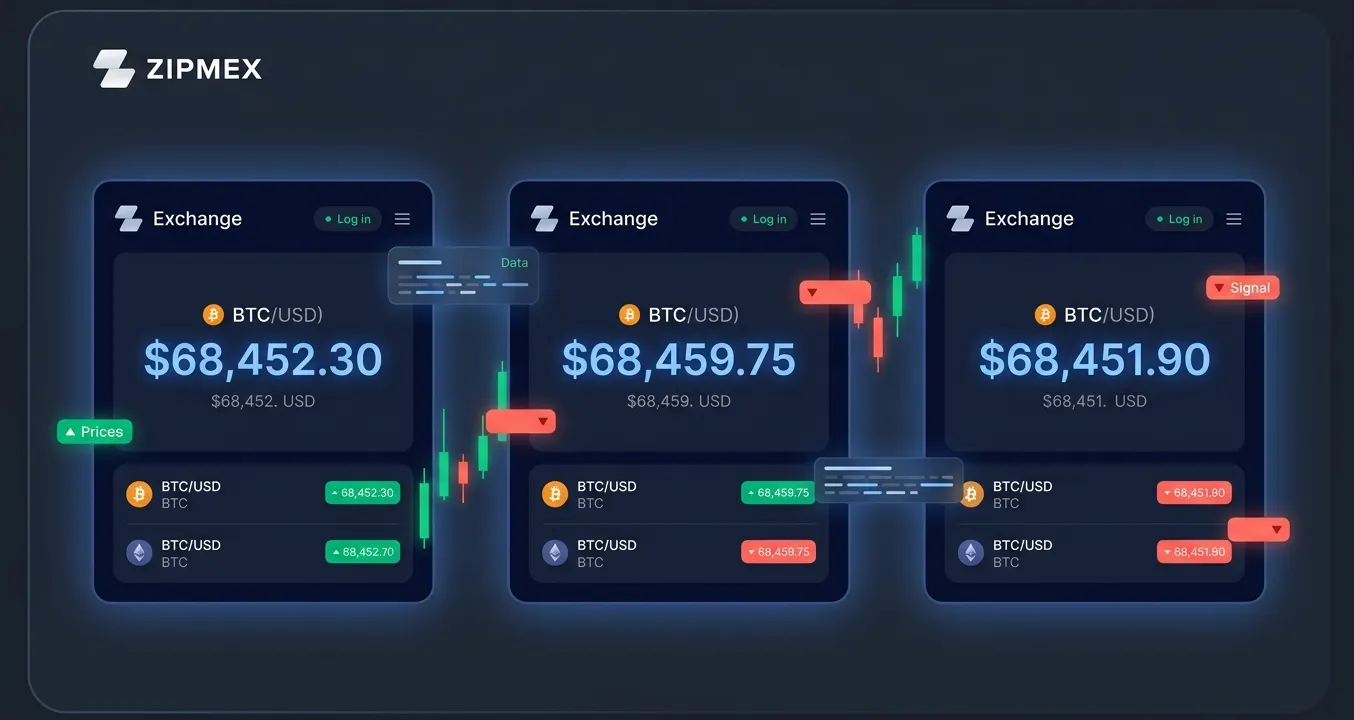
Why Do Crypto Exchanges Have Different Prices?
Unlike stock markets, which funnel trades through regulated central exchanges that enforce uniform pricing, crypto markets are fragmented across thousands of independent platforms worldwide. There is no global "official" Bitcoin price - only the price on the exchange where you happen to be trading at that moment.
Each exchange runs its own order book: a real-time list of buy and sell orders from its own users. When a buyer's bid matches a seller's ask on Exchange A, that transaction sets Exchange A's market price. If Exchange B has different buyers, different sellers, and different order volumes at the same moment, its price will be slightly different.
The result? The same asset can have legitimately different prices on different platforms simultaneously.
💡 Pro Tip
Use a price aggregator like CoinGecko or CoinMarketCap to see volume-weighted average prices across all exchanges. This gives you a "fair market" benchmark before placing any trade.
6 Reasons Crypto Prices Differ Between Exchanges
1. 📊 No Standardized Pricing (The Root Cause)
Traditional currencies are regulated by central banks. Crypto is not. There's no authority telling Binance or Coinbase what price to display for Bitcoin. Each exchange discovers its own price organically through the trades happening on its platform.
This means prices are always locally determined - and always slightly different.
2. 💧 Liquidity Varies Dramatically
Liquidity is how easily you can buy or sell without moving the price. High-liquidity exchanges (more buyers and sellers) produce tighter, more stable prices. Low-liquidity exchanges can swing dramatically on a single large trade.
According to CoinMarketCap liquidity scores, major exchanges rank significantly differently:
Source: CoinMarketCap liquidity scores, 2026
On a small exchange with few active traders, even a single "whale" order can push the price 1-3% in seconds. On Binance, that same order gets absorbed across millions of counterparties.
3. 📈 Trading Volume Shapes Price Discovery
Volume and liquidity are related but different. High trading volume means more transactions are happening, which accelerates price discovery - the process by which the market converges on a "fair" price.
Low-volume exchanges lag behind. When Bitcoin jumps 5% on Binance due to a major news event, smaller exchanges may take minutes or even hours to reflect the same move. During that window, prices genuinely differ.
4. 🌍 Regional Demand and Local Market Conditions
Geography matters more than most traders realize. Local regulations, fiat currency availability, and regional sentiment can create persistent price premiums.
The most famous example: the Kimchi Premium. In South Korea during the 2017-2018 bull run, Bitcoin consistently traded 20-30% higher on Korean exchanges than on international platforms. Capital controls made it nearly impossible for arbitrageurs to close the gap - so it persisted for months.
Smaller regional premiums exist regularly, typically in the 0.5-5% range, in countries with restricted banking access or strong local crypto demand.
5. 💸 Fees Are Embedded in Prices
Different exchanges have different fee structures - and those fees often get baked into the displayed price. An exchange charging 0.5% per trade may show prices that already account for execution costs, making them appear slightly higher than a zero-fee competitor.
Additionally, when traders face high withdrawal fees, they're reluctant to arbitrage price gaps across platforms. This friction allows price differences to persist longer than they otherwise would.
6. 🔗 Trading Pairs and Stablecoin Peg Drift
Not all exchanges quote prices in the same currency. Some use BTC/USD (actual US dollars). Others use BTC/USDT (Tether). These are not identical.
Tether (USDT) maintains an approximate $1 peg, but it occasionally drifts to $0.998 or $1.002. That tiny deviation means:
- A BTC/USDT price of $97,500 on one exchange
- Could equal $97,306 in real USD terms if USDT is at $0.998
This stablecoin peg difference is a subtle but real source of price variation that most beginners overlook.
🔑 Key Takeaways
- Crypto prices differ because each exchange is an independent marketplace with its own order book
- Typical price gaps are 0.1-2%; wider gaps appear during volatility or on low-liquidity platforms
- Regional factors (like South Korea's kimchi premium) can push gaps to 20%+ in extreme cases
- Fees, trading pairs, and stablecoin peg drift all add subtle layers of price variation
- Use CoinGecko or CoinMarketCap to benchmark fair market price before trading

How Crypto Arbitrage Price Differences Work
When prices diverge between exchanges, a profit opportunity appears: buy where it's cheap, sell where it's expensive. This is crypto arbitrage.
In theory it sounds simple. In practice, it's dominated by bots.
Algorithmic arbitrage bots continuously monitor hundreds of exchanges simultaneously. The moment a price gap appears, they execute buy and sell orders in milliseconds - closing the gap before most human traders even see it. By the time you notice Bitcoin is $50 cheaper on Exchange A vs Exchange B, the bots have already traded it away.
This is why:
- Visible arbitrage gaps are usually tiny (under 0.5%) on major coins
- Larger gaps persist only on illiquid pairs or during extreme volatility
- Transfer times between exchanges (10+ minutes for some blockchains) create execution risk even when gaps exist
- Fees often eat the entire margin on small price differences
Want to dive deeper into this topic? Read our full guide on crypto arbitrage strategies and whether crypto arbitrage is legal.
Why Is Bitcoin Price Different on Each Exchange? (Practical Example)
Let's make this concrete. Imagine BTC is worth $97,000 and a major institutional buyer places a $500M market order on Coinbase. That order sweeps through Coinbase's entire order book, pushing the price to $97,800 in seconds.
At the same moment, Binance's order book hasn't changed. BTC is still $97,050 on Binance. For about 30-60 seconds, there's a $750 price difference.
Arbitrage bots immediately start buying BTC on Binance and selling on Coinbase. Within a minute, both prices converge to approximately $97,600.
This is the constant, invisible engine running behind every crypto market: price discovery happening independently on each exchange, then being stitched together by arbitrageurs into something approaching a global consensus price.
Understanding how market makers and automated market makers (AMMs) work gives you even deeper insight into this process.
*Source: CryptoHopper research; data ranges are indicative, not guaranteed*How to Find the Best Crypto Price Across Exchanges
You don't need to be an arbitrage bot to benefit from price differences. Here's what regular traders do:
1. Use a price aggregator first. Before buying on any exchange, check CoinGecko or CoinMarketCap. They aggregate prices from dozens of exchanges and show you the volume-weighted average - your benchmark for "fair" price.
2. Check liquidity, not just price. A lower displayed price on a tiny exchange might look attractive, but if there's no sell-side liquidity at that price, your order will execute much higher (this is called slippage). A slightly higher price on a deep-liquidity exchange is often the better deal.
3. Factor in fees. A 0.5% lower price means nothing if the exchange charges 0.8% per trade. Always compare total cost of execution, not just the headline price.
4. Consider your trading pair. If the exchange quotes BTC/USDT instead of BTC/USD, verify the current USDT peg before assuming the prices are directly comparable.
For a secure starting point, learn how to store your crypto safely once you've bought it - keeping funds on the right exchange matters as much as getting the right price.
Conclusion
Crypto price differences between exchanges aren't glitches - they're a natural feature of how decentralized, fragmented markets work. Six core factors drive them: no standardized pricing, liquidity differences, trading volume, regional demand, fee structures, and trading pair variations.
For most traders, the practical takeaway is simple: always check a price aggregator before trading, choose high-liquidity exchanges for large orders, and account for fees in your total cost calculation. The gaps are real - but for everyday traders, they're usually too small and too short-lived to chase directly.
Understanding why prices differ makes you a more informed trader, even if you never attempt arbitrage yourself.
❓ Frequently Asked Questions
Q: Why does Bitcoin have different prices on different exchanges?
A: Because each exchange is an independent marketplace. Bitcoin's price on any exchange reflects the most recent trade between buyers and sellers on that specific platform's order book - not a universal standard. Liquidity, trading volume, fees, and regional demand all create small but real differences.
Q: Is it legal to buy crypto on one exchange and sell on another?
A: Yes, this is called arbitrage and it is entirely legal in most jurisdictions. Read our full guide on whether crypto arbitrage is legal for country-specific details.
Q: How much do crypto prices typically differ between exchanges?
A: For major coins on large exchanges during normal market conditions, the difference is typically 0.05-0.5%. During high volatility events or on smaller exchanges, gaps of 1-5% are possible. Extreme regional premiums (like the historical kimchi premium) can reach 20-30%, but these are rare and usually impossible to arbitrage due to capital controls.
Q: Which exchange has the "real" price of Bitcoin?
A: There is no single "real" price. Price aggregators like CoinGecko calculate a volume-weighted average across all exchanges, which is the closest thing to a global consensus price.
Q: Can I make money from crypto price differences between exchanges?
A: It's technically possible, but very difficult in practice. Arbitrage bots execute in milliseconds and capture most profitable opportunities before human traders can react. Transfer times, fees, and execution risk further reduce the practical margin. For beginners, it's not a reliable strategy.
⚠ Investment Disclaimer: The information provided in this article is for educational purposes only and does not constitute financial, investment, or legal advice. Cryptocurrency trading involves significant risk of loss. Price data referenced is illustrative and subject to change. Always conduct your own research and consult a qualified financial advisor before making investment decisions. Zipmex does not guarantee the accuracy of third-party data sources cited.
ZIPMEX promotes trading on trade.zipmex.com. Promotions are labelled and kept separate from news coverage, which is selected and checked without regard to them. Perpetual futures are leveraged derivatives. Prices can move fast and you can lose all of your margin. Not available in every jurisdiction. Not investment advice.