A decentralized exchange (DEX) is a peer-to-peer marketplace where you trade crypto directly from your own wallet - no company holding your funds, no sign-up forms, no middleman taking custody of your assets. Instead of a centralized institution matching your orders behind closed doors, a DEX uses self-executing smart contracts deployed on a public blockchain. Every trade settles on-chain, visible to anyone, executable by no one except the code itself.
This automated execution removes the need for centralized oversight and relies entirely on programmable logic deployed on-chain. Understanding how these self-executing agreements function is critical for any trader looking to utilize decentralized liquidity pools safely and efficiently. To dive deeper into the mechanics of this underlying technology, check out our detailed guide on how Ethereum smart contracts work.
That's a fundamentally different model from anything traditional finance built. And once you understand how it works, it's hard to unsee why it matters.
⚡ Key Takeaways
- A DEX (decentralized exchange) is a peer-to-peer crypto trading platform that operates without a custodial intermediary.
- Trades execute automatically via smart contracts - code that runs on a blockchain and can't be altered mid-execution.
- You always control your private keys on a DEX; the platform never holds your funds.
- The main DEX models are order book DEXs, Automated Market Makers (AMMs), and DEX aggregators.
- DEXs are a cornerstone of DeFi - and come with real advantages, as well as real risks worth understanding before you trade.
Because these platforms do not hold your capital, you must interact with their smart contracts using a secure, non-custodial Web3 interface. Connecting your own cryptographic vault ensures you maintain total sovereignty over your assets during every swap. Before executing your first decentralized trade, make sure you properly configure your digital gateway by following our step-by-step tutorial on how to set up a MetaMask wallet.
What Is a DEX and How Does It Work?
At its core, a DEX replaces the internal matching engine of a traditional exchange with smart contracts - self-executing programs that live on a blockchain. When you trade on a centralized exchange (CEX) like Coinbase or Binance, their servers are processing your order, matching it with a counterparty, and maintaining a database of trades. You trust their system to execute fairly. On a DEX, that trust is replaced by math.
The smart contract holds the logic: if User A sends Token X, and the conditions are met, User B receives Token Y. No human intervention. No ability for a platform to freeze your funds mid-trade or execute your order at a worse price than displayed. The outcome is deterministic - it runs exactly as written, every single time.
DEX transactions are settled directly on the blockchain they're built on. That means every trade is publicly verifiable. You don't need to take anyone's word for what happened - you can look it up.
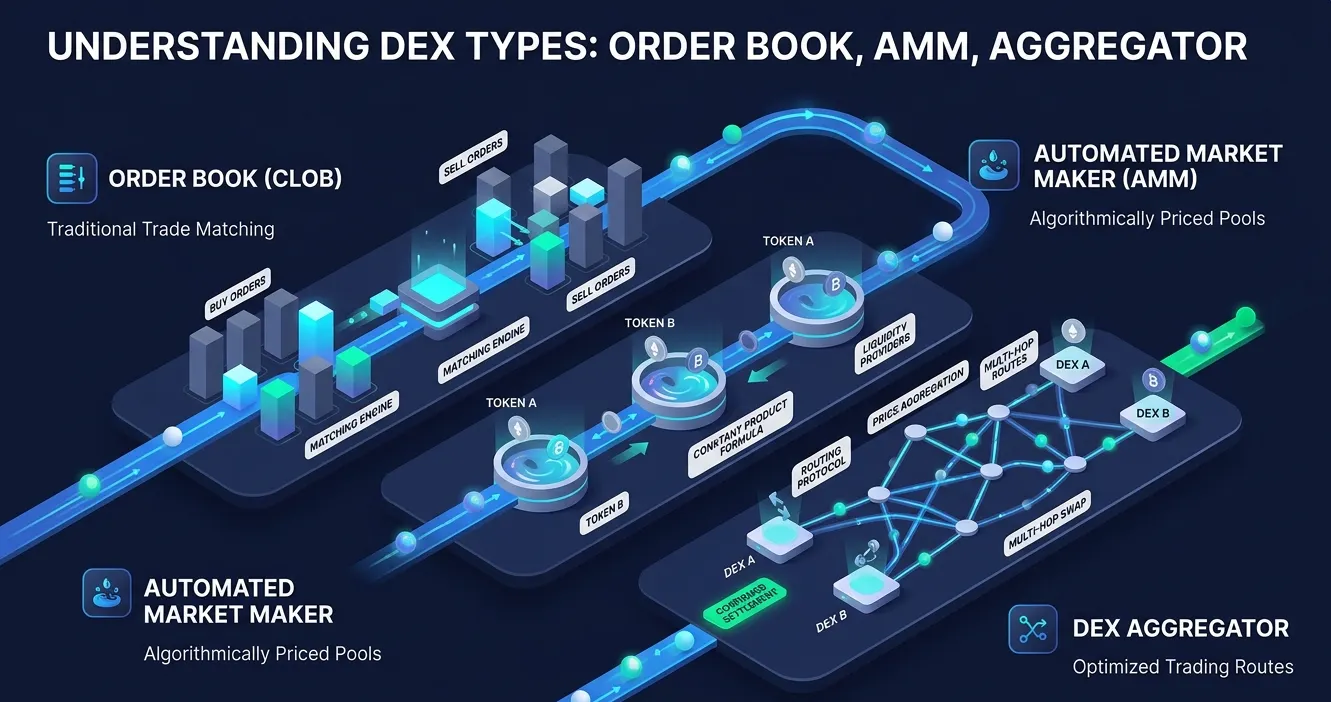
There are three primary DEX architectures, and they work quite differently from each other.
Order Book DEXs
Order book DEXs mirror the structure you'd recognize from traditional exchanges and centralized crypto platforms: a live list of open buy and sell orders that an automated system matches when prices align. Conceptually straightforward. Historically, the execution was messy.
Fully on-chain order books were impractical for years because every single order - placing it, modifying it, canceling it - required a blockchain transaction. On Ethereum, that meant paying gas for every interaction, and the network couldn't process orders fast enough to compete with centralized alternatives. Early versions had thin liquidity and a frustrating user experience.
Layer-2 scaling networks changed the equation. Optimistic rollups and ZK-rollups dramatically increased throughput while keeping security rooted in the underlying blockchain. Today, hybrid order book DEXs have become viable: order matching happens off-chain for speed, while final settlement executes on-chain for verifiability. Platforms like dYdX, Loopring DEX, 0x, and Serum operate on this model and now handle meaningful trading volume.
The appeal of order book DEXs for active traders is precision: limit orders, conditional fills, and the familiar mechanics of professional trading. The dominant DeFi model, though, took a completely different approach.
Automated Market Makers (AMMs)
Automated Market Makers are what most people interact with when they use a DEX - and they replaced the order book with something elegantly simple: a liquidity pool. To understand how AMMs work in depth, the core mechanic is trading against a smart contract pool rather than a counterparty.
Instead of matching you with another trader, an AMM matches you with a smart contract that holds a reserve of two tokens. You swap one token in, you get the other out. No counterparty needed. No waiting for your order to fill. Instant execution, 24/7, for any token pair with an active pool.
Prices are set algorithmically. The most common formula is the constant product model:
This formula ensures the pool never runs dry - as one token depletes, its price automatically rises. The larger the pool, the less your trade moves the price.
Those pools are funded by Liquidity Providers (LPs) - ordinary users who deposit token pairs into the smart contract and earn a share of every trading fee generated by the pool. On Uniswap, LPs earn 0.3% of each swap proportional to their pool share. Sounds passive, but there's a catch: impermanent loss. If the relative price of the two tokens shifts significantly while your capital is locked in the pool, you may end up with less value than if you'd simply held both tokens. It's not a theoretical risk - in volatile markets, it's material. Read our full breakdown of what impermanent loss means in practice before committing capital to any pool.
Major AMMs include Uniswap (the AMM pioneer on Ethereum), SushiSwap, PancakeSwap (Binance Smart Chain), Curve Finance (specialized for stablecoin swaps with minimal slippage), Balancer, Bancor, and Trader Joe. Each has distinct fee structures, liquidity concentrations, and supported token universes.
DEX Aggregators
DEX aggregators sit one layer above individual exchanges. Rather than routing your trade to a single DEX, an aggregator scans dozens of liquidity sources simultaneously - multiple AMMs, liquidity pools, and sometimes order book DEXs - and finds the combination that gives you the best net price.
The key feature is smart order routing: your trade may actually be split across three different DEXs to execute at a better overall rate than any single venue could offer. Think of it like a flight comparison tool that books you on two airlines with a layover because the combined cost is cheaper than a direct flight.
1inch and 0x are the most widely used aggregators. Coinbase's DEX integration, launched in 2026, uses both behind the scenes - so when you tap "swap" in the Coinbase app, aggregator logic is routing your order across the DeFi ecosystem automatically.
For most users, aggregators are the right default - you get the benefits of DeFi liquidity without manually comparing prices across five platforms.
DEX vs CEX: Key Differences Explained
The most fundamental difference between a DEX and a CEX isn't fees or token selection - it's who controls your money.
On a centralized exchange, you deposit funds into the platform's wallet. The exchange holds your private keys. You have an account balance in their database, not actual crypto in your possession. That's custodial trading - and it's the model that produced the Mt. Gox collapse of 2014, where hundreds of thousands of Bitcoin disappeared because one company held too much of the ecosystem's capital. More recently, the FTX collapse in 2022 showed the same structural vulnerability at even larger scale.
DEXs operate non-custodially. You connect a self-hosted wallet (like MetaMask), trade directly from it via smart contracts, and your assets never leave your possession during the process. There's nothing to hack at the custodial level - the DEX itself doesn't hold user funds.
The trade-off is responsibility. When you control your keys, you also absorb the full risk of losing them.
According to data tracked by The Block, centralized exchanges still handled roughly 95% of all crypto trading volume in September 2020. By August 2023, DEXs had grown from 0.11% of global volume (January 2019) to 14% - with over $40 billion in monthly trading volume. The shift is real, but CEXs still dominate for beginners and fiat on-ramps.

How to Use a DEX: Step-by-Step for Beginners
Using a DEX takes more setup than signing up for a centralized exchange - but once you've done it once, the process becomes second nature. Here's exactly how it works.
Step 1 - Set up a self-hosted wallet
MetaMask is the standard starting point for Ethereum-based DEXs. Download the browser extension or mobile app, generate your wallet, and - critically - write down your 12-word seed phrase and store it offline. Lose that phrase, lose your wallet permanently.
Step 2 - Fund your wallet with crypto
DEXs don't accept fiat (USD, EUR, etc.). You'll need to buy crypto through a centralized exchange first, then transfer it to your self-hosted wallet. For Ethereum-based DEXs, you need ETH to pay gas fees - even if you're trading other tokens.
Step 3 - Navigate to a DEX interface
Go to app.uniswap.org (Uniswap is the best starting point - highest liquidity, most audited codebase, clearest interface). Verify you're on the correct URL - phishing sites mimic popular DEXs.
Step 4 - Connect your wallet
Click "Connect Wallet" → select MetaMask → approve the connection in the MetaMask popup. Your wallet address is now visible in the DEX interface. You haven't shared any funds yet - just your public address.
Step 5 - Select your token pair and amount
Choose the token you're swapping from (e.g., ETH) and the token you want (e.g., USDC). Enter the amount. The DEX calculates your expected output and shows the exchange rate.
Step 6 - Review gas fees and slippage tolerance
Two numbers to check before confirming: (a) the gas fee estimate (this goes to the Ethereum network, not Uniswap), and (b) the slippage tolerance setting (default is 0.5% - for low-liquidity tokens, you may need to increase this). High-traffic periods on Ethereum can push gas fees above $20 for a single swap.
Step 7 - Confirm the transaction in your wallet
Click "Swap" in the DEX interface, then approve the transaction in the MetaMask popup. Your trade executes on-chain. You can track it via the transaction hash on Etherscan.
⚠ Common Beginner Mistake to Avoid
- Approval transaction confusion → Your first interaction with a new token requires a separate on-chain approval step. It costs gas but moves no funds. Many beginners think something went wrong. It didn't - approve it, then execute your swap.
- Wrong wallet address → On-chain transactions are irreversible. Double-check recipient addresses character by character before confirming.
- Phishing URLs → Always verify you're on the correct domain (app.uniswap.org, not variations). Bookmark the official URL.
Alternative beginner path: Coinbase now integrates DEX trading directly in its app, with aggregated liquidity from Uniswap and Aerodrome, Coinbase-sponsored gas fees, and a familiar centralized-style interface. For first-timers, this removes the wallet setup step entirely.
Understanding how DEXs work is step one. Knowing their genuine advantages - and honest limitations - is what separates traders who use them well from those who get burned.
Advantages of Decentralized Exchanges
DEXs aren't popular because of marketing. They've grown to handle $40+ billion in monthly trading volume because they solve real problems that centralized infrastructure consistently fails at.
Non-custodial trading is the headline advantage. On a DEX, your funds stay in your wallet from the moment you connect to the moment your trade confirms. The DEX smart contract briefly holds your tokens during execution - for seconds, not days. No platform can freeze your account, misuse your capital, or lose it in a hack that targets custodial wallets. When Celsius, FTX, and other centralized platforms froze withdrawals in 2022, DEX users kept full access to their funds. The math on self-custody is simple: if you don't hold the keys, you don't own the crypto.
Permissionless access means no gatekeeping. You don't submit an ID, wait for approval, or worry about geographic restrictions at the smart contract level. An internet connection and a compatible wallet is all the access control a DEX implements. For users in regions where centralized exchange access is restricted or banking infrastructure is unreliable - large parts of Southeast Asia, Sub-Saharan Africa, and Latin America - this isn't a convenience feature, it's the only viable path to on-chain financial markets.
Token diversity is a practical edge for anyone tracking emerging projects. Centralized exchanges list tokens selectively, prioritizing established assets with sufficient trading volume and legal compliance. DEXs list everything - a new token becomes tradeable minutes after its smart contract deploys. If you've ever wanted exposure to a project before it reaches CEX listing, DEXs are where that access exists.
Transparency is structurally guaranteed. Every transaction on a DEX is recorded on a public blockchain. Fee structures are specified in smart contract code, not buried in a terms of service document. There are no hidden order flows, no front-running by the platform's own trading desk, no opaque price discovery. The mechanics of every trade are cryptographically verifiable - which is a meaningfully different promise than "trust us, it's fair."
Financial inclusion is an underappreciated dimension of what DEX adoption represents. Peer-to-peer lending, fractional access to global markets, and pseudonymous participation have made DEXs increasingly relevant in developing economies where banking infrastructure doesn't reach. Anyone with a smartphone and an internet connection can participate - that's a genuine expansion of who gets access to financial tools.

Risks and Disadvantages of DEXs
Transparency cuts both ways. The same on-chain openness that makes DEXs trustless also creates attack surfaces that don't exist in centralized systems. Understanding these risks isn't optional - it's part of trading on DEXs competently.
⚠ Top 5 DEX Risks at a Glance
- Smart Contract Risk → code bugs can drain funds; audits reduce but don't eliminate this
- Liquidity Risk → thin pools cause high slippage on low-cap tokens
- MEV / Frontrunning → bots can exploit your pending transaction before it confirms
- Impermanent Loss → liquidity provision can underperform simple holding in volatile markets
- Rug Pulls & Scam Tokens → permissionless listing means fraudulent tokens appear constantly
Smart contract risk is the technical baseline everyone accepts when using DeFi. Blockchains execute code deterministically - which means bugs execute deterministically too. Exploits like reentrancy attacks or price oracle manipulation have drained hundreds of millions of dollars from DEX protocols over the years. Security audits from reputable firms substantially reduce this risk, but they don't eliminate it. Newer, unaudited protocols carry meaningfully higher exposure.
Liquidity risk affects anyone trading tokens with shallow pools. The x*y=k formula means price impact scales with trade size relative to pool depth. A $500 swap in a $2 million pool barely moves the price. The same swap in a $50,000 pool could result in 20%+ slippage - you receive far less than the quoted price. Always check pool liquidity before trading low-cap tokens, and use aggregators to route around thin liquidity where possible.
MEV (Maximal Extractable Value) and frontrunning exploit the public nature of blockchain mempools. When you submit a DEX transaction, it sits in the mempool - visible to everyone - before confirmation. Automated bots scan the mempool constantly, identify profitable trades, and insert their own transactions with higher gas fees to execute before yours. The result: you pay a worse price than you expected, and the bot pockets the difference. This is called a "sandwich attack." According to research by Flashbots, MEV extraction has accounted for hundreds of millions in value redirected from regular traders. Mitigation tools exist - MEV-protected RPC endpoints like Flashbots Protect can obscure your transaction from public mempools.
Impermanent loss is the LP-specific risk. If you're providing liquidity to a pool where one token is volatile, there are realistic scenarios where fees earned don't compensate for the loss versus simply holding. Stablecoin pairs (USDC/USDT) have near-zero impermanent loss. ETH/USDC pools at high volatility can see LPs end up worse than non-participants.
Rug pulls and scam tokens are a real operational hazard. Because DEX listing is permissionless, fraudulent projects can deploy a token, create a liquidity pool, attract buyers, and then drain the pool and disappear - often within hours. In 2024 alone, crypto investors lost over $500 million to memecoin rug pulls and scams, according to research by Merkle Science. Red flags: anonymous teams, no smart contract audit, liquidity not locked or time-locked, token contract with owner mint privileges. Always check whether liquidity is locked - our guide on locked liquidity in crypto covers exactly how to verify this before entering any new position.
How to Choose and Evaluate a DEX
Knowing which DEX to use isn't about picking the most popular name. It's about matching the platform's strengths to what you actually need. Here's the framework I apply.
1. Security audit history is non-negotiable as a first filter. A DEX that hasn't had its smart contracts independently audited by a reputable firm (Chainalysis, Trail of Bits, OpenZeppelin, Certora) is asking you to trust code that no expert has verified. Audit reports are usually public - if you can't find one, treat it as a hard no. Uniswap has multiple audits from multiple firms and billions in verified TVL. That's a meaningful track record.
2. Total Value Locked (TVL) is the most accessible proxy for liquidity depth and community trust. A DEX with $2 billion TVL has vastly deeper pools than one with $10 million - which directly affects your slippage on any given trade. You can verify current TVL across all DEXs on DeFiLlama, which aggregates live on-chain data. Uniswap consistently leads on Ethereum.
3. Governance model affects how the protocol responds to crises and how decisions about fees, new features, and security patches get made. DAO-governed protocols are more resistant to unilateral changes but can also be slower to respond to exploits. For long-term users, understanding who controls the admin keys matters more than most people realize.
4. Supported chains and tokens determines whether the DEX is practically useful for what you're trading. Uniswap is the standard for ERC-20 tokens on Ethereum. PancakeSwap dominates Binance Smart Chain. If you're trading on Solana, Raydium and Orca are the relevant venues.
5. Fee structure - both trading fees and gas costs - should match your trading frequency and size. For large, infrequent trades, 0.3% on Uniswap makes sense. For high-frequency small trades, gas fees may exceed trading fees on Ethereum mainnet; Layer-2 DEXs like Uniswap on Arbitrum or Optimism reduce this significantly.
Popular DEXs Compared: Uniswap, PancakeSwap, dYdX, and More
Here's how the major platforms stack up in practice:
Verify current fees at time of trading - DEX fee structures can update via governance votes. The above reflects typical 2026 configurations, not guaranteed current rates.
The Future of Decentralized Exchanges
The trajectory of DEXs points toward fewer trade-offs, not a fundamentally different model.
Layer-2 scaling is the most immediate force reshaping the space. On Ethereum mainnet, gas fees have historically been the primary barrier to DEX adoption for retail traders - paying $15 to execute a $200 swap doesn't work economically. On Layer-2 networks like Arbitrum, Optimism, and Base, the same swap costs cents. As liquidity migrates to L2s (already well underway in 2026), the fee argument against DEXs versus CEXs weakens substantially.
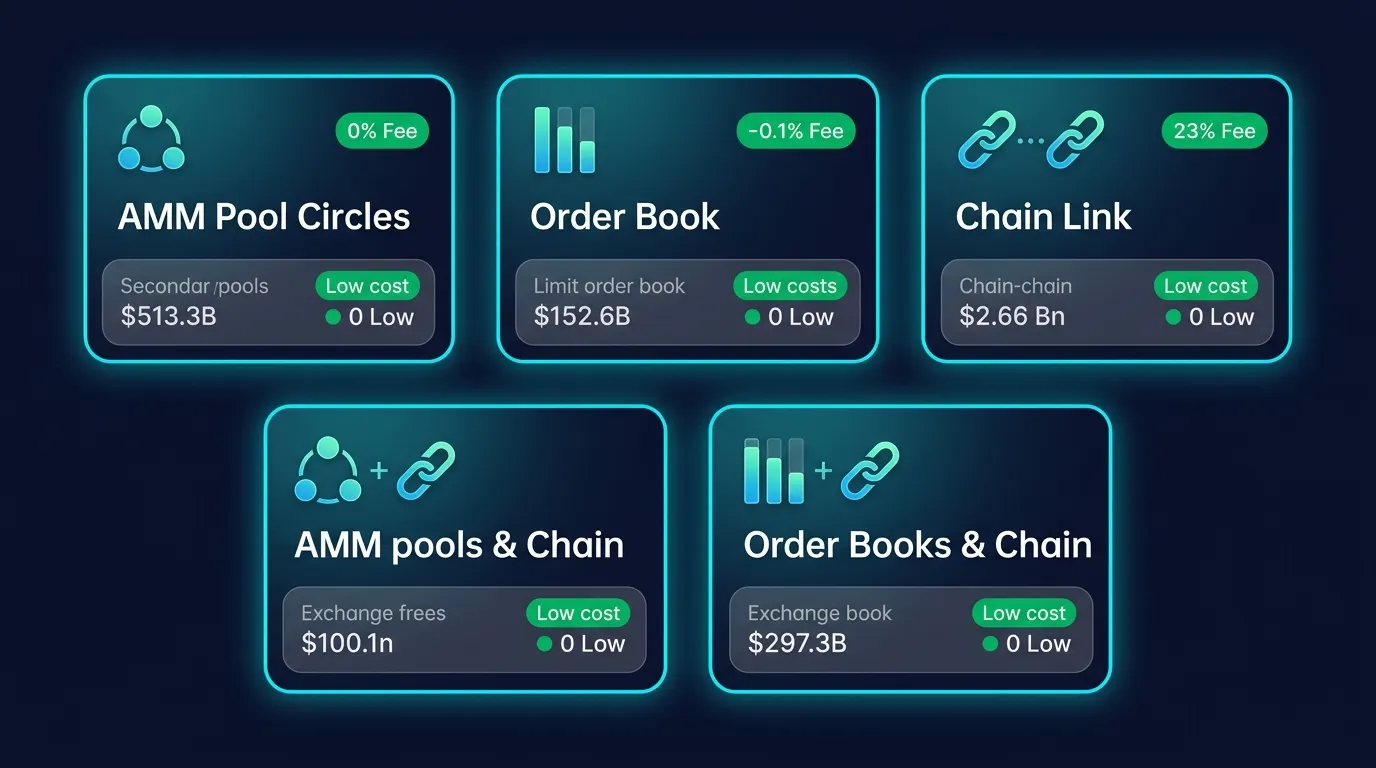
Cross-chain trading is the next structural evolution. Today, most DEXs operate within a single blockchain ecosystem. Swapping ETH for a Solana-native token requires going through a bridge, which is a separate trust assumption and attack vector. Cross-chain DEX protocols - using interoperability layers like Chainlink's CCIP - aim to enable native swaps across chains without bridging. When that infrastructure matures, the fragmentation of liquidity across dozens of separate ecosystems starts to consolidate.
Beyond cryptocurrency, DEXs built on programmable blockchains could facilitate the exchange of tokenized real-world assets - equities, bonds, real estate fractions, carbon credits, and NFTs. The smart contract infrastructure is already capable of this. What's needed is the regulatory clarity and institutional participation to make RWA markets liquid enough to be useful.
On the regulatory front, the most likely near-term development isn't DEX prohibition - it's the emergence of compliance layers that operate optionally on top of existing protocols. KYC-optional DEXs, or DEX interfaces that apply regulatory filters for certain jurisdictions while leaving the underlying contracts unchanged, are already being explored. The on-chain logic doesn't care about regulation; the front-end interfaces increasingly do.
Ultimately, the entire foundation of decentralized finance rests upon public distributed ledgers that maintain immutable transaction histories without central authorities. By leveraging cryptographic consensus, these networks provide the transparent and secure settlement layer required for peer-to-peer trading to flourish globally. For a comprehensive look at the infrastructure making this economic shift possible, read our foundational explainer on what blockchains are and how they operate.
The direction is clear: DEXs that are faster, cheaper, and more interconnected - while preserving the non-custodial, on-chain verifiable core that defines them.
Conclusion
A decentralized exchange isn't a worse version of Coinbase. It's a different architecture with a different set of guarantees. You trade faster access to emerging tokens and genuine self-custody for a steeper learning curve, gas costs, and the responsibility of managing your own keys.
Whether DEXs are the right tool depends on what you're doing. Here's a practical split:
🟢 NEW TO CRYPTO
Start with Coinbase's integrated DEX trading or try a small swap on Uniswap using testnet ETH first. Learn the mechanics with stakes you can afford to lose.
🔵 ACTIVE DEFI TRADER
Uniswap or Curve for spot swaps; dYdX or similar order book DEXs for derivatives and perpetuals. Use aggregators (1inch) to maximize execution quality.
🟠 EARLY-STAGE TOKEN HUNTER
DEXs are the only venue for pre-listing access. Check audit status and liquidity lock before entering any new position.
⚪ PASSIVE YIELD SEEKER
Liquidity provision on Curve's stablecoin pools or Uniswap's concentrated liquidity positions generates real fees from actual trading activity - no token emissions inflating the APY figure.
The self-custodial, on-chain verified model that DEXs represent is where the most interesting DeFi infrastructure is being built. Platforms built on transparent fee mechanics and verifiable outcomes - like Zipmex's approach to real yield from actual platform activity - reflect the same underlying principle: users deserve to see exactly where their returns come from.
Trade smart. Keep your keys. Verify everything on-chain.
Crypto trading and DeFi participation involve substantial risk of loss. Leveraged trading and liquidity provision can result in losses exceeding your initial investment. Nothing in this article constitutes financial advice or an investment recommendation. Always conduct independent research and assess your own risk tolerance before trading.
Last updated: April 2026.
Frequently Asked Questions
What is a DEX in crypto?
A DEX, or decentralized exchange, is a crypto trading platform where users swap tokens directly from their own wallets using smart contracts - no company intermediary, no account registration, no custody of your funds by a third party. The exchange logic runs on a public blockchain, making every transaction transparent and verifiable by anyone. DEXs are the primary infrastructure of decentralized finance (DeFi) and operate 24/7 without downtime or withdrawal freezes. The non-custodial model means you keep full control of your assets throughout the trading process.
What does DEX stand for?
DEX stands for Decentralized Exchange. The "decentralized" refers to the absence of a central authority controlling the platform - instead of a company managing order books and holding funds, smart contracts automate the entire trading process on-chain. The term distinguishes these platforms from CEXs (Centralized Exchanges) like Coinbase or Kraken, where a single organization operates the infrastructure and maintains custody of user assets. In practice, different DEXs achieve varying degrees of decentralization in their governance and front-end interfaces, even when their core trading contracts are fully on-chain.
How is a DEX different from a CEX?
The fundamental difference is custody. On a CEX, you deposit funds into the exchange's wallet - they control your private keys and you trust them to execute trades fairly and keep your assets safe. On a DEX, your wallet connects directly to smart contracts; funds never leave your possession during trading. CEXs require KYC verification and support fiat on-ramps. DEXs require only a compatible wallet and offer pseudonymous access to a far wider range of tokens. CEXs are generally easier to use and carry more regulatory protection. DEXs offer self-custody, permissionless access, and on-chain transparency at the cost of higher technical complexity.
What is an Automated Market Maker (AMM)?
An Automated Market Maker is the mechanism most DEXs use to price tokens and execute trades without a traditional order book. Instead of matching buyers with sellers, an AMM maintains liquidity pools - smart contracts holding pairs of tokens. When you swap, you trade against the pool, and the price adjusts algorithmically based on the ratio of tokens remaining. The most common formula is x * y = k (constant product), where x and y are token quantities and k stays fixed. This means liquidity is always available, but price impact increases as trade size grows relative to pool depth.
What is impermanent loss on a DEX?
Impermanent loss is the difference in value between holding tokens in a liquidity pool versus holding them in your wallet. It occurs when the price ratio between the two tokens in a pool changes after you deposit. The AMM rebalances automatically - buying the depreciating token and selling the appreciating one - leaving you with proportionally more of the token that lost value. If prices return to your entry ratio, impermanent loss disappears (hence "impermanent"). If they don't, it becomes a permanent realized loss when you withdraw. Stablecoin pools eliminate this risk almost entirely; volatile pairs amplify it.
Are decentralized exchanges safe?
DEXs eliminate custodial risk - the platform can't steal or freeze your funds. But they introduce smart contract risk (code bugs), user error risk (irreversible transactions), and market risks like MEV frontrunning and rug pulls. No DEX is universally "safe" - safety is a function of the specific protocol, its audit history, liquidity depth, and the token you're trading. Established, heavily audited protocols like Uniswap carry substantially lower smart contract risk than a two-week-old AMM with anonymous developers. The self-custody model means security is your responsibility - protect your seed phrase, verify URLs, and never sign transactions you don't understand.
What is a rug pull and how do I avoid it on a DEX?
A rug pull is a scam where token creators drain all liquidity from a DEX pool and disappear, leaving token holders with worthless assets. Warning signs include: anonymous team with no verifiable track record, smart contract code not publicly audited, liquidity not locked or time-locked, and owner wallet permissions to mint unlimited tokens. Before entering a new token position, check whether liquidity is locked on platforms like Team Finance or UNCX Network, and review the contract on Etherscan for red flags. In 2024 alone, rug pulls and memecoin scams cost DeFi participants over $500 million.
ZIPMEX promotes trading on trade.zipmex.com. Promotions are labelled and kept separate from news coverage, which is selected and checked without regard to them. Perpetual futures are leveraged derivatives. Prices can move fast and you can lose all of your margin. Not available in every jurisdiction. Not investment advice.