
Fantom is a layer-1, EVM-compatible smart contract blockchain. Its network was called Fantom Opera and its native token was FTM. In late 2024 the project moved to a new chain called Sonic. Sonic launched on December 18, 2024, and FTM can be upgraded to the new S token at a 1:1 rate. On April 7, 2026, Sonic Labs said Opera is now "legacy infrastructure" and that the Opera bridge from FTM to S would close at 5:00 PM GMT on June 30, 2026. That deadline has passed. The route for ERC-20 FTM on Ethereum is still supported, so anyone looking up Fantom today is mostly looking at a chain that has been retired and a token that has been replaced.

The latest: Opera is being retired (April–June 2026)
Sonic Labs set out the end of Fantom Opera in a post dated April 7, 2026:
- Opera bridge closed. Users were told to finish transfers "before 5:00 PM GMT on June 30, 2026". After that time, FTM-to-S migration through the Opera route is blocked.
- ERC-20 FTM still works. The route from ERC-20 FTM to S "will remain supported while some exchanges complete their migration". The Sonic Gateway is not affected.
- History is kept. Opera's chain data and historical records "will remain preserved". Validator migration has already happened.
The same post gives a timeline: migration incentives began in June 2024, the transition was announced publicly in September 2024, and Sonic launched on December 18, 2024.
How the FTM-to-S upgrade worked
Sonic's launch post (December 18, 2024) and its upgrade handbook (last updated December 31, 2024) describe these terms:
- Rate: 1:1, FTM to S.
- Two-way period: For the first 90 days, swaps ran in both directions. Two-way swaps ended at about 00:00 UTC on March 18, 2025. Since then, swaps run only from FTM to S.
- Paths by where the FTM sits:
- FTM on Fantom Opera: the MySonic upgrade portal. This is the route that closed on June 30, 2026. - FTM on Ethereum (ERC-20): bridge through the Sonic Gateway, then claim S on Sonic. This route remains open. - Staked FTM: unstake in fWallet, wait 24 hours, withdraw, then upgrade.
Sonic's migration documentation also says that "Opera will continue to operate, but all future development focus will shift to Sonic". That line predates the April 2026 retirement notice. The April post is the newer statement.
What Fantom was built on
CoinMarketCap's Fantom guide was written around 2022 and has not been updated since. It describes the design as follows:
Lachesis: the consensus layer
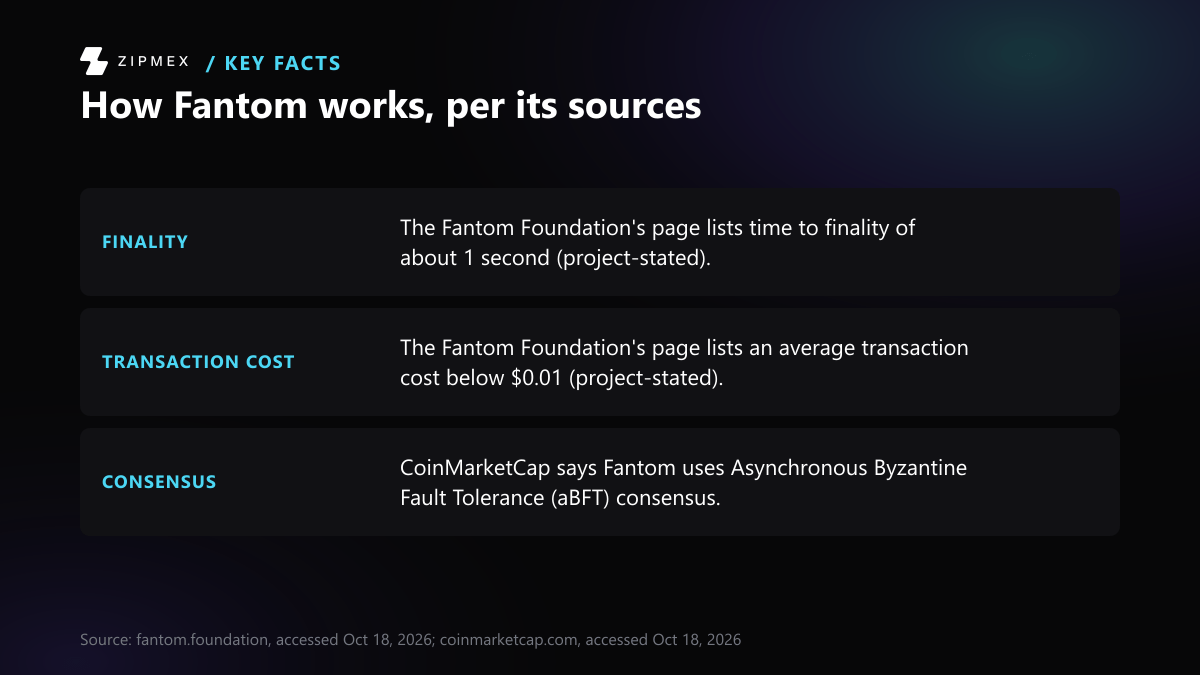
Fantom uses Asynchronous Byzantine Fault Tolerance (aBFT) and a directed acyclic graph (DAG). Nodes process transactions without a designated leader. The guide says 67% of nodes must validate a transaction before it settles.
Opera: the smart contract layer
Opera was the first layer built on top of Lachesis. It is an EVM-compatible, proof-of-stake smart contract platform that uses the Lachesis validator set. Because it is EVM-compatible, Ethereum-style contracts and tools could run on it.
FTM: the token
FTM was used for staking, governance, payments and fees. The guide says the network has been live since December 2019. It gives a total supply of 3.175 billion FTM.
Where does your FTM sit, and what is left to do?
Answer where your FTM is held and when you acted to see which upgrade path the article describes for you.
Where is your FTM held?
- Native FTM on Fantom Opera → next question
- ERC-20 FTM on Ethereum → Sonic Gateway route still listed
- Staked FTM → Unstake first, then upgrade
Did you finish the upgrade through the MySonic portal before the Opera bridge closed at 5:00 PM GMT on June 30, 2026?
- Yes, before the deadline → Upgrade done on the Opera route
- No, not yet → Opera route closed
FTM upgraded to S at 1:1 before the deadline. Since March 18, 2025, swaps run only from FTM to S, so S cannot be swapped back to FTM. Opera's chain data and history remain preserved.
After 5:00 PM GMT on June 30, 2026, FTM-to-S migration through the Opera route is blocked, and the Sonic Labs material reviewed here gives no route after that date. Check Sonic Labs' official channels directly, and check any site offering a "late upgrade" against docs.soniclabs.com before you connect a wallet.
Bridge ERC-20 FTM through the Sonic Gateway, then claim S on Sonic at 1:1. Sonic Labs' April 7, 2026 post says this route remains supported and the Sonic Gateway is not affected by the Opera retirement. Use official links only.
The handbook path: unstake in fWallet, wait 24 hours, withdraw, then upgrade. The material reviewed here does not say how this path works after the Opera bridge closed on June 30, 2026, so check docs.soniclabs.com before acting.
This follows the paths Sonic Labs described up to April 2026 only; it cannot confirm any route for native Opera FTM after June 30, 2026, check a specific wallet or site, or cover tax and third-party deadlines.
The figures, and what each one measures
| Figure | Value | Source and status |
|---|---|---|
| Finality (Fantom) | ~1s | Fantom Foundation page, project-stated, undated |
| Average transaction cost (Fantom) | below $0.01 | Fantom Foundation page, project-stated, undated |
| Active dApps / app partners | +300 / more than 200 | Fantom Foundation page, project-stated, undated |
| Daily transactions | 48,692 | Fantom Foundation page, project-stated, undated |
| FTM total supply | 3.175 billion | CoinMarketCap guide, c. 2022 |
| ERC-20 FTM max total supply on Ethereum | 2,138,153,790.59 FTM | Etherscan, live value, read October 2026 |
| Sonic throughput | "up to 10,000" TPS at launch; "400,000 TPS" in current docs | Sonic Labs, project-stated |
The two supply numbers measure different things. Etherscan shows the ERC-20 FTM contract on Ethereum, which is a bridged version of the token. CoinMarketCap's 3.175 billion refers to FTM as a whole. They are not two estimates of the same quantity. The Etherscan page now carries the notice "Fantom (FTM) is now upgradable to Sonic (S)." On the same reading it listed 94,478 holders.
The Fantom Foundation's page still shows its figures but gives no date or method. Its finality and fee numbers describe Fantom Opera, not Sonic. Sonic's own throughput claim rose from 10,000 TPS in the launch post to 400,000 TPS in the current docs. Both numbers come from the project, and neither has been independently measured.
What changed with Sonic and the S token
Sonic's documentation says S is used to pay transaction fees, for staking, to run validators and for governance. These are the same roles FTM had. Other changes, as Sonic Labs describes them:
- Fee Monetization: developers earn "up to 90%" of the network fees their apps generate (launch post). The current docs say "90%".
- Airdrop: 190.5 million S, issued in phases. Users who claim 75% of their airdrop before it fully matures lose part of it, and that part is burned.
- Issuance: 47,625,000 S per year for six years, starting six months after mainnet launch. The first issuance was on June 18, 2025, and unused tokens are burned. No new S is issued as block rewards for the first four years. After that, block rewards resume at 1.75% per year.
- Institutional allocation: the docs say a governance proposal approved S for an ETF, a Nasdaq-listed digital-asset treasury and Sonic USA. The first institutional issuance was 472,372,662.8 S, on September 4, 2025.
What to check if you still hold FTM
- Find out where the FTM sits. Native Opera FTM, ERC-20 FTM on Ethereum and staked FTM each had a different upgrade path.
- Native Opera FTM: the Opera bridge closed on June 30, 2026. The Sonic Labs material reviewed here gives no route for it after that date. Check Sonic Labs' official channels directly.
- ERC-20 FTM on Ethereum: the Sonic Gateway route is still listed as supported.
- Use official links only. The migration was announced in advance, so any site offering a "late upgrade" is worth checking against docs.soniclabs.com before you connect a wallet.
Limitations: the throughput, fee and usage figures come from Fantom and Sonic Labs, not from independent measurement, and the CoinMarketCap technical description dates from about 2022.
