Gaming tokens are the fuel behind a new kind of digital economy - one where players don't just spend money on games, but actually earn from them. As blockchain gaming has matured from a niche experiment into a multi-billion dollar sector, understanding how gaming tokens work has become essential for both crypto newcomers and experienced investors.
In this guide, we cover everything you need to know about gaming tokens in 2026: what they are, how they work, the top coins to watch, and the honest risks every player should understand before jumping in.
⚡ Quick Answer
Gaming tokens are cryptocurrencies built into blockchain-based games, serving as in-game currency, governance rights, or play-to-earn rewards. Unlike traditional in-game money, they can be traded on crypto exchanges for real value. Top tokens in 2026 include IMX, AXS, GALA, and SAND.
🎮 What Are Gaming Tokens?
Gaming tokens are digital assets built on blockchain networks that power the economies of video games. As the foundational currency of play-to-earn blockchain games, they allow players to earn, spend, trade, and own value within - and beyond - their favorite games.
Unlike a traditional game's in-app currency (which only works inside that one game and disappears if the game shuts down), gaming tokens exist on the blockchain. That means they're stored in your crypto wallet and can be traded on exchanges like Zipmex, transferred to other players, or used across multiple games in the same ecosystem.
🔗 How Gaming Tokens Work on the Blockchain
Every gaming token is a smart contract on a blockchain network - Ethereum, Ronin, Immutable zkEVM, BNB Chain, Solana, or others. When you earn tokens by completing quests, winning battles, or staking assets, those rewards are recorded on-chain. There's no central server that can shut down your balance.
The blockchain gaming economy also supports NFTs - unique digital items representing characters, weapons, land, and skins. You own these assets outright. You can sell them on marketplaces, rent them to other players, or hold them as investments. This combination of fungible tokens and NFT ownership is what defines the modern GameFi ecosystem.
🎯 Key Takeaways
- Gaming tokens are blockchain-based assets that can be traded on crypto exchanges - they have real monetary value outside the game.
- Two main types exist: utility tokens (in-game currency) and governance tokens (voting rights on game development).
- The GameFi sector has a total market cap of over $6.2 billion as of 2026.
- Earning potential varies widely - infrastructure tokens like IMX are more stable; game-specific tokens are higher risk.
🧩 Types of Gaming Tokens
Not all gaming tokens work the same way. Understanding the different token types helps you evaluate any GameFi project before investing time or money.
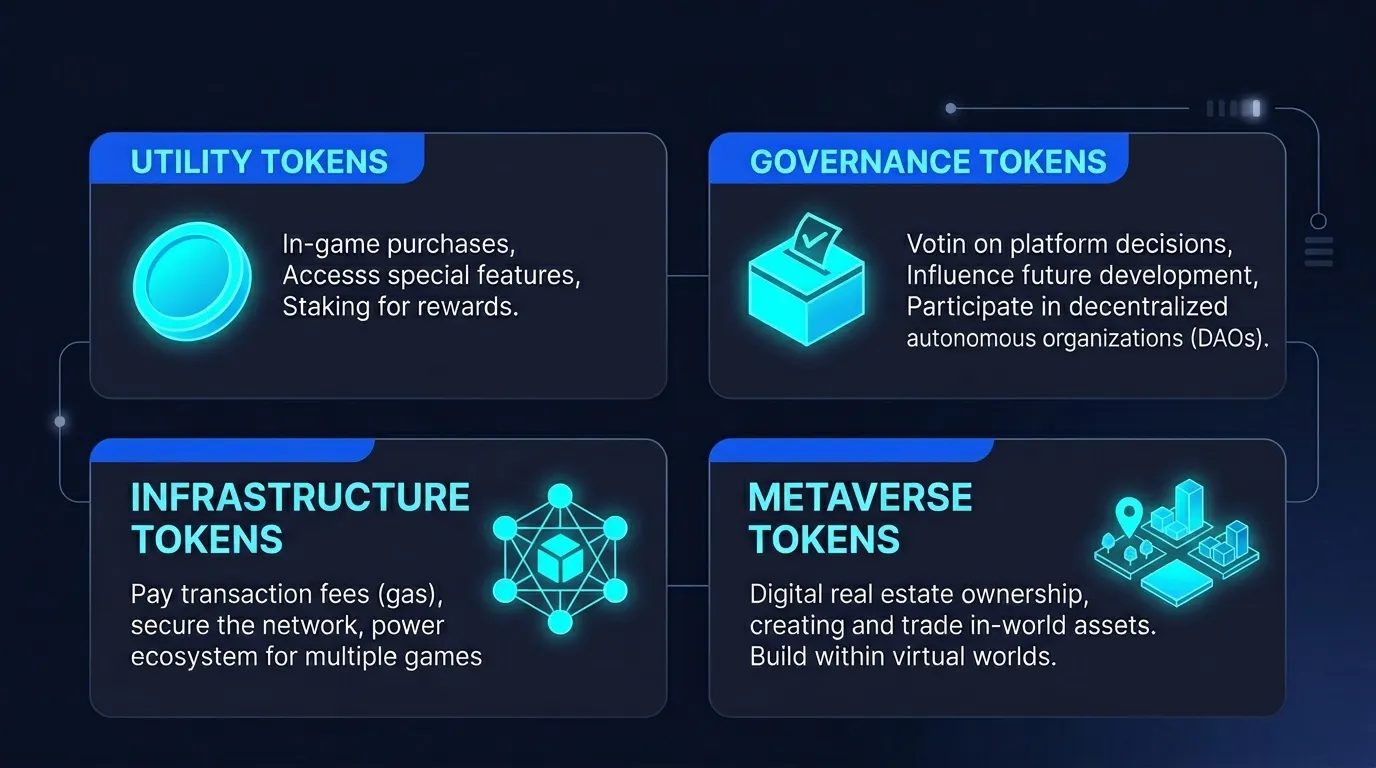
Utility Tokens vs Governance Tokens
Utility tokens function like in-game currency. They're used for purchasing items, unlocking characters, paying transaction fees, or accessing premium content. Examples include SLP (Smooth Love Potion) in Axie Infinity - it's earned through gameplay and spent to breed new Axies.
Governance tokens give holders a vote on how the game evolves. AXS (Axie Infinity Shards) is both a governance and staking token: hold it, stake it for rewards, and vote on protocol changes. GALA works similarly in the Gala Games ecosystem, letting node operators and players influence which games get funded.
Gaming infrastructure tokens like IMX (Immutable) power entire blockchains built for gaming - multiple games use the same network, and the token captures value from the whole ecosystem rather than a single title.
🏆 Best Gaming Tokens in 2026
The GameFi crypto coins market is large and growing, but not all tokens are equal. Here are the most established gaming tokens worth knowing in 2026, based on market cap, active development, and real gameplay.
Immutable (IMX)
IMX is the native token of Immutable, a Layer-2 blockchain built specifically for gaming and NFTs on Ethereum. Using ZK-rollup technology, it enables gas-free NFT minting and fast transactions. With over 680 games now in its ecosystem - including Gods Unchained, Guild of Guardians, and Illuvium - IMX has become the leading infrastructure token for Web3 gaming. The SEC formally closed its investigation into Immutable in March 2025 with zero findings of wrongdoing, according to Webopedia. IMX trades at approximately $0.70 with a market cap of around $1.36 billion.
🔢 Top Gaming Tokens - 2026 Snapshot
IMX Price
~$0.70
AXS Price
~$2.14
GALA Price
~$0.0155
GameFi Market Cap
~$6.2B
Axie Infinity (AXS)
Axie Infinity is the game that defined play-to-earn. Players collect, breed, and battle NFT creatures called Axies, earning AXS and SLP tokens through gameplay. AXS serves as both a governance and staking token - hold it to earn rewards, vote on ecosystem proposals, or use it for in-game purchases. After explosive growth in 2021 and a painful correction, the team has rebuilt with Axie Origins and a more sustainable economy. AXS trades at approximately $2.14 with a market cap of around $357 million.
Gala Games (GALA)
Gala Games is a multi-game ecosystem founded by Zynga co-founder Eric Schiermeyer. GALA powers games, music, and film platforms across the Gala ecosystem. Players earn GALA through gameplay and node operation. The platform is migrating to its own GalaChain to reduce fees and increase performance. GALA trades at around $0.0155 with a market cap of approximately $715 million, according to Changelly.
The Sandbox (SAND)
The Sandbox is a creator-first metaverse where players build, own, and monetize virtual experiences. SAND is used for buying virtual land, trading, staking, and DAO governance. Major brands including Adidas and Snoop Dogg have partnered with the platform. Starting in 2026, The Sandbox has committed to sourcing over half of each season's content from the community - a model similar to Roblox - according to WazirX.
💰 How to Earn With Gaming Tokens
Gaming tokens can be earned in several ways depending on the game and its economy. Understanding these methods helps set realistic expectations - and avoids the mistakes made during the 2021 P2E boom.
Play-to-Earn vs Play-and-Own
The original play-to-earn (P2E) model rewarded players with tokens simply for time spent farming. At its peak in 2021, Axie players in the Philippines were reportedly earning over $1,000 per month. However, this model was economically unsustainable - as new players stopped entering, token prices collapsed and earnings dried up.
The newer play-and-earn model (sometimes called "play-and-own") is more sustainable. Token rewards are calibrated to real gameplay activity - winning battles, completing quests, hosting tournaments, or creating content - rather than just logging hours. Projects like Axie Infinity have structurally reformed their economies to reflect this shift, according to WazirX.
Earning paths available in 2026:
Gameplay Rewards
Win battles, complete quests, or finish daily challenges to earn tokens directly. Available in most [play-to-earn blockchain games](https://zipmex.com/blog/4-popular-blockchain-games/). Earning amounts vary widely by game and market conditions.
NFT Trading
Buy, craft, and sell in-game NFTs (characters, weapons, land) on marketplaces. This is the primary earning path for most experienced players in 2026 - skill at trading often matters more than gameplay skill.
Staking
Lock governance tokens like AXS or ILV to earn staking rewards. Illuvium distributes 100% of platform revenue to ILV stakers, according to [WazirX](https://wazirx.com/blog/top-gaming-crypto-coins/). Staking is a passive income option, though token price volatility affects real-world returns.
Node Operation
Run a Gala Games node or similar infrastructure to earn tokens for supporting the network. Higher upfront cost and technical complexity, but provides more reliable rewards than gameplay farming.
⚠ Risks of Gaming Tokens
Gaming tokens can deliver real returns - but they carry risks that traditional investors and gamers alike often underestimate. Here's an honest breakdown before you commit capital.
📉 Key Risks to Know
- Token inflation: P2E emission models can crash token value if player growth stalls. SLP lost over 99% of its 2021 peak value.
- Game dependency: Tokens tied to one title collapse if the game loses players. A single bad update can wipe months of earnings.
- Regulatory uncertainty: Some jurisdictions treat P2E rewards as gambling or securities income. Tax treatment varies by country.
- Smart contract risk: Exploits and bridge hacks have cost gaming projects hundreds of millions. Ronin (Axie's network) suffered a $620M hack in 2022.
- Bear market pressure: As of April 2026, gaming tokens have broadly underperformed in a weak altcoin market, according to WazirX. High-beta assets see steeper drops.
📈 What Makes a Gaming Token Resilient?
- Actual gameplay: Projects with playable, enjoyable games retain users even when token prices drop.
- Balanced tokenomics: Healthy "token sinks" (ways to spend tokens in-game) offset inflationary rewards.
- Ecosystem breadth: Infrastructure tokens like IMX are more resilient because multiple games share the demand.
- Active development: Regular updates, new content, and transparent roadmaps signal long-term commitment from the team.
⚠ Risk Warning
Past gaming token rallies (2021 bull run) attracted many players expecting high income. Most utility token prices have declined 90-99% from peak. Treat gaming tokens as speculative assets - never invest more than you can afford to lose, and always play the game first before buying the token.
❓ Frequently Asked Questions
What are gaming tokens in crypto?
Gaming tokens are cryptocurrencies built into blockchain-based games. They serve as in-game currency, staking assets, governance votes, or play-to-earn rewards. Unlike traditional in-game money, gaming tokens have real market value and can be traded on crypto exchanges.
Are gaming tokens a good investment in 2026?
Gaming tokens are high-risk, high-potential assets. Infrastructure tokens like IMX show more stability than game-specific tokens. As of April 2026, the sector is in a broadly bearish phase, but on-chain gaming activity remains resilient. Focus on projects with real gameplay, active development, and healthy tokenomics.
How do you earn gaming tokens?
You can earn gaming tokens through gameplay rewards (completing quests, winning battles), NFT trading, staking governance tokens, or running network nodes. The play-and-earn model of 2026 ties rewards to real in-game achievement rather than simple time investment.
What is the difference between a utility token and a governance token?
A utility token (like SLP) functions as in-game currency - you spend it and earn it through gameplay. A governance token (like AXS or GALA) gives you voting rights on game development decisions and can typically be staked for rewards. Many tokens combine both functions.
Which blockchain is best for gaming tokens?
Immutable zkEVM, Ronin, BNB Chain, Solana, and Avalanche are the leading gaming blockchains in 2026. Immutable is particularly popular with developers due to gas-free NFT minting and a growing ecosystem of 680+ titles, according to Webopedia.
🏁 Conclusion
Gaming tokens have transformed how players interact with virtual worlds - turning leisure time into a potential source of income, ownership, and community governance. The sector has matured significantly since the 2021 boom, with more sustainable models, better infrastructure (like Immutable zkEVM), and a growing catalog of genuinely playable games.
In 2026, the most interesting opportunities aren't just in chasing the next big P2E game - they're in understanding which projects have real players, balanced token economics, and active development. Whether you're a gamer curious about the crypto gaming NFT ownership model or an investor looking at GameFi as a portfolio allocation, start with research, keep position sizes modest, and never rely solely on token rewards as income.
⚠ Disclaimer: The information provided in this article is not intended to provide investment or financial advice. Investment decisions should be based on the individual's financial needs, objectives, and risk profile. We encourage readers to understand the assets and risks before making any investment entirely. Cryptocurrency investments are subject to high market risk. Past performance does not guarantee future results.
ZIPMEX promotes trading on trade.zipmex.com. Promotions are labelled and kept separate from news coverage, which is selected and checked without regard to them. Perpetual futures are leveraged derivatives. Prices can move fast and you can lose all of your margin. Not available in every jurisdiction. Not investment advice.