
Stablecoins matter because they let people hold and move a dollar-linked token on a blockchain at any hour. They are used mainly to trade other cryptoassets, to send money across borders and to get access to dollars where local currencies are weak. The latest change is in the US. On October 21, 2026, the Office of the Comptroller of the Currency (OCC) finalized its rules under the GENIUS Act, the federal stablecoin law signed on July 18, 2025. The rules and the law take effect on January 18, 2027. Total supply was a little over $290 billion in late October 2026.
The newest development: US rules take effect January 18, 2027
- October 21, 2026: The OCC announced a final rule for permitted payment stablecoin issuers and foreign payment stablecoin issuers under its jurisdiction, and for some custody activities by banks it supervises. Comptroller Jonathan V. Gould said the framework comes "with strong standards for reserve backing, redemption, and risk management."
- What the rule covers: A new part 15 of the OCC's regulations (12 CFR 15). It covers reserve assets, redemption, risk management, audits and reports, custody, applications, and a capital and operational backstop (OCC Bulletin 2026-50).
- What it leaves out: Rules under the Bank Secrecy Act, anti-money-laundering rules and Office of Foreign Assets Control sanctions rules. These will come in a separate rulemaking with the Treasury Department.
- Still open: The OCC says it will announce separately when it starts accepting applications from prospective issuers.
Why January 18, 2027
Section 20 of the GENIUS Act (Public Law 119-27) says the law takes effect on whichever comes first: 18 months after enactment, or 120 days after the federal regulators issue final implementing rules. The rules were not final in time to bring that date forward, so the 18-month date applies: January 18, 2027.
What the GENIUS Act requires of issuers
These requirements come from the enacted text:
- 1:1 reserves (Sec. 4(a)(1)(A)): Issuers must keep identifiable reserves backing outstanding payment stablecoins "on an at least 1 to 1 basis."
- Permitted reserve assets: US coins and currency; money held at a Federal Reserve Bank; demand deposits at insured depository institutions; Treasury bills, notes or bonds with a maturity of 93 days or less; certain overnight repurchase and reverse repurchase agreements; government money market funds that hold only these assets; and tokenized forms of these assets.
- Monthly disclosure: Each month, issuers must publish on their website the total number of coins outstanding and the amount and composition of their reserves. A registered public accounting firm must examine each monthly report. The CEO and CFO must certify each report to the regulator, and a knowingly false certification carries criminal penalties.
- No interest or yield: Issuers may not pay holders interest or yield "solely in connection with the holding, use, or retention" of the stablecoin (Sec. 4(a)(11)).
- Priority in insolvency (Sec. 11): If an issuer fails, holders' claims on the required reserves come before the claims of other creditors.
- Sales restriction: Starting three years after enactment (July 18, 2028), digital asset service providers may not offer or sell payment stablecoins from issuers that are not permitted to US persons. The law lists some exceptions (Sec. 3(b)).
The law defines a payment stablecoin as a digital asset used, or designed to be used, for payment or settlement. Its issuer must be obliged to redeem it for a fixed amount of money. National currencies, deposits and securities are excluded.
How the peg works
The Bank of England describes a stablecoin as "a form of digital asset that you can use to make payments." It is usually issued by a company and tied to a national currency such as the US dollar. The issuer keeps a reserve, usually in currency, equal to the coins it has issued. The holder "has the right to swap it for that amount whenever they want."
So the peg rests on two things:
- The quality and liquidity of the reserves.
- Whether holders can actually redeem at face value when many want out at once.
Brookings (updated October 24, 2025) names the main risk to holders: the issuer "may not be willing or able to fulfill redemption requests for their tokens at face value."
Where stablecoins are used
- Trading crypto: The Bank of England lists buying and selling other cryptoassets as a main use. Cornell's Emerging Markets Institute (August 25, 2025) says decentralized exchanges use stablecoins as base trading pairs.
- Cross-border payments: Sending money abroad without a bank in between (Bank of England). Chainalysis (December 11, 2024) estimates that sending a $200 remittance from Sub-Saharan Africa is "about 60% cheaper" in stablecoins than through traditional fiat-based methods. That is one corridor and one transfer size, and the estimate is Chainalysis's own.
- Dollar access: Brookings says stablecoins have grown in countries with unstable currencies "by easing access to foreign currencies, especially the dollar." Chainalysis found that Latin America and Sub-Saharan Africa were the fastest-growing regions for retail and professional-sized stablecoin transfers. Growth there was above 40% year over year in the period from July 2023 to June 2024.
- Share of crypto activity: In the same December 2024 report, Chainalysis said stablecoins made up "more than two-thirds" of the value of recent cryptocurrency transactions.
Stablecoin rules: what has happened and what comes next
Step through the dated events behind today's stablecoin rules, from the 2022 failures to the US sales restriction in 2028.
- May 2022TerraUSD loses its pegdone
A growing sell-off pushed TerraUSD, an algorithmic stablecoin with no 1:1 cash-like reserve, off its peg. Over $45 billion in value was wiped out within a week (Brookings).
- May 12, 2022Tether briefly falls to $0.97done
Tether briefly fell to $0.97 and then quickly rebounded. It processed over $13 billion in USDT redemptions over a week-long stretch (Chainalysis).
- June 30, 2024EU MiCA applies to stablecoin issuersdone
The Markets in Crypto-Assets Regulation (EU) 2023/1114 starts to apply to stablecoin issuers. It treats them as e-money tokens or asset-referenced tokens, and issuers need authorisation to operate in the EU.
- July 18, 2025GENIUS Act signeddone
The federal stablecoin law (Public Law 119-27) is enacted. It sets 1:1 reserves, monthly disclosure, a ban on paying interest or yield, and priority for holders if an issuer fails.
- October 21, 2026OCC finalizes its ruledone
The OCC adds a new part 15 (12 CFR 15) covering reserves, redemption, risk management, audits, custody, applications and a capital backstop. Anti-money-laundering and sanctions rules are left to a separate rulemaking with the Treasury.
- January 18, 2027Law and rules take effectupcoming
Under Section 20, the law takes effect 18 months after enactment, because the final rules did not come in time to set an earlier date. From then on, US holders can check whether an issuer is a permitted payment stablecoin issuer.
- July 18, 2028Sales restriction beginsupcoming
Three years after enactment, digital asset service providers may not offer or sell stablecoins from non-permitted issuers to US persons, with some exceptions listed in Sec. 3(b).
This shows only dates stated in the article. It leaves out when the OCC will start accepting applications and when the Treasury's anti-money-laundering and sanctions rules will be final, and it does not judge any particular stablecoin.
stablecoins are pegged 1:1 to less volatile assets such as fiat currencies or commodities in order to maintain a consistent, predictable value.
How big the market is
Data from DefiLlama's stablecoin API, read on October 25, 2026:
| Stablecoin | Circulating supply |
|---|---|
| Tether (USDT) | about $182.4 billion |
| USD Coin (USDC) | about $71.7 billion |
| All dollar-pegged stablecoins | above $290 billion |
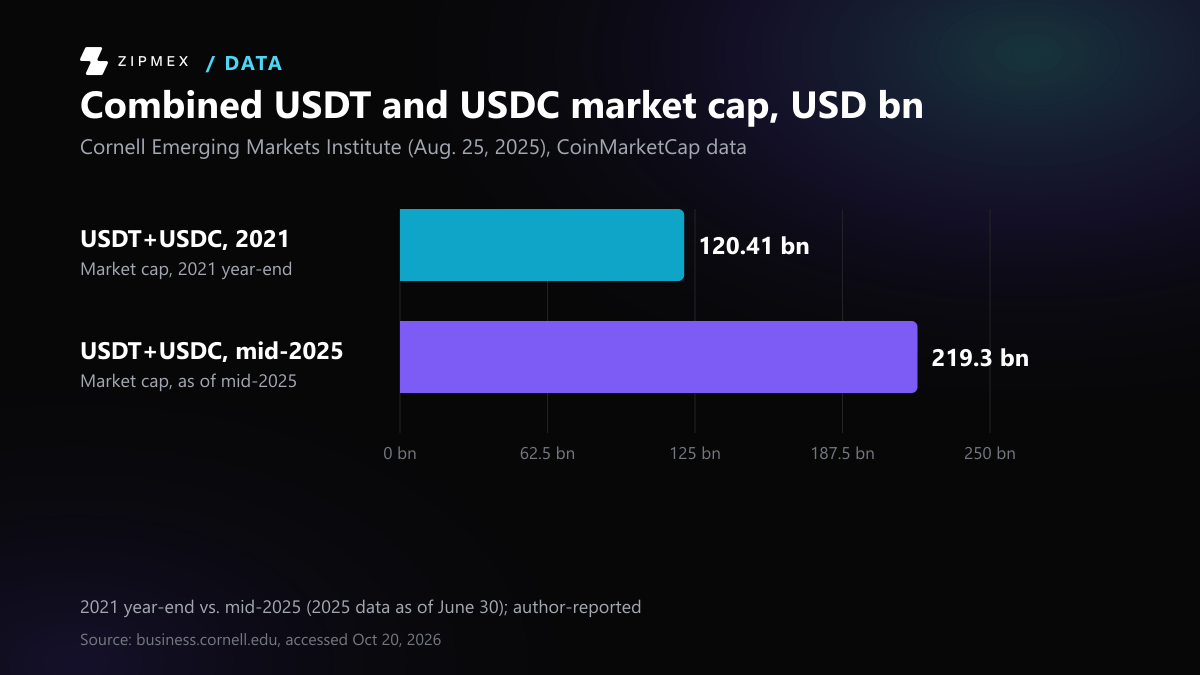
For context, Cornell's Emerging Markets Institute put the combined market cap of USDT and USDC at $120.41 billion at the end of 2021 and $219.30 billion as of June 30, 2025. Trackers count different sets of tokens, so totals vary by source.
The 2022 stress tests
- TerraUSD, May 2022: Brookings says an escalating sell-off pushed TerraUSD, an algorithmic stablecoin, off its peg, wiping out over $45 billion in value within a week. Its design relied on an algorithm, not on a 1:1 cash-like reserve.
- Tether, May 12, 2022: Chainalysis (June 9, 2022) says Tether "briefly fell to $0.97 on May 12" but quickly rebounded, and it processed "over $13 billion in redemptions of USDT over a week-long stretch."
The two cases test different things. TerraUSD shows how an algorithmic design can fail. Tether's dip shows a reserve-backed coin under heavy redemptions. In both cases the outcome depended on whether redemptions could be honored at face value, and the GENIUS Act's reserve, disclosure and insolvency rules are aimed at that weak point.
Outside the US: the EU
In the European Union, the Markets in Crypto-Assets Regulation (MiCA, Regulation (EU) 2023/1114) has applied to stablecoin issuers since June 30, 2024. It treats them as e-money tokens or asset-referenced tokens. The European Banking Authority says issuers of these tokens "are required to hold the relevant authorisation to carry out activities in the EU."
Other risks
- Illicit use: Chainalysis estimates that "less than 1%" of on-chain transactions are illicit. That figure covers all on-chain activity, not stablecoins alone. The same report says stablecoins have been used for money laundering, fraud and sanctions evasion.
- Gaps before the effective date: Until January 18, 2027, the GENIUS Act requirements are not yet in force. The Treasury's anti-money-laundering and sanctions rules were still pending as of October 25, 2026.
What to check before holding a stablecoin
- Issuer reports: The latest monthly reserve report, how much of the reserve sits in cash and short-dated Treasuries, and who examined it.
- Redemption terms: Who can redeem directly, the minimum amount, fees and timing.
- Legal status: From January 18, 2027 in the US, whether the issuer is a permitted payment stablecoin issuer. In the EU, whether the token is authorised under MiCA.
Limitations: supply figures move daily, and the OCC rule summary here draws on the OCC's release and bulletin, not a full reading of the final rule text.
