Uniswap, PancakeSwap, and SushiSwap collectively processed over $2.3 trillion in trading volume in 2025 - and choosing the wrong one for your use case can cost you real money in fees, slippage, and missed liquidity. Each platform runs on a different blockchain, serves a different type of trader, and handles liquidity in fundamentally different ways. This guide cuts through the noise with a head-to-head comparison covering fees, chain coverage, security, governance tokens, and - critically - which DEX actually fits your trading context.
⚡ Key Takeaways
- Uniswap is the dominant DEX on Ethereum and its Layer 2 networks, processing roughly $1.1 trillion in the past 365 days
- PancakeSwap leads overall 2026 DEX volume at $1.2 trillion, powered by BNB Chain's low fees and memecoin activity
- SushiSwap operates on 20+ blockchains - the widest native multichain coverage of the three
- Trading fees range from 0.01% (PancakeSwap stablecoin pairs) to 1% depending on pool tier and platform
- All three use an Automated Market Maker (AMM) model with on-chain liquidity pools - no order books, no custodial intermediaries
What Are Uniswap, PancakeSwap, and SushiSwap?
At their core, all three are decentralized exchanges (DEXs) - trading platforms where no company holds your funds, no KYC is required, and every transaction settles directly on-chain via smart contracts. The model that makes this possible is called an Automated Market Maker, or AMM.
Traditional exchanges match buyers and sellers using order books. AMMs replace that with liquidity pools - paired token reserves locked in smart contracts. When you swap ETH for USDC on Uniswap, you're trading against pooled liquidity, not against another human. An algorithm determines your price based on the ratio of assets in the pool. Liquidity providers (LPs) deposit those token pairs and earn a share of trading fees in return.
The catch for LPs: impermanent loss. When the price ratio between the two tokens in your pool shifts significantly, you may end up with less total value than if you'd simply held the tokens. It's not a bug - it's a structural property of AMMs that every liquidity provider should understand before deploying capital. We'll return to this in the strategy section.
⚡ How an AMM Trade Works: 5 Steps
- Connect your self-custody wallet (MetaMask, Trust Wallet, etc.)
- Select a token pair to swap (e.g., ETH → USDC)
- The AMM algorithm prices the swap based on pool reserves
- Liquidity providers collect a fee from your trade proportional to their pool share
- Transaction confirms on-chain - final, verifiable, non-custodial
Each of these three platforms applies the AMM model differently. Here's what sets them apart.
How Uniswap Works
Uniswap launched in 2018 on Ethereum and has since become the reference implementation for AMM-based DEXs. Its defining innovation came with v3 in 2021: concentrated liquidity, which lets LPs allocate capital within specific price ranges rather than spreading it uniformly across all possible prices. That single feature dramatically improved capital efficiency - a pool with $10M in concentrated liquidity can outperform one with $50M in traditional uniform liquidity for active price ranges.
Currently on v3, with v4 architecture under active development. V4 introduces hooks - customizable smart contract logic that executes before or after swaps. That means developers can build pools with dynamic fees, on-chain limit orders, or automated rebalancing directly within the Uniswap protocol. Uniswap's trading fee tiers are 0.05%, 0.30%, and 1%, with the tier selected at pool creation based on expected volatility.
Over the trailing 365 days, Uniswap processed approximately $1.1 trillion in volume per Token Terminal. The $UNI governance token - originally launched in 2020 to counter the SushiSwap fork - gained a new value accrual mechanism in November 2025 via UNIfication, a governance update redirecting a portion of protocol fees toward UNI buybacks and burns.
How PancakeSwap Works
PancakeSwap launched in September 2020 as the first major DEX on BNB Smart Chain. It has since grown into the highest-volume DEX by annual trading activity, processing roughly $1.2 trillion in 2026 per Token Terminal - aided significantly by the BNB memecoin wave and Four.meme launchpad activity.
Fee tiers run 0.01%, 0.05%, 0.25%, and 1% - that 0.01% tier for stablecoin pairs makes PancakeSwap among the cheapest options available for high-frequency stablecoin rotation. Combined with BNB Chain's sub-cent gas fees, total transaction costs on PancakeSwap can be a fraction of what Ethereum-based swaps cost.
But PancakeSwap is far more than a swap exchange. Its product suite includes:
- Yield Farming - deposit LP tokens into farms to earn $CAKE rewards on top of trading fees
- Syrup Pools - single-asset staking with flexible or locked terms to earn $CAKE and partner tokens
- Prediction Markets - bet on the next BNB or BTC price candle direction
- Perpetual Futures - leveraged trading directly within the ecosystem
- NFT Marketplace - buy/sell NFTs without leaving the platform
- Initial Farm Offerings (IFOs) - participate in new project launches via liquidity commitment
The $CAKE token (BEP-20, max supply 750M) is the engine behind most of these incentives. A deflationary burn mechanism runs in parallel with emissions to manage supply pressure.
How SushiSwap Works
SushiSwap began as a fork - specifically a fork of Uniswap created in 2020 by the pseudonymous "Chef Nomi." The origin story is infamously spicy: the anonymous developer briefly drained development funds before community pressure triggered a return of assets and a governance restructuring around a multi-signature treasury wallet. That episode actually accelerated SushiSwap's governance maturity relative to its peers.
Today, SushiSwap operates on 20+ blockchains - more native multichain coverage than either Uniswap or PancakeSwap. Trading fee is a flat 0.3%. Beyond swapping, SushiSwap offers Kashi (a decentralized isolated lending/borrowing market), Onsen (liquidity incentive programs), Miso (open-source token launchpad), Trident (a framework for building custom AMM pools), and Furo (token streaming and vesting).
The $SUSHI token (ERC-20, max supply 250M) governs the protocol and can be staked as xSUSHI - which historically entitled holders to a portion of protocol trading fees.
Candidly: SushiSwap's market position in 2026 is weaker than its peak. It sits outside the top 10 DEXs by annual volume per DeFiLlama, and its per-chain liquidity is thinner as volume concentrates on Uniswap and PancakeSwap. Where SushiSwap still adds genuine value is for traders working with niche assets across less-common chains, or DeFi users who want a single interface for lending, borrowing, and swapping across multiple ecosystems.

Uniswap vs PancakeSwap vs SushiSwap: Side-by-Side Comparison
Before getting into the decision framework, here's the data in one place.
Fee Comparison: Which DEX Is Cheapest to Use?
Trading fees are only part of the cost equation. Gas fees - paid to the underlying blockchain network - often matter more, especially for smaller trades.
Uniswap on Ethereum mainnet can be expensive. A single swap might cost $5-$25 in gas during moderate network activity. The 0.05% trading fee on a $500 swap is just $0.25 - but $15 in gas makes the true cost 3%+ on that trade. The fix: use Uniswap on L2 networks (Arbitrum, Optimism, Base), where gas typically runs $0.05-$0.50. On L2, Uniswap becomes genuinely competitive on total cost.
PancakeSwap on BNB Chain is cheapest for most trade sizes. BNB gas fees typically run $0.01-$0.10 per transaction. A $500 swap on a 0.05% fee pool costs about $0.25 in trading fees plus maybe $0.05 in gas - total cost under $0.35. For stablecoin pairs on the 0.01% tier, total transaction costs can fall under $0.15.
SushiSwap sits in the middle - 0.3% flat regardless of pair. No fee tiers means no optimization opportunity, but also no complexity. On a $500 swap, that's $1.50 in trading fees plus chain-specific gas costs.
Slippage tolerance is the third cost variable and shouldn't be ignored. Low-liquidity pools on any of these platforms can cause actual execution prices to deviate significantly from quoted prices. For pairs with thin liquidity, increasing slippage tolerance helps execution but means you pay more. PancakeSwap's depth on BNB-paired assets and Uniswap's depth on ETH-paired assets make slippage less of an issue for major pairs - but exotic tokens on any platform carry real slippage risk.
Liquidity and Trading Volume
Volume and liquidity are distinct but related. Volume reflects trading activity; TVL (Total Value Locked) reflects how much capital is deployed in pools - a proxy for how deep the liquidity is and how much slippage large trades will generate.
In 2026, the DEX sector has continued to set records. Weekly DEX volume peaked at over $220 billion in October 2025 per Dune Analytics, and the DEX-to-CEX volume ratio reached 19.84% - a clear signal that on-chain trading is no longer a niche activity. PancakeSwap ($1.2T) and Uniswap ($1.1T) sit at the top of the annual volume rankings. SushiSwap's spread across 20+ chains produces aggregate activity, but per-chain liquidity is thinner, making large trades on SushiSwap more slippage-prone than on the top two.
📊 2026 DEX Annual Volume
🥇 PancakeSwap: ~$1.2 trillion
🥈 Uniswap: ~$1.1 trillion
SushiSwap: Outside top 10 (declining market share)
Source: Token Terminal, Dune Analytics. Verify current figures at DeFiLlama.
For practical trading: if you're executing a $50K+ swap, depth matters. Uniswap's Ethereum mainnet pools for major pairs (ETH/USDC, WBTC/ETH) are among the deepest in DeFi. PancakeSwap dominates BNB-denominated depth. SushiSwap works for smaller size across niche chains.
Blockchain Coverage and Supported Assets
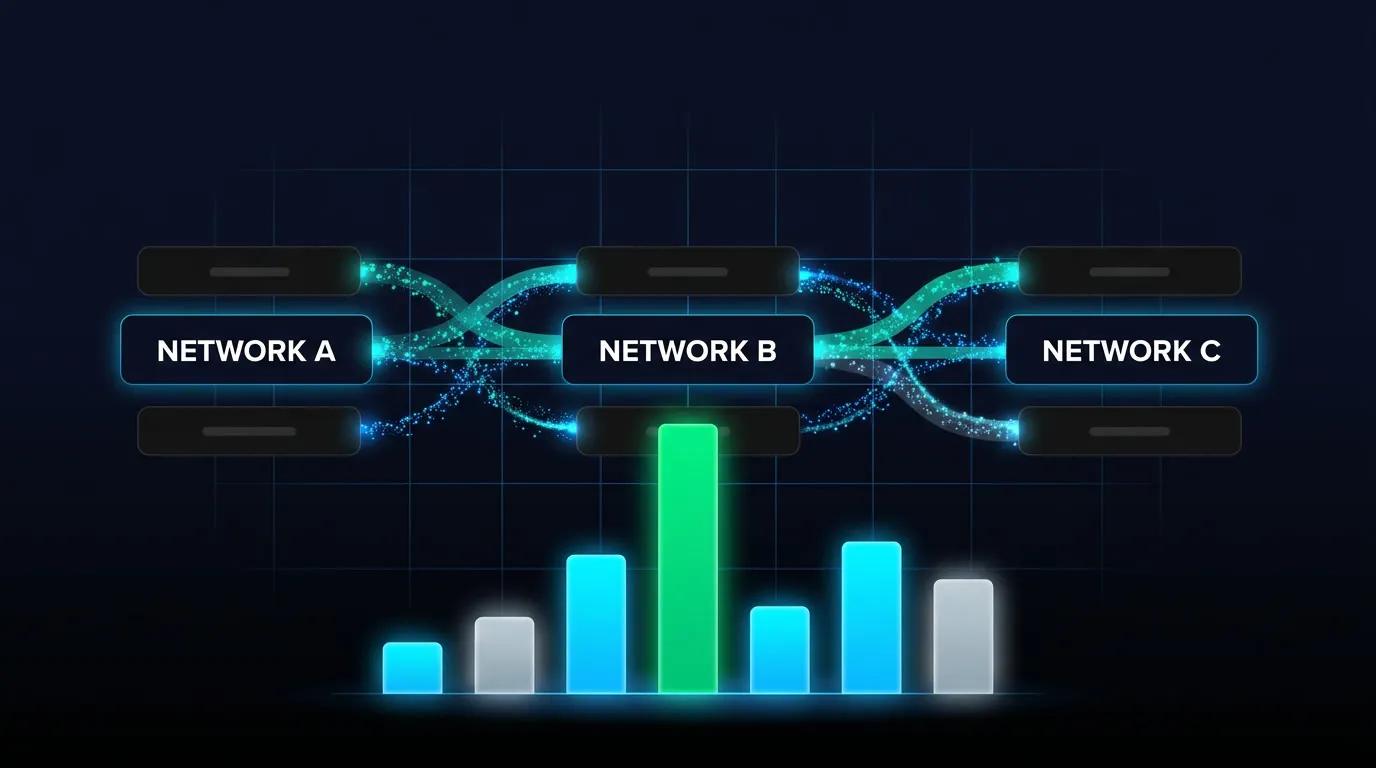
This is where the three DEXs diverge most clearly - and where many traders make costly mistakes by confusing chains.
Uniswap is Ethereum-native, expanded to 17+ chains. Its liquidity core remains the Ethereum ecosystem: ERC-20 tokens, ETH, and wrapped assets (WBTC, stETH). For Arbitrum, Optimism, and Base - all Ethereum L2s - Uniswap is typically the deepest DEX available.
PancakeSwap is BNB Chain-native. It supports BEP-20 tokens and accepts wrapped ERC-20 deposits (WBTC, WETH via bridge). One nuance worth flagging: BNB Chain uses a smaller validator set than Ethereum, which some DeFi purists characterize as a tradeoff between decentralization and speed/cost. Wrapped token deposits also carry bridge risk - assets locked on one chain while a wrapped version circulates on another.
SushiSwap spans 20+ chains natively, including Ethereum, Arbitrum, Polygon, Avalanche, Fantom, Gnosis Chain, and others. This breadth is genuinely useful if you're moving across ecosystems.
How to Start Trading on Each DEX
DEXs don't have accounts. There's no email registration, no password, no support ticket queue - just a wallet and a connection. That's the point. Here's the five-step universal process, with the key difference per platform noted below.
⚡ 5-Step DEX Onboarding Process
- Set up a self-custody wallet - MetaMask for Ethereum/Uniswap/SushiSwap; MetaMask or Trust Wallet for PancakeSwap
- Fund your wallet - transfer ETH (for Uniswap), BNB (for PancakeSwap), or the native chain token for gas
- Switch to the correct network - Ethereum mainnet, Arbitrum, BNB Chain, etc.
- Connect to the DEX - go to the official URL, click "Connect Wallet," approve
- Select your token pair, set slippage tolerance, confirm the swap
⚠ Security Rule #1
- Never share your seed phrase. → No DEX, no support channel, no protocol will ever ask for it. Anyone who does is attempting theft.
Setting Up for Uniswap
Go to app.uniswap.org - verify the URL exactly. Phishing sites mimicking Uniswap's interface are common; one wrong letter in the domain means you're potentially signing a malicious transaction.
With MetaMask connected to Ethereum mainnet (or switch to Arbitrum for lower gas), select your token pair. Default slippage tolerance is 0.5% - for high-volume pairs like ETH/USDC, that's typically fine. For low-liquidity tokens, increase to 1-2% if your swap keeps failing. One important mechanic first-time users miss: token approvals. The first swap of any new token requires a separate approval transaction with its own gas fee. This approves the Uniswap router contract to spend that token on your behalf. Check and revoke unnecessary approvals periodically using a tool like Revoke.cash.
Uniswap also has a mobile app for iOS and Android, which handles the network switching and approval flow more smoothly for new users.
Setting Up for PancakeSwap
Go to pancakeswap.finance - again, URL verification matters. Fake PancakeSwap interfaces exist.
MetaMask doesn't include BNB Chain by default. You'll need to add it manually: visit Chainlist.org, search "BNB Smart Chain," and click "Add to MetaMask." This adds the network with the correct RPC settings (Chain ID: 56). Alternatively, Trust Wallet comes preconfigured for BNB Chain and is a smooth option for mobile users.
Fund your wallet with BNB for gas - $2-5 of BNB covers hundreds of swaps given BNB Chain's low fees. Connect to PancakeSwap, select your pair, swap. The UX is nearly identical to Uniswap. One thing to watch: BEP-20 tokens and ERC-20 tokens use different addresses even for the same underlying asset (e.g., USDT on BNB Chain vs USDT on Ethereum). Sending BEP-20 tokens to an Ethereum address is a common error that results in lost funds - always verify the chain before confirming any transfer.
Setting Up for SushiSwap
SushiSwap's onboarding mirrors Uniswap's on Ethereum and follows the chain-specific setup steps above for other networks. Go to app.sushi.com, connect MetaMask or WalletConnect, and select your target network from the chain switcher. Because SushiSwap spans many chains, it's worth double-checking which network you're on before approving any transaction - liquidity depth varies significantly between chains.
How to Choose the Right DEX for Your Needs
Forget the idea of a single "best" DEX. The right platform depends on what you're trading, on which chain, and how often.
If you're primarily trading Ethereum-native assets - ETH, WBTC, stETH, or major ERC-20 tokens like LINK, UNI, AAVE - Uniswap on Ethereum mainnet or its L2 deployments is the natural choice. Deepest liquidity, lowest slippage for major pairs, concentrated liquidity for sophisticated LP strategies. Use Arbitrum or Optimism to keep gas costs manageable.
If you want the lowest possible fees or trade BNB-ecosystem tokens - PancakeSwap wins on total transaction cost for the vast majority of use cases. Sub-cent gas, four fee tiers including a 0.01% stablecoin pool, and the broadest DeFi feature suite in the BNB ecosystem. Also the go-to for BNB memecoins and IFO participation.
If you need access to a specific niche chain - SushiSwap's 20+ chain coverage makes it the practical choice when neither Uniswap nor PancakeSwap has deployed meaningful liquidity on your target network.
Free vs Paid vs Platform-Staking: DEX Business Models Compared
All three DEXs are free to use in the sense that you don't pay a subscription. But their underlying tokenomics and fee structures create very different economic relationships between the platform, liquidity providers, and token holders.
Uniswap's original model (LPs get everything, UNI holders get votes only) faced years of criticism from governance participants who wanted the "fee switch" to redirect revenue to token holders. UNIfication finally activated that mechanism in late 2025 - though the exact percentage and timing of buybacks depends on ongoing governance votes.
PancakeSwap's $CAKE emission model has a classic tension: high yields attract liquidity, but emissions dilute existing holders. The deflationary burn - sourced from trading fees, lottery revenue, prediction markets, and more - is designed to offset this.
SushiSwap's xSUSHI model is conceptually the cleanest: stake $SUSHI, earn a direct cut of protocol trading fees. The problem is that declining trading volume means declining revenue for xSUSHI holders. Protocol sustainability is a real question if SushiSwap's market share continues to compress.
DEX Trading Strategies for DeFi Users
Spot swapping is the baseline: connect wallet, select pair, confirm. No ongoing management, no exposure beyond the swap itself. Match your DEX to your chain.
Yield farming on PancakeSwap means providing liquidity to a pair (e.g., BNB/BUSD) and staking your LP tokens in a farm. You earn trading fees in real time plus $CAKE token rewards on top. Attractive yields exist - but impermanent loss can erode or eliminate gains if the price ratio between your pair shifts significantly. Model your IL scenarios before committing capital.
Concentrated LP positions on Uniswap v3 require active management. You set a price range for your capital; when the price moves outside that range, your position stops earning fees entirely. Narrower ranges generate higher fee yield when active but go out of range more often. Most sophisticated LPs rebalance positions regularly or use automation tools.
Arbitrage across DEXs is largely dominated by bots and MEV (Maximal Extractable Value) searchers at this point. Manual arbitrage opportunities close in milliseconds. This isn't a realistic retail strategy, but understanding it matters - MEV bots affect your swap price, especially on large trades in illiquid pools.
Stablecoin LP strategies offer the best risk-adjusted returns for passive participants. Pairing USDC/USDT or USDC/DAI generates consistent trading fee income with near-zero impermanent loss. PancakeSwap's 0.01% fee tier for stablecoins captures high-volume rotation efficiently.

Security and Risk: What to Watch Out for on DEXs
All three platforms have track records. All three have published audits. None of the core swap contracts has suffered a successful exploit at scale. That said, DeFi security is a spectrum - not a binary.
⚠ 5 Red Flags When Using a DEX
- Suspicious URL → bookmark official DEX sites; check every character before connecting
- Unaudited token contract → new tokens with no audit history carry smart contract exploit risk
- Unlimited token approval request → always use exact-amount approvals; revoke old approvals regularly
- Anonymous team + no community presence → especially relevant for farming pools and new pair launches
- Promises of abnormally high APY → real yield comes from trading activity, not thin-air emissions on sketchy tokens
The primary attack vectors in DeFi aren't usually the DEX protocols themselves - they're the tokens listed on them and the user behaviors around approvals and URL verification.
Comparing Security Measures: Uniswap vs PancakeSwap vs SushiSwap
Uniswap's most recent published audit is from March 2021 - which means the audited codebase doesn't reflect all subsequent protocol updates. The bug bounty program provides ongoing coverage, but users should verify the audit status of any specific pool or peripheral contract before providing significant liquidity. PancakeSwap's contracts are verified on BscScan, allowing on-chain verification that deployed code matches published source. SushiSwap's core audits date to 2020-2021. Newer features (Kashi, Trident, Furo) have had their own reviews, but the frequency and recency of security coverage is less robust than Uniswap or PancakeSwap.
For core swapping activity, all three are battle-tested. Risk increases significantly with peripheral features - lending pools, new token farms, and smart contract interactions with unaudited third-party protocols.
Governance Tokens: $UNI, $CAKE, and $SUSHI Compared
$UNI had a rough few years as a "governance-only" token with no direct fee revenue connection. The UNIfication upgrade changed that - a portion of protocol fees now flows toward buybacks and burns, creating a demand-side mechanism for UNI. Initial allocation vesting completed in 2024, removing that supply overhead.
$CAKE is the most functionally complex of the three. It's earned by providing liquidity, used for IFO participation, staked in Syrup Pools for yield, and burned through multiple mechanisms (trading fees, lottery, predictions, Syrup Pool locked staking). The burn-to-emission ratio fluctuates with platform activity - check PancakeSwap's official tokenomics page for current real-time burn/emission data.
$SUSHI with xSUSHI staking is the clearest model for direct fee revenue sharing: stake $SUSHI, receive xSUSHI, earn a slice of the 0.3% trading fees generated across all SushiSwap chains proportional to your share. The math is simple and on-chain verifiable. The risk is equally transparent: declining platform volume means declining xSUSHI yield.
All token prices, yield rates, and supply mechanics change. Verify current data on CoinGecko or the respective platform's tokenomics documentation before making any capital decisions.
Alternatives to Uniswap, PancakeSwap, and SushiSwap
The AMM DEX space extends well beyond these three. Depending on your use case, one of these alternatives might actually serve you better.
Curve Finance is the specialist's choice for stablecoin-heavy strategies. Its algorithm is specifically optimized for assets that trade near the same price - USDC/USDT, DAI/USDC, stETH/ETH - producing dramatically lower slippage and fees than general-purpose AMMs.
1inch isn't a DEX at all - it's an aggregator that routes your swap across Uniswap, SushiSwap, Curve, Balancer, and dozens of others to find the best execution price. For large trades where execution price matters more than familiarity, running a 1inch quote alongside a direct DEX quote is worth the 30 seconds.
dYdX operates in a different category: decentralized perpetual futures, not spot swapping. If leveraged crypto derivatives with deep liquidity and a self-custody model are your interest, dYdX is the reference platform in decentralized perps - having migrated to its own Cosmos-based chain for settlement efficiency.
Platforms emphasizing on-chain verifiability and self-custody across trading, gaming, and yield - like Zipmex - reflect the direction the broader DeFi ecosystem is trending: trustless architecture where every outcome and fee is verifiable directly on-chain, rather than claimed by a counterparty.
Conclusion: Which DEX Should You Use in 2026?
There is no universally "best" DEX. The three platforms have genuinely different strengths, and the right choice depends on your chain preference, trade size, feature needs, and fee sensitivity.
⚡ The 2026 DEX Verdict by User Profile
🔷 Uniswap - Best for Ethereum-native DeFi. Deepest ETH/ERC-20 liquidity, concentrated LP positions for capital efficiency, expanding L2 coverage. Use Arbitrum or Base to keep gas costs low.
🟡 PancakeSwap - Best for BNB ecosystem, low-fee trading, and full DeFi suite engagement. Lowest total transaction costs, highest 2026 volume, and the most product breadth of the three. Default choice for most traders who aren't specifically Ethereum-focused.
🍣 SushiSwap - Best for multichain coverage and isolated lending. If you're working across five or more chains and need a single interface, SushiSwap's reach is unmatched among these three. Just size positions accordingly given the thinner per-chain liquidity.
The longer-term picture favors platforms that deliver genuine on-chain transparency and real yield - fee revenue from actual trading activity, not token inflation. Uniswap's UNIfication, PancakeSwap's burn mechanics, and SushiSwap's xSUSHI model all attempt this in different ways, with varying current effectiveness. As the DEX sector matures, the structural winners will be platforms whose economics work without artificial token incentives.
All three DEXs have earned their position in the DeFi ecosystem for legitimate reasons. The question isn't which one is superior - it's which one matches your next trade.
Crypto trading and DeFi participation involve substantial risk of loss, including the potential loss of your entire invested capital. Leveraged trading, liquidity provision, and yield strategies carry additional risks including impermanent loss, smart contract exploits, and liquidation. Nothing in this article constitutes financial advice or a recommendation to trade any specific asset or platform. Always conduct your own research and consider your risk tolerance before engaging with any DeFi protocol.
Last updated: April 2026.
Frequently Asked Questions
What is the difference between Uniswap, PancakeSwap, and SushiSwap?
All three are decentralized exchanges (DEXs) that use an Automated Market Maker model - no order books, no custodial intermediaries, trades execute against on-chain liquidity pools. The core differences: Uniswap is Ethereum-native with the deepest ETH-ecosystem liquidity and concentrated liquidity technology; PancakeSwap is BNB Chain-native with the lowest fees, the highest 2026 trading volume (~$1.2T), and the broadest product suite including yield farming and perpetuals; SushiSwap spans 20+ blockchains and adds lending/borrowing (Kashi) to its feature set. All three are self-custodial - you connect a wallet, trade, and retain full control of your funds throughout.
Which DEX has the lowest fees - Uniswap, PancakeSwap, or SushiSwap?
PancakeSwap consistently offers the lowest total transaction cost. Its 0.01% fee tier for stablecoin pairs is among the cheapest anywhere in DeFi, and BNB Chain gas fees run sub-cent per transaction. For a $500 stablecoin swap, total cost can be under $0.15. Uniswap on Layer 2 networks (Arbitrum, Optimism) competes closely on trading fees (0.05% tiers) but gas costs are still slightly higher than BNB Chain. SushiSwap's flat 0.3% fee sits highest among the three on a trading-fee-only basis, with gas costs determined by whichever chain you use.
What is an Automated Market Maker (AMM) and how does it work?
An AMM is a smart contract that prices trades algorithmically using the ratio of token reserves in a liquidity pool - replacing the traditional order book used by centralized exchanges. When you swap Token A for Token B, the AMM's constant product formula (x . y = k) determines how much Token B you receive based on current pool balances. The larger your trade relative to pool size, the more the price moves against you - this is called price impact. Liquidity providers supply both sides of the pool and earn a fee on every trade proportional to their share of the total pool.
What is impermanent loss and how does it affect DEX liquidity providers?
Impermanent loss occurs when the price ratio of your pooled token pair changes after deposit. If you deposit equal values of ETH and USDC, and ETH doubles in price, arbitrageurs will buy ETH from your pool until it's rebalanced - leaving you with less ETH and more USDC than you started with. Compared to simply holding both tokens, you've "lost" value relative to the hold scenario - though this loss is impermanent (it reverses if the price returns to the entry ratio). Trading fee income can offset or exceed impermanent loss on high-volume pairs, but on volatile pairs with thin trading activity, IL can significantly erode LP returns.
Is it safe to use Uniswap, PancakeSwap, or SushiSwap?
All three have battle-tested core swap contracts with no major exploits of the primary protocol. Uniswap has undergone multiple external security audits and maintains an active bug bounty program. PancakeSwap's contracts are verified on BscScan with multiple published audits. SushiSwap has Certik and PeckShield audits and a multi-signature treasury structure. That said, "safe protocol" doesn't mean "zero risk" - token approval vulnerabilities, phishing sites mimicking DEX interfaces, smart contract risks in newly listed tokens, and bridge risks for wrapped assets are all real. Use hardware wallets for significant sums, revoke unused token approvals regularly, and verify URLs before connecting.
What is the best DEX for beginners?
PancakeSwap is generally the most beginner-friendly starting point. Its BNB Chain base means gas fees are low enough that mistakes don't cost much - a failed transaction costs cents rather than dollars. The interface is clear, the product suite is intuitive, and the stablecoin pools offer a low-risk way to start exploring yield strategies. Uniswap on Arbitrum or Base is equally accessible and worth learning for Ethereum-native assets. The key beginner fundamentals apply regardless of platform: use small amounts initially, understand that funds can be lost permanently through incorrect transactions, verify URLs obsessively, and never share your seed phrase with anyone or any application.
Can I trade on Uniswap without KYC?
Yes. Uniswap, PancakeSwap, and SushiSwap don't require identity verification - there are no accounts to create. You connect a self-custody wallet and trade directly. The protocol contracts are permissionless: anyone with an Ethereum address can interact. Some token projects or front-end interfaces may implement geo-restrictions at the UI layer, but the underlying smart contracts remain accessible to any wallet. This is a core property of decentralized protocols - the exchange logic lives on-chain and can be accessed directly, independently of any specific front-end interface. Regulatory requirements may evolve; users are responsible for understanding their local laws around DeFi activity.
ZIPMEX promotes trading on trade.zipmex.com. Promotions are labelled and kept separate from news coverage, which is selected and checked without regard to them. Perpetual futures are leveraged derivatives. Prices can move fast and you can lose all of your margin. Not available in every jurisdiction. Not investment advice.