Ethereum is the second-largest blockchain by market cap - but who actually built it? The short answer: a 19-year-old who was frustrated with World of Warcraft. The full answer involves eight co-founders, an $18 million crowdfunding campaign, and a vision that redefined what a blockchain could be.
⚡ Quick Answer
Ethereum was created by Vitalik Buterin, a Russian-Canadian programmer who published the Ethereum whitepaper in November 2013 at age 19. He was joined by seven co-founders - including Gavin Wood, Joseph Lubin, and Charles Hoskinson - and the network officially launched on July 30, 2015.
Who Is Vitalik Buterin, the Creator of Ethereum?
Vitalik Buterin was born on January 31, 1994, in Kolomna, Russia. His family emigrated to Canada when he was six years old, where he quickly stood out for his mathematical abilities and was placed in a gifted children's program. By the time he was a teenager, Buterin had taught himself programming and was fluent in economic theory.
His path to crypto began in 2011, when his father - a computer scientist - introduced him to Bitcoin. Buterin was skeptical at first, dismissing it as a currency with no intrinsic value. What changed his mind was a painful personal experience: Blizzard nerfed his favourite World of Warcraft character, and Buterin later described this as the moment he understood what damage centralized control could do. He began writing for Bitcoin Weekly, earning small amounts of BTC per article, and then co-founded Bitcoin Magazine in 2011 alongside Mihai Alisie.
Travelling the world to meet Bitcoin developers in 2013, Buterin kept running into the same problem: Bitcoin's scripting language was too limited to build complex applications on. He proposed improvements to the Bitcoin Core team, but failed to gain consensus. Rather than give up, he designed something new entirely. In November 2013, at 19 years old, he published the Ethereum whitepaper - a document proposing a programmable blockchain powered by smart contracts.
"I am truly grateful to have the opportunity to work in such an interesting and interdisciplinary area of industry, where I have the chance to interact with cryptographers, mathematicians and economists prominent in their fields."
- Vitalik Buterin, Ethereum Co-Founder

Who Are the 8 Co-Founders of Ethereum?
Ethereum was never a solo project. After the whitepaper circulated in late 2013, a group of talented individuals rallied around Buterin's vision. Anthony Di Iorio wrote at the time: "Ethereum was founded by Vitalik Buterin, Myself, Charles Hoskinson, Mihai Alisie & Amir Chetrit (the initial 5) in December 2013. Joseph Lubin, Gavin Wood, & Jeffrey Wilcke were added in early 2014 as founders."
👥 The 8 Ethereum Co-Founders
Visionary / Architect
Vitalik Buterin
Whitepaper author, chief technical philosopher
Technical Lead
Gavin Wood
Created Solidity, wrote the Yellow Paper (EVM spec)
Business & Infrastructure
Joseph Lubin
Funded early stages, founded ConsenSys (MetaMask, Infura)
Go Ethereum Client
Jeffrey Wilcke
Built Geth, the most-used Ethereum execution client
Early CEO / Manager
Charles Hoskinson
Left in 2014; later founded Cardano (IOHK)
Legal & Media Foundation
Mihai Alisie
Co-founded Bitcoin Magazine with Vitalik; VP of Ethereum Foundation
Early Investor & Organiser
Anthony Di Iorio
Financed early development; founded Toronto Bitcoin meetups
Initial 5 Member
Amir Chetrit
Early contributor; stepped back from active role by mid-2014
Hoskinson’s Cardano has since carved its own path as a leading Layer-1 protocol, prioritizing a research-driven approach to scalability and security. The network’s technical journey reached a defining moment with a major update that significantly improved its smart contract efficiency. To understand how Hoskinson’s vision has evolved, you can explore our guide to the Vasil hard fork and the Cardano upgrade roadmap for 2026.
Most of the co-founders eventually parted ways. Hoskinson left over disagreements about Ethereum's non-profit structure and later built Cardano. Gavin Wood departed in 2016 to found Polkadot. Today, only Vitalik Buterin remains actively involved in Ethereum's core development. Joseph Lubin continues to lead ConsenSys, which develops key ecosystem tools including MetaMask and Infura.
After authoring the Ethereum Yellow Paper, Wood turned his attention to the challenge of blockchain isolation, envisioning a future where different networks could talk to each other seamlessly. This led to the creation of a Layer-0 protocol designed for cross-chain interoperability. For a deeper look at the infrastructure Gavin Wood built after Ethereum, read our complete guide on what is Polkadot (DOT) and how it works.

How Was Ethereum Created? The Key Milestones
Understanding who created Ethereum is only half the story. The how is just as remarkable. The journey from whitepaper to live blockchain took less than two years - remarkably fast for a project of this scope.
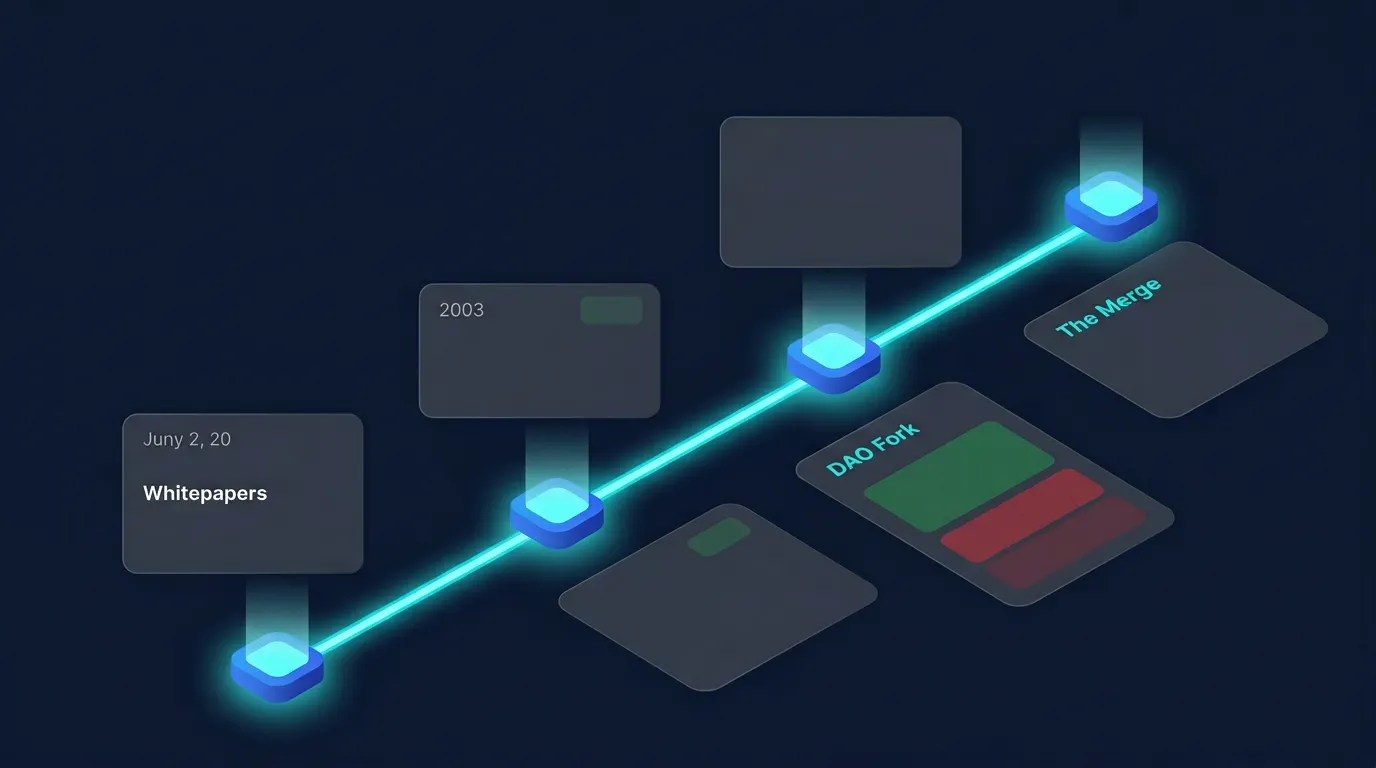
📅 Ethereum Creation Timeline
November 2013
Vitalik publishes the Ethereum whitepaper, proposing a programmable blockchain for smart contracts and dApps
January 2014
Public announcement at the North American Bitcoin Conference in Miami. The founding team of 8 begins forming
July-August 2014
Public crowdfunding campaign raises 31,000 BTC (~$18 million) - one of the largest ICOs at the time
April 2015
Olympic testnet launches - the final public beta before mainnet, offering 25,000 ETH bug bounties
July 30, 2015
"Frontier" - Ethereum mainnet launches. The Genesis Block is mined, containing 8,893 allocation transactions
June 2016
The DAO hack - $50M in ETH stolen, sparking a controversial hard fork that split the chain into Ethereum and Ethereum Classic
September 15, 2022
The Merge - Ethereum transitions from Proof-of-Work to Proof-of-Stake, cutting energy use by ~99.95%
June 2026
Glamsterdam upgrade (EIP-7732 & EIP-7928) targets 10,000 TPS and 78% gas fee reduction - Ethereum's biggest update since The Merge
The decision to structure Ethereum as a non-profit was a defining fork in the road. Charles Hoskinson had pushed for a venture-funded, for-profit model; Buterin insisted on open, non-profit architecture. When Hoskinson and Buterin met in Zug, Switzerland in mid-2014, Hoskinson departed, and the Ethereum Foundation was established as a Swiss non-profit to coordinate development.
What Did Vitalik Buterin Create Ethereum For?
The Ethereum whitepaper opened with a simple observation: Bitcoin was digital money, but the blockchain was capable of so much more. Buterin envisioned a "world computer" - a globally distributed platform where developers could deploy decentralized applications (dApps) using a Turing-complete programming language.
This shift from centralized silos to an open, programmable internet is the defining achievement of the Ethereum network, laying the groundwork for what we now call the "read-write-own" web. Ethereum remains the primary infrastructure for this new digital era where users reclaim sovereignty over their assets. To see how this technology is reshaping the global internet, check out our Web 3 explained: the complete expert guide to the decentralized web.
The core innovation was the smart contract: code that executes automatically when conditions are met, with no intermediary required. This single idea unlocked an entire ecosystem - from DeFi protocols to NFT marketplaces to tokenized real-world assets.
📈 What Ethereum Powers in 2026
- DeFi: Ethereum + L2s remain home to the majority of global on-chain DeFi TVL
- Staking: Over 34 million ETH (~28% of total supply) currently staked, yielding ~3-5% APY
- Developers: Over 200,000 independent developers and organisations contribute to Ethereum
- Supply mechanics: EIP-1559 burn mechanism means ETH issuance can turn deflationary during high-activity periods
- Scalability: Glamsterdam upgrade (June 2026) targets 10,000 TPS and 78% gas fee reduction
To fully comprehend how this economic shift impacts the long-term value of the network's native token, investors must look at where these base fees actually go. When network congestion is high, thousands of tokens are permanently removed from circulation, fundamentally altering the asset's inflation rate. Learn exactly how this mechanism functions in our detailed guide explaining the Ethereum burn address and how ETH burning creates deflation.
Buterin's vision was deliberately broader than Bitcoin's. As he described it, rather than building rules for one application, Ethereum would be a general-purpose platform where developers could "build their own applications and the rules for whatever applications they built can be executed on the Ethereum platform." That philosophy - open, censorship-resistant, programmable - remains Ethereum's defining characteristic a decade later.
Does Anyone Own Ethereum Today?
This is one of the most common misconceptions about Ethereum. No single person or organisation owns or controls it - not even Vitalik Buterin.
Ethereum is an open-source, decentralized network secured by thousands of validators worldwide. Since The Merge in September 2022, it operates on Proof-of-Stake: any user who deposits 32 ETH can run a validator node and help secure the network. This distributes control far and wide, making censorship or unilateral changes practically impossible.
This transition to a Proof-of-Stake consensus mechanism successfully eliminated the energy-intensive mining process that characterized the network’s first seven years. While staking is now the only way to secure the chain, understanding the legacy of block validation provides key insights into how the supply model changed. You can look back at the original mechanics in our historical analysis of how long it used to take to mine Ethereum and what replaced it.
The Ethereum Foundation - a Swiss non-profit established in 2014 - supports research and development but does not control the protocol. Even Buterin himself cannot make unilateral changes; any protocol upgrade requires broad consensus from the developer community, validators, and ETH holders.
🎯 Key Takeaways
- Vitalik Buterin conceived Ethereum in 2013 and published the whitepaper at age 19
- Eight co-founders - including Gavin Wood (Solidity) and Joseph Lubin (ConsenSys) - helped build and launch it
- Ethereum launched on July 30, 2015 after raising ~$18M in its 2014 crowdfunding campaign
- No single entity owns Ethereum - it is decentralized and governed by its global community
- Buterin's current ETH holdings are estimated at approximately 240,000 ETH (~$467M-$750M in early 2026)
Frequently Asked Questions
Who is the father of Ethereum?
Vitalik Buterin is universally recognised as the primary creator and "father" of Ethereum. Born in 1994 in Russia and raised in Canada, he published the Ethereum whitepaper in November 2013 at age 19 and has guided the project's technical direction ever since.
When was Ethereum created?
The Ethereum whitepaper was published in November 2013. The network officially launched on July 30, 2015, with the mining of the Genesis Block - a journey of roughly 20 months from concept to live blockchain.
How many founders does Ethereum have?
Ethereum has eight official co-founders: Vitalik Buterin, Gavin Wood, Joseph Lubin, Charles Hoskinson, Anthony Di Iorio, Mihai Alisie, Amir Chetrit, and Jeffrey Wilcke. Most departed the project within a few years; today only Buterin remains actively involved in core development.
Who controls Ethereum now?
No single person or organisation controls Ethereum. It is a decentralized network governed by its global community of developers, validators, and ETH holders. The Ethereum Foundation provides support but cannot make unilateral protocol changes. Even Vitalik Buterin cannot force changes without community consensus.
What is Ethereum's relationship to Bitcoin?
Bitcoin was designed as digital money - a peer-to-peer payment system. Ethereum was designed as a programmable platform - a "world computer" for smart contracts and decentralized applications. Buterin created Ethereum precisely because Bitcoin's scripting language was too limited for the applications he envisioned. See our full Bitcoin vs Ethereum comparison for a detailed breakdown.
Beyond their structural differences, understanding the capital flow between these two dominant networks is essential for any cryptocurrency trader. During different phases of the market cycle, liquidity tends to rotate from the primary store-of-value asset into programmable smart contract platforms and alternative tokens. You can track these macroeconomic shifts by learning what is BTC dominance and how Bitcoin's market share influences altcoin seasons.
What did Gavin Wood contribute to Ethereum?
Gavin Wood made two foundational contributions: he wrote the Ethereum Yellow Paper (the technical specification of the Ethereum Virtual Machine) and co-created Solidity, the programming language used to write smart contracts on Ethereum. He left in 2016 and later founded Polkadot and the Web3 Foundation.
Is Vitalik Buterin still involved in Ethereum in 2026?
Yes. Buterin remains Ethereum's most influential voice and is actively involved in protocol research and development. His 2025-2026 focus includes simplifying Ethereum's architecture, a proposal to replace the EVM with RISC-V, and initiatives to improve privacy and reduce gas fees for everyday users.
Managing transaction costs remains a critical part of Buterin’s research, as high demand on the mainnet continues to push users toward Layer-2 scaling solutions. Understanding how these costs are algorithmically calculated is essential for any active on-chain participant looking to save on overhead. We recommend studying our breakdown of what gas fees are and how blockchain transaction costs work to help you time your transactions during periods of low congestion.
Conclusion
The story of who created Ethereum is the story of a teenager frustrated by a video game nerf, who saw through the noise to something bigger: a blockchain that could run the world's applications, not just its payments. Vitalik Buterin wrote the whitepaper at 19. Eight co-founders joined the mission. An $18M crowdfunding campaign funded the build. And on July 30, 2015, the world's first programmable blockchain went live.
Today, Ethereum hosts the majority of the world's DeFi activity, powers thousands of dApps, and has over 200,000 developers building on its infrastructure. The co-founders have mostly moved on to build their own projects - but the decentralized world computer they created keeps running, exactly as programmed, without needing any of them anymore.
⚠ Disclaimer: The information provided in this article is not intended to provide investment or financial advice. Investment decisions should be based on the individual's financial needs, objectives, and risk profile. We encourage readers to understand the assets and risks before making any investment entirely. Cryptocurrency investments are subject to high market risk. Past performance does not guarantee future results.
ZIPMEX promotes trading on trade.zipmex.com. Promotions are labelled and kept separate from news coverage, which is selected and checked without regard to them. Perpetual futures are leveraged derivatives. Prices can move fast and you can lose all of your margin. Not available in every jurisdiction. Not investment advice.