
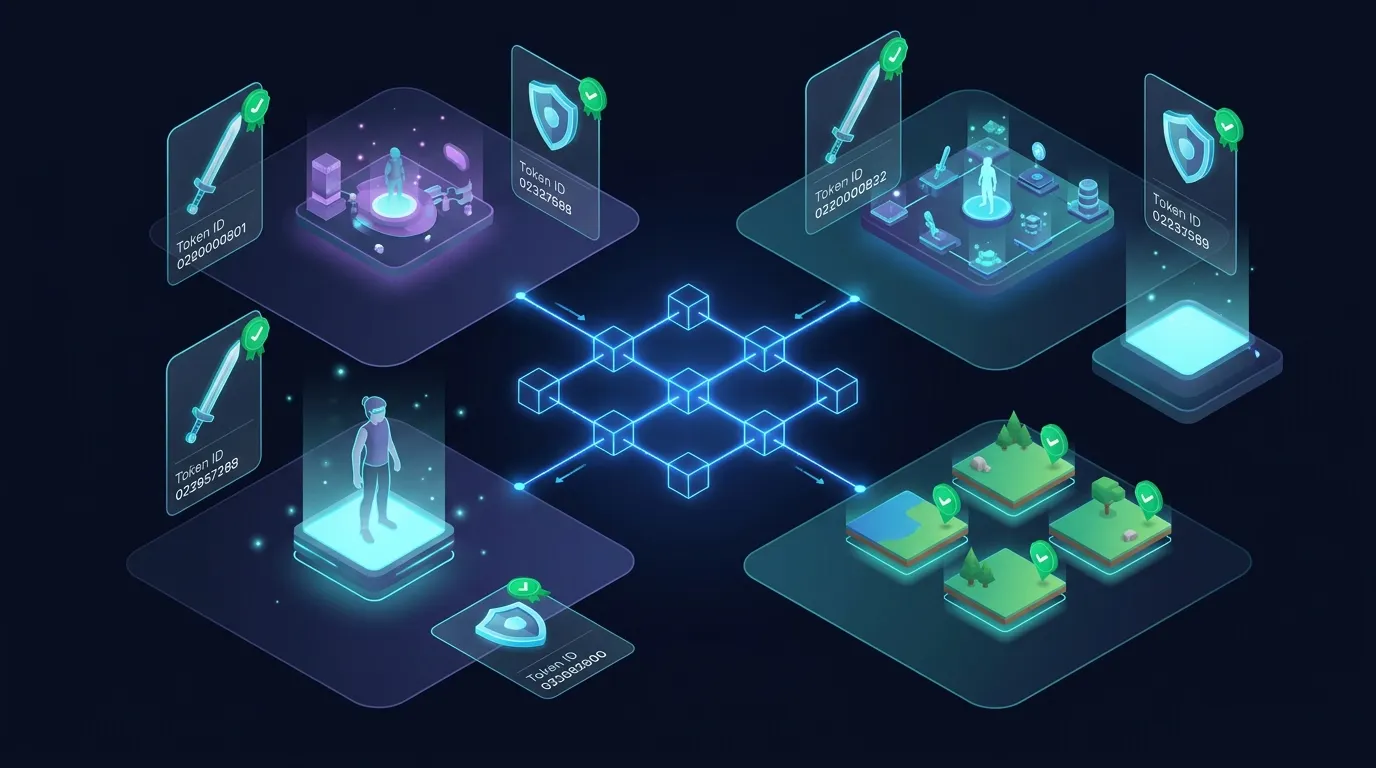
NFTs in gaming are blockchain tokens that record who owns a specific in-game item, such as a character, weapon, land parcel or card. The token sits in a wallet the player controls, so the item can be sold or moved outside the publisher's own store. That record does not make the item useful outside the game, and it does not hold its value. The newest evidence on the sector is harsh. A report by trading firm Caladan, covered by CoinDesk on 23 April 2026, estimates that about 93% of GameFi projects are effectively dead. It also puts token values about 95% below their 2022 peaks.
The latest picture (April–October 2026)
- Most projects failed. Caladan's report says Web3 gaming burned through up to $15 billion. Funding to studios had fallen 93% by 2025. Gaming took 62.5% of Web3 venture funding in 2022 but only a single-digit share in 2025, as capital moved to AI, tokenised real-world assets and layer-2 infrastructure (CoinDesk, 23 April 2026).
- The flagship collapsed in usage. Citing DappRadar, the same article puts Axie Infinity's daily active users at about 5,500, down from a peak of roughly 2.7 million. It also cites DappRadar's count of more than 300 blockchain games that have shut down.
- Players never arrived in numbers. Even at the peak, 12% of gamers had tried a crypto game, according to a Coda Labs survey cited by Caladan.
- Projects that shut or stalled. CoinDesk reports that Ember Sword shut down after seven years and $18 million of development, with no refunds. Pixelmon raised $70 million in a 2022 NFT mint and still has no public game. Square Enix wound down its Symbiogenesis experiment.
- Trading venues are shrinking. On 23 October 2026, crypto.news reported that a long-running NFT marketplace had closed and that other services had cut back NFT trading support.
- Wallet changes hit players directly. Odaily and eGamers report that Ronin is retiring its Waypoint wallet, which used keyless or social logins. Users were asked to migrate assets by 16 October, and Odaily reports a final grace period ending on 31 October 2026. Seed-phrase wallets are reportedly not affected.
Caladan's own reading is that the model was built around financial incentives, while the audience wanted entertainment.
How a gaming NFT actually works
The token standards
Most gaming NFTs on Ethereum and compatible chains use one of two standards:
- ERC-721 (created 24 January 2018, status Final) is the non-fungible token standard. It describes "a common interface for smart contracts that track and transfer individually distinct tokens."
- ERC-1155 (created 17 June 2018, status Final) is the multi-token standard. One contract can manage fungible, non-fungible and semi-fungible tokens together and move several token types in a single batch transfer. Games use it because a single contract can hold both a currency and thousands of unique items.
What the player really owns
The chain records that a wallet holds token ID X from contract Y. The item's stats, artwork and in-game behaviour usually come from metadata and servers the developer runs. In practice:
- Owned: the token, which can be transferred or sold wherever that token is supported.
- Not guaranteed: that the game keeps running, that the item's artwork and data stay online, or that any other game will recognise it. Using an item across games requires other developers to build that support, and there is little evidence that this happens at scale.
- Exposed to custody risk: if the wallet service changes, as with Ronin Waypoint, the owner has to act to keep access.
Common item types
Characters and creatures, weapons and equipment, virtual land, collectible cards and cosmetic skins. Utility tokens are earned in play and spent on in-game actions. Governance tokens carry voting rights. Many games use both.
Why play-to-earn broke
In the play-to-earn model, players buy or earn NFTs, earn tokens by playing and sell those tokens for money. Caladan describes how the loop failed once new money slowed: token prices fell, rewards shrank and users left. Two other factors made it worse. Large sums were raised before games existed, which removed pressure to build games people would keep playing. Development took three to five years while the tokens traded every day (CoinDesk, 23 April 2026).
Security added to the losses. Attackers broke into the Ronin bridge, the sidechain behind Axie Infinity, on 23 March 2022, and the theft was disclosed on 29 March. On 14 April 2022 the FBI attributed the theft of about $620 million to the Lazarus Group and APT38, which it links to North Korea. The US Treasury added an address tied to the "Ronin Bridge Exploiter" to its sanctions list.
Run the six checks on an NFT game
Answer each question about a game you are looking at to see which risk from this article applies first.
Is there a live, playable game with current player numbers, not just a roadmap or a mint?
- Yes, people are playing it now → next question
- No, only a roadmap, a mint or a promised launch → No game to check yet
Do you know where the item's stats and artwork are held, and is there a stated plan for assets if the studio stops?
- Yes, both are stated → next question
- The data sits on the developer's servers and there is no shutdown plan → The token may be only a receipt
- I can't tell → The token may be only a receipt
How is the wallet that holds the items set up?
- A seed-phrase wallet I control → next question
- A hosted or keyless wallet with a social login → Custody risk comes first
Have you checked that the platform you use and the law where you live allow this kind of game?
- Yes, it is allowed where I live → next question
- No, or I'm not sure → Check the rules where you live
Will you need to move the items or tokens from one chain to another?
- Yes, through a bridge → Bridge and contract risk applies
- No, they stay on one chain → All six checks covered
The article's first check fails. Pixelmon raised $70 million in a 2022 NFT mint and still has no public game, and Ember Sword shut down after seven years with no refunds. Without a playable product, the other checks have nothing to test.
The chain records that a wallet holds a token. If the stats and art sit on the developer's servers and nothing is said about a shutdown, the game may stop or the item's data may go offline while the token stays in the wallet.
Hosted and social-login wallets can be changed by the provider. Ronin's Waypoint wallet is being retired: users were asked to move assets by 16 October, with a final grace period reported to end on 31 October 2026. Seed-phrase wallets are reportedly not affected.
Rules differ by platform and country. Steam does not allow blockchain games that issue or exchange cryptocurrencies or NFTs. South Korea's rating committee has refused to rate play-to-earn games, and a Seoul court upheld one refusal on 13 January 2023.
Moving assets between chains has caused some of the largest losses on record. In 2022 attackers took about $620 million from the Ronin bridge behind Axie Infinity, a theft the FBI attributed to the Lazarus Group.
You have been through the article's six checks. That covers the risks they list, not the item's value: Caladan's report estimates that about 93% of GameFi projects are effectively dead and that token values are about 95% below their 2022 peaks.
This tool only walks through the article's six checks. It cannot tell you whether a game or item is worth anything, whether a project will survive, or what the law says in your country, and its Waypoint dates come from secondary reports.
Where the rules stand
- Steam: Valve's onboarding rules list "Applications built on blockchain technology that issue or allow exchange of cryptocurrencies or NFTs" among the content it does not allow on Steam.
- South Korea: Under the Game Industry Promotion Act, every game must be rated. The Game Rating and Administration Committee has consistently refused to rate play-to-earn games, which in effect bars them. On 13 January 2023 the Seoul Administrative Court upheld the refusal for SkyPeople's "Five Stars for Klaytn" (BKL Legal Update, 31 January 2023).
- European Union: Article 2(3) of the Markets in Crypto-Assets Regulation (MiCA) excludes crypto-assets that are "unique and not fungible with other crypto-assets." Recital 10 adds that such assets must not be readily interchangeable. Legal commentary from A&O Shearman reads five further limits into recital 11. Fractions of NFTs are not excluded. Issuing items in a large series or collection points to fungibility. A unique identifier on its own is not enough. An excluded NFT can still be a financial instrument under other EU rules. Features that make an asset fungible in practice override its form. Whether gaming items qualify depends on how they are issued.
What the growth forecasts say
Fortune Business Insights values the global NFT gaming market at $6.1 billion in 2025. It projects $7.63 billion in 2026 and $45.88 billion by 2034, a 25.14% CAGR. This is a commercial research projection. It is hard to square with the funding and usage collapse described above, so treat it as one firm's estimate, not a measurement.
Non-transferable tokens
The 2022 paper "Decentralized Society: Finding Web3's Soul" by E. Glen Weyl, Puja Ohlhaver and Vitalik Buterin proposed soulbound tokens. These are non-transferable tokens that record credentials, commitments and affiliations. In games they could record achievements without creating a tradable asset. That removes the speculation problem, but it also removes the resale value play-to-earn depended on.
Checks before touching an NFT game
- Is there a game people play for fun? Look for a live, playable product and current player numbers, not a roadmap or a mint.
- Where is the item's data held? If the stats and art sit on the developer's servers, the token is only a receipt.
- What happens if the studio stops? Look for any stated plan for assets after a shutdown.
- How is the wallet held? Seed-phrase wallets and hosted or social-login wallets fail in different ways. Know which one you have and what the provider can change.
- Is it legal where you live? Platform rules and national law vary, as the examples above show.
- What are the bridge and contract risks? Moving assets across chains has led to some of the largest losses on record.
